Guy Sigsworth is a UK based composer, producer and songwriter.
In his career to date he has worked with many famous artists, including Seal, Björk, Goldie, Madonna, Britney Spears, Bebel Gilberto, Stina Nordenstam and Alanis Morissette.
He has also collaboated with many celebrated instrumental musicians, including Talvin Singh, Jon Hassell and Lester Bowie. He was previously a member of the band Frou Frou together with Imogen Heap. Unforgettable our breakfast and evening conversations in Kristiansand!
Hello Michael
I’m hidden away in Essex, working for a month at Imogen Heap’s house while she’s away in China!
I want to listen to all the music you list that I’ve never heard of. I’ll try and make time soon.
Wonderful to notice you’ve included Anton Karas’s music for The Third Man.
I’m listening to Balam Acab „Wander / Wonder“. It’s really good.
I’d previously heard his „See Birds“ EP. Back then he was being grouped together with bands like „oOoOO“, as part of the Witch House scene. Have you heard any Witch House? The hallmarks of the style are Goth imagery, distorted synths, 808 drum machines, slow tempos, and the influence of chopped and screwed Houston hip hop.
All this is irrelevant, because his debut album definitely isn’t Witch House any more. At times it reminds me of Stephan Betke’s first three „Pole“ albums, at times Murcof (especially the use of classical samples). Maybe it’s like „Burial goes to the countryside“. Tell me what you think…
I’v also been listening to Zomby’s „Dedication“. It’s intermittently great. „Natalia’s Song“ (which samples a Ukrainian pop singer), „Florence“ and „Haunted“ are great; „Things Fall Apart“ (featuring Panda Bear) is quite good; the rest of the album hasn’t stuck with me.
I’m thinking a lot about the synthesiser. The synth is now a historical instrument just as much as the lute or the viola da gamba. It’s interesting that people like David Sylvian – who grew up when synth was the new energetic instrument of the moment – almost never uses synth now. I’m guessing it feels too old-fashioned to him.
In the early 80s, Japan famously parted with their guitarist, because there just weren’t enough guitar parts for him to play any more. The musical action was all in the synths. In those days it seemed like everyone needed a synth just to sound correctly tuned into modern hearing. Even the white rock records of the 80s – by ZZ Top, Bon Jovi, Bruce Springsteen and Van Halen – feature prominent synths. ZZ Top’s „Afterburner“ (1985) is basically a hybrid of blues-rock and Donna Summer era Giorgio Moroder.
In the 90s – when I started to have a music career – something changed. If your song featured a synth prominently, it meant you were a dance act. Rock bands consciously dropped synths (and keyboards more generally, though hammond organs and pianos were tolerated). There were no keyboards in Grunge.
In styles where synths were still important, the main energy moved from synths to samplers – which were the basis of most US hip hop, UK drum’n’bass etc. The first Prodigy album (1992) has plenty of cool synths, but it’s the speeded up break beats and chopped up vocal samples you really notice.
In the noughties synths have made a comeback. There are many reasons for this. There’s 80s revivalism, hip hop’s embrace of European dance music and the cheap availability of soft synths. Dubstep is the musical style of the moment, and the first in a long time to use synths in a fundamentally new way. (You really can’t make dubstep with an old analog synth. You need something like Native Instruments‘ „Massive“ wavetable synth, with tempo sync’d LFOs.)
One of the most fascinating things about working with younger musicians is noticing how they creatively mis-hear the music of a past they never knew. So the music which inspires the most interesting current synth artists isn’t what synth connoisseurs who are old enough to remember the 80s would probably choose. These new artists love Giorgio Moroder, for instance, but not his 70s European Donna Summer classics. It’s his decadent LA Top Gun soundtrack that’s inspiring people.
Have you heard „A Real Hero“ by College? It’s featured in the new Ryan Gosling movie, „Drive“. That song – and the accompanying score by Cliff Martinez – references that mid-80s Californian Moroder. There’s a great Chillwave artist called „Washed Out“, and he seems more influenced by Boy Meets Girl’s „Waiting For A Star To Fall“ than by, say, Japan.
The king of all this is M83: a Frenchman, Anthony Gonzalez, just turned 30, who seems to live in an imaginary America of John Hughes movies. The ghost of Molly Ringwald seems to haunt his songs. His new album, „Hurry Up, We’re Dreaming“ is great, by the way.
There’s an emotional reinterpretation going on here. The 80s American pop they reference is hedonistic and „up“. But the new music feels sad and yearning. The new music is like a protest at what the 80s didn’t deliver…
Have to get back to work…
Best
Guy
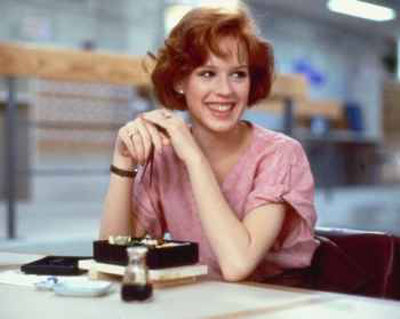
(Molly Ringwald, in „The Breakfast Club“)


