For quite a while I have wanted to take the opportunity to recommend a few current albums that are not (yet or otherwise) mentioned here. There are already numerous albums on this list, which is why I’m now shortening my recommendations in a telegram-like style.
Although I have been a big fan of the English duo Autechre since the mid-1990s and appreciate and strongly recommend almost all their albums, I can only be amazed at their latest album. This is not necessarily because the opus is eight hours long (the previous album elseq 1-5 was almost five hours long, the preceding exai a 2-CD album of over two hours, and the two preceding ones – Quaristice and Oversteps – were each followed by a one to two hour-long „EP“). Autechre have released so many CDs since the early nineties (and their numerous so-called „EPs“ were in most cases album-length releases, plus their first live album consisted of nine tracks each lasting around an hour) that it is almost astonishing how varied and complex, how imaginative and surprising and at what high level each new release still is – even though Autechre still keep their own unmistakable style and never have guests or producers on board on their regular albums. NTS Sessions 1-4 is an 8-hour-opus; as of now it is only available as download, but the 8-CD-version can be pre-ordered at the Autechre Bleep store and will be produced according to the numbers of the pre-orders.
Mark Smith writes in his epic Resident Advisor review (and he actually only states „Autechre“ as their „style“ or „genre“):
The majority of artists in Autechre’s cohort either dropped off in quality or entered the extended victory lap period of their careers. […] ‚NTS Sessions 1-4′ […] their best record in many years. […] The range Autechre get out their patches is staggering. You can feel their own sense of discovery as they’re pushing and pulling parameters. They navigate treacherous skies but they always breach the cloud line, providing clarity, a sense of scale and structure. Even though they’re challenging themselves, there’s no doubt as to who’s created the rules.
Without question one of this year’s top 10 albums.
Far less spectacular, but most likely also among my album favourites at the end of this year, is Meshell Ndegeocello, an extremely versatile and fascinating songwriter, singer, bassist and producer (Anthony Joseph, Jason Moran and others) from the U.S., who will celebrate her 50th birthday this August. 25 years ago a certain Madonna released Meshell’s first CD Plantation Lullabies on her then newly founded label Maverick, and since then I have fallen in love with almost every Ndegeocello album. Ventriloquism is a personal collection of songs the singer interprets as if it were her own. Which is obviously because she has a very personal relationship with each one of them.
In the frequently very recommendable songwriter podcast Sodajerker, Meshell Ndegeocello talks very openly about her work process and also mentions her many role models and inspirations, some of whom she has already honoured by interpreting songs in her very personal way, such as her gorgeous Nina Simone tribute album Pour Une Âme Souveraine with guests like Valerie June or Sinead O’Connor, among others, and a flamboyant version of Leonard Cohen’s Suzanne. Taking into consideration that I can easily recommend every single Meshell album with all my heart, Ventriloquism (with a terribly uninspired cover image, though), reflecting personal episodes and recent experiences, may be an album rather for the advanced listener, an unusually quiet one at that, but the intensive, masterful 7-minute rendition of Prince’s (another one of the singer’s idols) Sometimes it snows in April, which condenses the song to its essence and emotional core, is worth the purchase of the album alone.
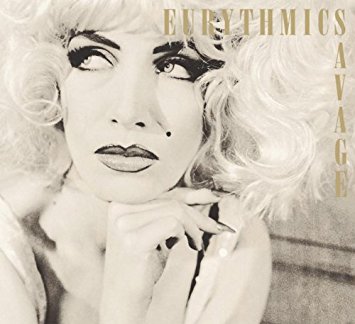
At this moment I am listening to Eurythmics’ 1983 album Touch — admittedly I have never been a big Dave Stewart fan, but Annie Lennox has been one of my favorite pop artist since the days of my childhood. So it is worth mentioning that all but one of Eurythmics’ studio albums are now, long overdue, being re-released on vinyl, and PopMatters’ Adam Mason has written this extensive recommendation of their body of work. No two albums of theirs sound alike, but arguably best of them, and my personal favorite for 30 years — though most people prefer Touch — is 1987’s Savage. Both these albums are halfway between avant-garde and pop. Mason concludes,
we are here to witness again the powerful counterblow of ‚Savage‘, now becoming the firm fan favorite of the Eurythmics catalog, while building up a reputation as the duo’s ‚Revolver‘, or maybe ‚Low‘, with an experimental sound dominated by Stewart’s adopted digital synthesizer of choice, a synclavier, facilitating Lennox’s excursions into concept-album territory, where the distinctive two sides of the record tell the unsettling story of a woman’s descent into heartbreak, cynicism, emotional devastation and masochism.
Jon Hopkins, whom some of you will know as Eno’s collaborator on the wonderful Small Craft on a Milk Sea album, finally has a new album out, five years after his deserved breakthrough with the excellent techno-ambient-electronic album Immunity, which ended up on many best-of-the-year lists in 2013. I loved Immunity, and I instantly loved Singularity on first listen. „As striking as Immunity was, Singularity feels more developed, and it’s ultimately a tough call as to which album is more exciting,“ writes Paul Simpson. And Paul Carr summarizes, „Jon Hopkins‘ Singularity evokes the euphoria and vivid awareness of a psychedelic experience.“
The man behind the pseudonym Amen Dunes is Damon McMahon, and his fourth album Freedom is strongly reminiscent of the songwriting and style of Robert Forster, though with a different, slightly softer and more versatile sound. „Everything feels silvery and romantic, like a hallucination of the classic-rock songbook,“ writes Sam Sodomsky.
Meg Remy reaches a new level of complexity with her latest album under her U.S. Girls alias, In A Poem Unlimited, an idiosyncratic sound palette of noise pop, funk with saxophones, trumpets, synths and multilayered percussion; she crafts catchy songs between old-fashioned pop and contemporary art. „[…] her glorious, danceable new album is a righteous collection of razor-sharp songs, full of spit and fury, a high-water mark for political pop music,“ says Jonah Bromwich.
Mouse On Mars, another unique duo, this time from Germany, has also recently released a fascinating new album, which – while retaining the duo’s peculiarities – once again sounds completely new and different from any of their 14 preceding albums. They changed their M.O. and recorded Dimensional People abroad with dozens of (star) guests, including Justin „Bon Iver“ Vernon, rapper Spank Rock and the National bros. Bryce and Aaron Dessner. In the band’s 25th year the album may sound less radical than some predecessors, Jan St. Werner and Andi Toma may enter their „mature“ phase, but they are by no means less inspired and dazzling. The epic, 13-minute opening piece in three parts already surprises with its confrontation of Steve Reich’s stylistic devices and Bon Iver vocals. Mouse On Mars remain their unique universe. Benjamin Moldenhauer:
None of this should really fit together. But the perceptible naturalness with which techno, hip-hop, dub, krautrock, indie pop, drum robots, violins, ambient, dissonances and all kinds of indefinable things are brought together here is very delightful. […] Perhaps Mouse on Mars are the most thorough dialecticians of the electronic avant-garde. Two opposing attitudes determine what happens: that of the child euphoric about his own world discovery, who wants to touch everything and tests its suitability for his own, purely intuitively controlled mind. And that of the control-mad tinkerer, who still has to define the smallest sound shred and can do so. ‚Dimensional People‘ draws its tension from this entanglement of exuberant joy of discovery and demiurgical virtuosity.
Germany’s currently best rock band is arguably Die Nerven (The Nerves). Even Thurston Moore recommended them. Their new album Fake may not be as urgent and punchy as the preceding Out, but it is still great. Andreas Borcholte: „The fundamental [..] disorientation of society is the theme of Fake. It is, that much is already certain, one of the most haunting German albums of the year.“
… to be continued …