Manafonistas

on life, music etc beyond mainstream

You are currently browsing the blog archives for the day Sonntag, 10. Januar 2016.

Archives: Sonntag, 10. Januar 2016

2016 10 Jan.

Shelfies

| Filed under: Blog | RSS 2.0 | TB | Tags:  | Comments off

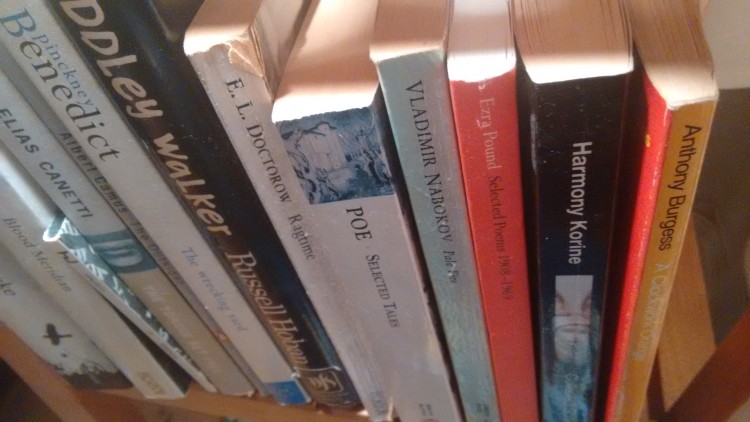
What does this partial book selfie say about the literary tastes of the shelfie-taker?


Next to nothing: that’s what. I’ll tell you what though: The Wrecking Yard is an American classic. I think music shelfies probably say more. But what if you sold or threw/gave away 90% of your vinyl and CD collection and rely instead on 4 apps? What you have is mostly partial virtual shelfies, like this:


„Loftus and Bone headed over to the Bowl*O*Drome to take in the women’s leagues and see if they could get Loftus’s mind off of Arnette. Arnette was the readheaded woman that had run off with some college puke a couple of days before and had broken Loftus’s heart and shattered his life.“

Pinckney Benedict, Getting Over Arnette from The Wrecking Yard.
 
„Red rain coming down over me in the red red sea, over me, over me, red rain“

Peter Gabriel, Red Rain from So.


Yeah, so fuck shelfies.

And long live shelfies.

2016 10 Jan.

26 years later …

| Filed under: Blog | RSS 2.0 | TB | Tags:  | 2 Comments

Short interruption of my one-month break. I’m a looper. And I’m looping in. Two days ago something happened. And that cannot wait to be told. Though it’s personal. Some Bowie albums were great company for me, and had their great days and weeks – and hours of return. All the first encounters happened in the golden era of vinyl between 1977 and 1980. In an old Germany. For reasons I don’t know Ziggy Stardust never crossed my way deep enough to say anything about it. Heathen (high expectations I had, David Torn was part of the play) disappeared (dunno why) within one week from my ears. So it happened with Diamond Dogs. Pale memories.

There were only a few Bowie albums that really soundtracked passages of my life. Low has been the first one, Heroes the second. Bowie with Tony Visconti, Brian Eno, Robert Fripp – and an awesome melange of masterfully executed songs and „Berlin ambient noir“ (Loop 1). The music was part of my life with my fiancee Christiana in Würzburg. Then I listened for the first time to Station To Station, an album of earlier times in his career. Brilliant. In fact I was a single then and saw Bowie playing „Warszawa“ in the Gruga-Halle, Essen. There he also performed the best version I ever heared from that „Alabama/Whisky Bar Song“-evergreen. There I saw an attractive woman and thought of sex as a cure for lost love. I got her adress. And was beaten up by her boyfriend. Then, some years later, the year of wine, roses and no happy ending – Scary Monsters, another stunner, great riffage. The songs all soundtracked love and sex with Hannah in the Bavarian Woods (Loop 2).

Decades later. No Bowie album after 1980 could stand the test of my merciless, treasure-hunting, deceivable ears. Good songs here and there, but nothing that stayed with me as something complete. Konrad Heidkamp (have always loved his writing in „Die Zeit“) was singing his praise about Thursday Child – I only discovered one good song there. And someone more lasting on the island of Borkum by the time it saw the light of day. December Days. Outside (again with Eno) was nearly pure disappointment (minus two wonderful songs that weren’t killed by the mix). Got bored with Bowie, only took mild notice of his unexpected return after years of silence, in 2013. God, only one good song there – over.

I thought I could close the case with my handful of ancient gems, and then, without any warning, I got an email from a friend: LISTEN, he wrote, LISTEN! And I answered – yep, I owe you at least one favor, but then, dude, you’ll get an opinion (adding a smile). I didn’t read anything about this new work except some short lines of Jan here on the blog. Didn’t even have a look at the video. Started listening to Blackstar in my Toyota Yaris Cool Plus, and was immediately hooked, spellbound, transported, floored, overwhelmed, sucked in – from the first note till the last.

There it was, a new record for my „shelfie“, the best Bowie since 1980. I said, it’s personal. Scary, isn’t it! And what a monster. So dark, so full of joy. „Into the impossible“ (B. E., Oblique Strategies). Two small observations: 1) When I heared track no. 5, I was reminded of the wonderful ways Ian Dury had been bending words and sometimes spitting them out. Bleak and funny. 2) The mixing and layering of saxophones inside some of the songs immediately rang a beautiful bell: Robert Wyatt’s Rock Bottom (Loop 3). In many ways, and in spite of several unique elements of Blackstar, the music is crossing decades.

Well, well, well. Imagine Norwegian jazz legend Jan Garbarek would do one other five-star-album in his lifetime (instead of never leaving the train of nostalgia, the formula of old days‘ glory), after All Those Born With Wings (1986) and Officium (1993, already a collaborative effort): that would be a similar surprise out of nowhere! This year will be exciting. Radiohead and Brian Eno are preparing their next releases. And Scott Walker? He is is still a restless and hungry mind, and will hold Blackstar in high regard, I’d bet on it.

(Days later: purely by accident, I wrote this on the day he died. I wouldn’t have written it this way if I had heared about it. News came the other day.)  

The music in question is constructed totally out of the sounds generated by a  washing machine. The album runs across  as a single, continuous thirty eight minute experience that starts with the grinding turn of the wash size selection wheel, and ends with the alert noise that signals that the wash is done.

Between these audio-verité book-ends, we experience an exploded view of the machine, hearing it in normal operation, but also as an object being rubbed and stroked and drummed upon and prodded and sampled and sequenced and processed by the duo.

Okay, it was all done with some occasional help from an ultra-local crew of guest stars (some of whom regularly do laundry with the „composers“). They all took part, either playing the machine like a drum, processing its audio, or sending MIDI data to the duo’s samplers.

The vocabulary of ths beloved washing machine, its rhythmic chugs, spin cycle drones, rinse cycle splashes, metallic clanks and electronic beeps are parsed into an eclectic syntax of diverse musical genres. The result is a suite of rhythmic, melodic and drone-based compositions that morph dramatically, but remain fanatically centered upon their single, original sound source.

The palette of genres in play reveals a hybrid musical DNA: Industrial music, vogue beats, gabber, dubber, Miami bass, free jazz, house, krautrock, drone, musique-concrete, ambient and new age music all churn up to the surface and are sucked back into the depths.

In this pattern of textures, the listener encounters elements that sound like horns, kick drums, xylophones, or sine waves, but in fact each component is meticulously crafted out of a manipulated sample of the machine.

In other hands, such relentless conceptual tightness would court claustrophobia. Happily, the willingness to transform audio and engage pop structure bypasses arid, arty thought exercises and produces instead unusual noises yielding weirdly listenable music.

In its starkest passage, we hear the rinse cycle of the machine run uninterruptedly for four minutes as a slow filter sweep combs across a kind of oceanic frequency range.

The result is a kind of “Environments” LP that never was: the Psychologically Ultimate Washing Machine. It’s a gesture that’s likely to infuriate some people and tantalize others.

Is this the conceptualist emperor’s new clothes, a wistful domestic reverie, a parody of recent moves in “object oriented” philosophy, a feminist point about alienated domestic labor, an elegy to a discontinued model that stands in for unsustainable and water-wasteful technologies generally, or simply an immersion in the beauty of the noises of everyday life?

Sucker-punching ambient pastoral, the album ends with a techno-industrial-booty bass workout that recapitulates motifs from across the entire composition before grinding to a halt, its task completed.

Funny and sad, bouncy and creepy, liquid and mechanical, this incredible music swirls with perverse paradox, but the agitation at its core offers vital evidence of faith in the musical potential of sound.

The artwork for the album is constructed entirely out of photographs of the machine in question shot in its natural habitat and then digitally manipulated.  The washing machine was not available for comment. Apart from cd and vinyl, there will be a limited edition of singles only available for ancient jukeboxes. Perfect to play it just before or after Kate Bush’s „Mrs. Bartolozzi“, you probably know the song in praise of a washing machine.

Manafonistas | Impressum | Kontakt | Datenschutz