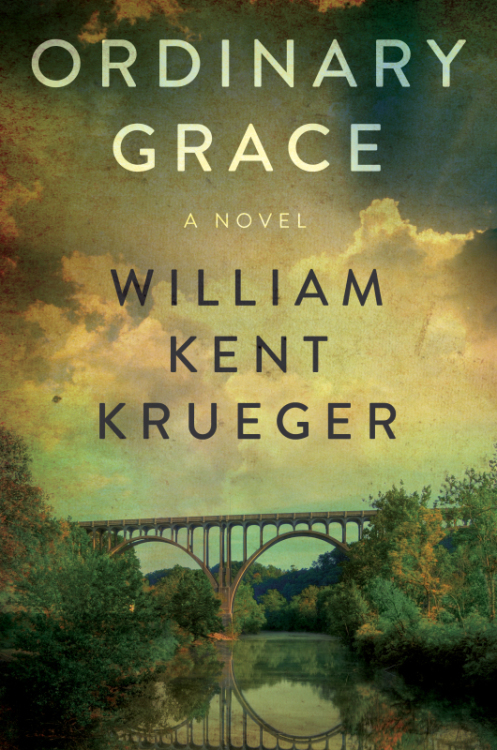
„All the dying that summer began with the death of a child …“ – thus starts the novel. Frank Drum remembers the most disturbing days of his childhood in a little town in Minnesota. I remember loving books that mix the process of growing up with thrill and adventure since I was a teenager myself. But it shouldn’t get too dark, I had always been looking for silver linings, happy endings, eager to see how the heroes or anti-heroes of my age were coping with dangerous situations. Training for life, so to speak.
This thriller might get quite dark, but the reader seems to be in good hands. William Kent Krueger knows how to tell a story with care and patience. I feel it. Obviously he’s not hunting from cliffhanger to cliffhanger. He takes his time to make us comfortable with the world of 1961 (which in fact was the year when I started my schooldays. I remember how many grown-ups around me had been thinking about another world war when East Germany vanished behind the „iron curtain“. They were buying tons of food.“Checkpoint Charlie“ sounded like a fun figure from a comic book, but the people who said the word seemed to worry).
But, here, now, America is waiting. The action evolves in the same tempo in which the actors become three-dimensional human beings. No hurry. Suggestions of future events are discreetly placed. So we know more dark things are lurking behind the horizon, or, to be more precise, within a little community full of ambivalent characters, strange and traumatized figures (Lise, Gus et al). The two brothers do everything they can to look behind the curtain (blue velvet, not iron!) of the grown-up world, they have big ears: „eavesdropping“ seems to be the word here.
It’s still old America. The family of a priest who believes in praying. Classical music, chorales, church music deliver the soundtrack at least of the first ten chapters. There is this mysterious, blind composer who befriended with Aaron Copland in even older days and is about to write his autobiography. Frank’s sister does this job, the shining star of New Bremen, full of talent, intelligence and extraordinary musical skills. I hope she won’t end up like Laurie Palmer in „Twin Peaks“. Shining stars may be a threatened species here.
All the ingrediences of the novel seem to follow an old route of American literature between Mark Twain and John Steinbeck. I keep asking myself why i’m quite often preferring thrillers, crime novels to fucking midlife-crisis books. The answer is easy: I want to keep the bridge alive between my today’s being and the curious, greenhead I had once been. It’s all about preserving a sense of wonder (WONDER!) which can easily get lost when you think you’ve seen it all. You never have.
Twenty, thirty pages into the book, and I’m fully captivated. From the start on a strange quietness is embracing me, I feel like getting much younger, moving shoulder by shoulder with the two brothers through zones of twilight even on days with clear blue skies. A certain melancoly is part of every good story that starts with these three resonating words: „All the dying …“!
Michael Engelbrecht
–

„ENGINE 143“
The doctor said to Georgie,
Your life cannot be saved
Murdered upon a railroad
And laid in a lonesome grave.
His face was covered up with blood
His eyes you could not see.
The very last words poor Georgie said, was,
Nearer my God to thee.(Johnny Cash/The Carter Family: „The Unbroken Circle“)
„Why does he do it? Captain?“
„Who?“
„God. Why does he take the sweet ones?“
This is the moving question, asked by Gus, a close friend of Mr. Drum the preacher, after Bobby Cole was buried. He was only 13, same age as Frank, the narrator of this novel Ordinary Grace, which he wrote 40 years later. Bobby was killed on the railroad tracks outside New Bremen/Minnesota. That´s where the story takes place: along the railroad tracks and the Minnesota River. Bob Dylan´s Heimat.
Frank is the older, bolder of the two sons of the Drums; Jake two years younger, sober minded and obedient. He stutters. He was immediately my little darling. Mrs. Drum is a would-be artist, who would like to see her unfulfilled dreams come true in her daughter Alice.
William Kent Krueger succeeds in building a tremendous tension from the beginning: „In this summer there will be a lot of dying.“ By chapt.11 an Indian dies, but „the next would be most painful to bear.“
Alice dates Karl, but „Mrs. Robinson“ does her Reifepruefung for a piano player, her mother was once fond of. Emil Brandt seems to be the planet for Ruth and Alice. Why he tried to kill himself, is not clear to me.
Anyway, during the nights Alice slips away until morning dawns. Nobody except Frank knows about that, though Frank and Jake stick together like glue. They know from their confidant Gus that their father killed people during the war, which does not match with his praying for everybody. „Praying I suppose for the awful grace of God“ (Frank)
I dive off now into the „Gesangsbuch“ of Johnny Cash (My mother´s Hymn book), hoping that not another child will be killed. Heaven forbid! Not Jake.
Lajla Nizinski
–
There’s no word in the English language for the feeling you get when you finish a book you’ve enjoyed. In the falling seconds as you scan the last paragraph, you see a small light lacuna ahead. An unmistakable final heavy white space. Amazing. Your mind kind of rebounds as the last piece of text is being read. You finish the story, and you get your brain back, now, but it’s changed. I love that feeling. I love it to the extent that – after inspecting the cover of a new book, I always read the last page first. Y’know, just in case there’s a shortcut to that feeling. (There isn’t.) You go back to the beginning. I guess if there was a word for the feeling of the moments after finishing a book, the word would be… rosebud.
The final page of Ordinary Grace is, oddly, a list of ways to „Enhance Your Book Club“. I don’t know if this is the final part of the novel’s text (I hope it is) or some suggestions for book clubbers. Either way, some of them are pretty inspired and undoubtedly influenced by Guy Debord. This should become the norm in either case. I would like all books written from now on to end with a series of semi-meaningless phrases from Paris 1968: SOUS LES PAVES, LA PLAGE. LA BEAUTE EST DANS LA RUE. LA LUTTE CONTINUE, etc.
Before we continue, let’s be clear: I don’t do literary criticism. I’ve read my Barthes, Derrida, de Beauvoir, Chomsky, Woolf, Adorno, Eagleton and so on. A very clever bunch, and no mistake. But I’d swap their entire written output for Roald Dahl’s „Danny, the Champion of the World“. In a fucking heartbeat.
The good:
The tone of this book reminds me (strongly) of William Maxwell’s „So Long, See You Tomorrow“ for some reason. American writers write clearly. But while this text is clear enough, you just don’t get the smell of the places and people or the contours of the landscape here that you do in Maxwell’s prose. This isn’t a criticism, OG just doesn’t have that mediumistic quality some novels have, where the characters are so well realised they jump out of the page at you.
The not-so-good:
A lot of excruciating preamble at the start of chapters one to ten. And a lot of backstory served raw. Put it this way: if William Kent Krueger (I call him Freddie, for his similarly un-umlauted namesake) was a film director, he wouldn’t be Ingmar Bergman.
Chapters one to ten make up about a third of the novel. I feel we haven’t really gotten out of first gear yet. The narrative inches forward bit by bit. And there is, for me, an instant problem with the narrative technique. This is a tale told four decades in retrospect, but with zero (and I mean zero) context in terms of who is doing the telling. The old guy telling the story of who he was? Maybe, but not from his current perspective – and not really from his 13 year old mind either. It feels like a dilution.
The narrator of David Mitchell’s Black Swan Green doesn’t have this slightly oaky nostalgia vibe going on. Black Swan Green’s narrator – the same age as Frank in Ordinary Grace – has the mind and the attitude and the once-in-a-lifetime „you may find yourself living in a shotgun shack“ all over-the-place future-past quality of a young sharp hormone-disordered mind. That book is a classic, by the way – read it.
The central character-narrators of novels like David Lodge’s Therapy and Julian Barnes The Sense of an Ending are acutely aware of the I who was and the I who is. They revisit their beliefs about the past and are confronted with the awkward problem of (ahem) epistemological entropy. In essence, they visit the ghosts of who they were, who they think they used to be. TS Eliot addresses a similar self/memory problematic in The Waste Land. „… heap of broken images“ etc.
Frank in Ordinary Grace hovers over the ‚reality‘ of the past like an omniscient narrator. Never questions his own memory of what was said or done, yet remembers entire conversations verbatim. These memories are presented grandly, like a big fucking cake on a table. To me, this is an outdated, kinda 20th century way of telling a story. Fine for what it is, but a bit drivetime and mild.
In summary
I’ve enjoyed reading this far into O.G. To an extent, anyway. I think I would probably have discontinued reading it somewhere in the first 30 or so pages were it not for the fact that I’m reading it for Manafonistas‘ parallel reading exercise. The exploration of the effect of war experiences on the psychology of the simple, unassuming former soldier was done to pitch perfection in Bobbie Ann Mason’s deftly written novel „In Country“ (1985) and this doesn’t really compete. Freddie’s effort – so far, at least – feels like a mass-market watercolour print – fine for what it is. Whereas Mason’s book changes your perception and visits your mind every now and then, even decades after reading the fucker.
Ian McCartney
–
„I wielded a mean needle.“
What a contrast to Bleeding Edge, subject of our first parallel reading adventure! Right from the start for me Ordinary Grace was a truly engaging and quite enchanting book. Written in very short but nevertheless compelling sentences it depicts the atmosphere of small town Minnesota in the early 60s and “all the dying that summer”. At first I expected a very different kind of mystery story. A mystery story it most certainly is (I wonder if the exploding bullfrog can be counted as one of the deaths) but I find the storyline not as important as I thought: “Tom Sawyer and Huckleberry Finn meet ‘Stand by Me’” was the first impression I had and I still stick to. And even after having read the first 100 pages images of the movie (I haven’t read Stephen King’s short story) still come to mind and mingle with images from the book: Daisies swaying in the wind, gooey tar in cracks on the pavement, grain elevators connected by catwalks and conveyor belts against the blue sky. Albeit its simple sentences Ordinary Grace`s concise language forces me to read slowly, reflect and compare with my own childhood memories and family history. And that I find quite unexpected.
Thomas Schirmer
–
Obwohl ich eine Paperback-Ausgabe bestellt hatte, bekam ich eine gebundene Ausgabe, die vom Umschlag befreit richtig handwerklich wie vom Buchbinder hergestellt aussieht, schwarz, mit goldenen Buchstaben am Rücken, gedruckt auf mattem, rauhem Papier.
Weniger begeistert war ich von den Klappentexten: der Familienalltag einer Pfarrersfamilie, irgendwo auf dem Lande im Jahr 1961 erschien mir wenig relevant in Bezug auf die aktuellen gesellschaftlichen und politischen Konflikte zu sein.
Aber bereits der Prolog stellt Spannung her und deutet archetypische Dimensionen an: „All the dying began with the death of a child…..It was a summer in which death, in visitiation, assumed many forms. Accident. Nature. Suicide. Murder.“
Das alles wird dem 13-jährigen Frank in diesem Sommer begegnen und seine Entwicklung zum Erwachsenen vorantreiben. „I still spend a lot of time thinking about the events of that summer. About the terrible price of wisdom. The awful grace of God.“ Es ist eine Vertreibung aus dem kindlichen Paradies – und bei solchen Wandlungsprozessen geht es immer auch um Erkenntnis, um die Akzeptanz von Gegensätzen.
Am schwersten ist dies wohl bei den Polaritäten gut-böse und Leben-Tod. Frank ist voller Neugierde, auch oder gerade gegenüber den Schattenseiten des Lebens. „I was a sinner. I knew that without a doubt. But I was not alone. And the night was the accomplice of us all.“
Frank – als Ich-Erzähler Jahrzehnte nach jenem Sommer – war mir schnell sehr vertraut; aber auch die anderen Personen kann man sich gut vorstellen. Krueger schreibt einen klassischen Erzählstil, der einen klar und sicher durch das Geschehen führt. Was für ein Gegensatz zum ersten Parallellesebuch, dessen Autor Pynchon seine Leser unentwegt von einem Rätsel zum anderen jagt, während Krueger sozusagen aufgeräumt schreibt, um Platz zu machen für die große Frage: was passiert als nächstes? Ahnungen, dass da noch Schlimmes geschehe, bestehen von der ersten Seite an.
„The town was dark and full of delicious possibility.“
Nach langem vergeblichem Nachdenken, welche Musik zum Roman passe, brachte mich heute eine neu erschienene CD immerhin in die gleiche melancholische Stimmung, die das Lesen von Ordinary Grace begleitet: Bob Dylan, Shadows in the night.
Da ist sie wieder, die Nacht …
Wolfram Gekeler