Seeing my blog brother Micha’s incredibly varied and deep list of rediscovered music got me thinking. I too seem to be on a roll of rediscovery. I really noticed this during the pandemic: I started revisiting old music, music from my formative years. I already posted the rediscovery of early electric Return to Forever through the remixed Anthology set. More recently, another guilty pleasure insinuated itself into my consciousness.
As a young hippie, I fell under the spell of one of the most unusual bands of the era – I am speaking of the Incredible String Band. A folk group which at first was comprised of 3 young men, their eponymous album was a pretty straightforward affair, captured without overdubs by the man with the golden ears, Elektra’s young wunderkind Joe Boyd, who heard something special in these young songwriters from Edinburgh. That first album won a prestigious folk award and garnered some positive reviews, but nothing could’ve prepared listeners for the journey to come.
After the release of the first album, Mike Heron stayed back in Scotland in hopes of playing gigs and taking the project to the next level, but oddly enough, Robin Williamson and Clive Palmer had different ideas, and left the British isles to travel abroad. Robin headed to Morocco and parts unknown where he had decided to study Middle Eastern music and wasn’t quite sure he was going to return at all. When he finally returned, he came bearing armloads of instruments and together with Mike, began reforming the group as a psychedelic folk/world duo. Mike had stayed busy as well, writing songs and opening his ears to world music.
During the next 8 years, ISB would make 11 more albums. After their first release, in just two short years they put out 4 genre (and gravity) defying albums that influenced everyone from the Beatles to Led Zeppelin, yet they mostly appealed to a relatively small but devoted fanbase. I was one of them.
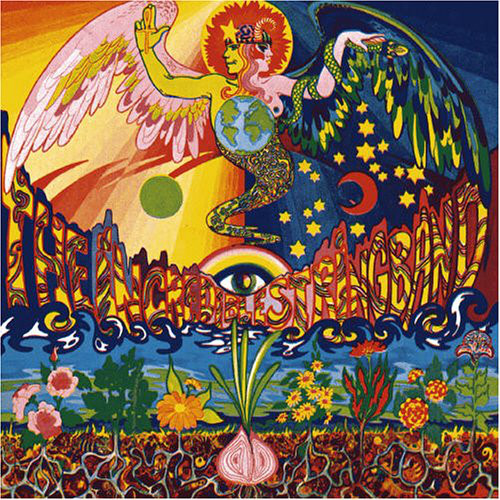
My love affair with ISB began with a musician friend of mine laying a copy of The 5000 Spirits (aka The Layers of the Onion,) on me. With its uber-psychedelic cover, designed by two Dutch artists known as The Fool, it immediately grabbed my attention. Inside the grooves was a new kind of hybrid music that incorporated the folk traditions of the British isles with influences from India, China, the Middle East, the West Indies and beyond. How did these two make such a quantum leap in the space of a year? Some of it was Robin’s incredible mind and his innate ability to make music on almost any instrument he took in his hands, his uncanny ability to absorb and borrow from multiple traditions, and part of it was perhaps the broader zeitgeist of freedom and experimentation that permeated the air. Mike Heron’s more straightforward, heartfelt, earthy approach to songwriting was the grounding element, which contrasted nicely with Robin’s penchant for far flung audacious experimentalism, odd juxtapositions of Indian, folk, blues, music hall and Celtic traditions, (often in the same song!) and somehow, it all just effortlessly worked.
As Joe Boyd once said, for a time these two could literally do anything. But that magic, like most magic, was fleeting. ISB was like a cosmic juggling act and there was simply no way all of those orbiting spheres could remain in the air forever. Not to say there aren’t many gems to be found on later releases, because there most certainly are, but those records never seemed to reach the consistently high bar the band had set for itself on those first four albums.
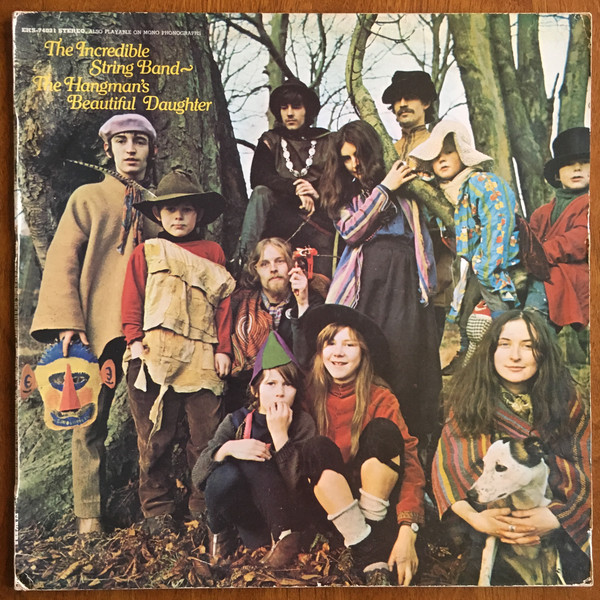
Most String Band aficionados will immediately point to the 3rd release, The Hangman’s Beautiful Daughter as their best, and I would begrudgingly have to agree. It is certainly their most beloved album. Quirky in all the best ways, inspired, surreal, varied in musical influences, it encapsulated all the elements that endeared the group to their fans. With its exoticism, surreal lyrics, cosmic references, whimsy and humor, dream imagery, summoning of archetypes, reverence for the sacredness of nature and of all living things, it is truly a wondrous recording. The opening track, Koeeoaddi There, embodies so much that is likable about the band. It’s a dream-like journey into Williamson’s childhood, sketching out the local scenes, characters, shopkeepers, the joys of skating on Happy Valley Pond, the gambling soldier’s admonitions (“Don’t worry, we won’t send anyone after you, they screamed.”) In just a few minutes, Robin outlines inexplicable events – the strange mysteries of the world seen through the innocent eyes of a child, replete with routine greetings to “The Invisible brethren,” the ritualistic “Earth Water Fire and Air” chant punctuating the stream of consciousness childhood reveries – somehow all the disparate elements meld into a perfectly cohesive whole. And Heron’s A Very Cellular Song, the centerpiece of the album, the song which for many epitomizes ISB, was like nothing that had come before it. A medley of snatches of a Caribbean religious folk tune (borrowed from The Pindar Family – Nonesuch,) songs about amoebas, cosmic paens to the Unseen, whimsical imagery inserted into harpsichord laden baroque verses, all coalescing into a pagan religious ritual, replete with themes and variations accompanied by guitars, gimbris, clay drums, mandolins, organs, jews harps, kazoos, and whatever else the boys could get their hands on.
They were courageously experimental in those days, and even though there were the obvious imperfections due to an understandable lack of proficiency on many of the instruments they had picked up, none of that really mattered – their sheer unbridled creativity and confidence in their collective vision overshadowed the occasional out of tune vocal or flubbed instrumental notes. There were also unexpected moments of virtuosity. In fact, both were decent musicians on guitar and mandolin. Mike’s sitar was one of the more successful uses of the instrument in a non-traditional pop setting. People often criticized their vocals, but I have always thought Robin’s melismatic flights of fancy back in the day to be pretty spot on, even inspired in terms of note choices and phrasing. And Mike’s earnestly honest vocals carried a certain charm all their own, even if he sometimes strained to reach notes that were a bit out of his range. Again, none of this mattered one whit – their technical limitations didn’t get in the way of their seeming boundless creativity. They were completely fearless.
For me, the high point of the ISB’s short period of conjuring the miraculous out of thin air culminated in Wee Tam And The Big Huge. Released as a double album in the UK, they were released separately in the US, but they really were a double album. I originally recorded them from a KPFA prerelease broadcast and listened to them incessantly. I remember taking those reels to a friend’s country home up in Connecticut and playing them over as elaborate system that had speakers hidden in the trees all thru the woods surrounding their house – a magical experience in the snow. These two albums in my opinion, were the last of the totally magical ISB albums. All the elements were there: the mysticism, some of Robin’s best long form tunes (Maya, The Iron Stone,) and some of Mike’s best innocent child-like tunes. (Puppies, My Greatest Friend.)
By now Robin and Mike had fully integrated their girlfriends into the group. Licorice and Rose brought their innocence and sweetness to the table. Neither was a trained musician, in fact, except for a few violin lessons as a child, Rose, a university student and mountain climber, had never played an instrument. Licorice had some guitar background and a little girl’s voice that was deployed to great effect on stage and on recordings. But musicianship wasn’t the point at all. As Robin once said when asked about the choice of including their partners: it was about friendship – that and chemistry – that’s the reason the girls were in the band. As anyone who saw the band in their heyday knows, the young women graced the stage with their shy presence, even when not doing anything but sitting and smiling when they weren’t playing finger cymbals, keyboards, singing backup vocals or playing an occasionally out of time dumbek. Somehow, Licorice’s and Rose’s mere presence gave the band even more charisma. In fact it was this odd combination of genius and amateurism that gave the band its unique, ineffable sound.
I still remember that first time seeing them. October 1968 – It was a magical night, a night to remember for sure. It had started with a personal initiation ritual: losing my virginity earlier that very evening. Then, synchronistically, my musician friend who had first turned me on to the String Band called to let me know his girlfriend couldn’t make the show and asked if I would like to meet him to see ISB at the Fillmore East. I remember that concert vividly. The stage setup with all those exotic instruments, the excitement and joy in the air, and the opening song, “Jobs Tears.” Robin in full hippie renaissance faire regalia was sitting on a chair playing guitar and Licorice, in a flowing dress, was kneeling on the floor singing the response to Robin’s lines. That image and Licorice’s little voice singing, “All will be one, all will be one” is permanently etched in my mind.
I’m currently reading Rose Simpson’s memoir of her time in ISB. It’s title, “Muse, Odalisque, Handmaiden” sums up this honest journal of a young woman’s improbable adventures into music and celebrity. It is an extremely well written and unflinching look at a time that will never exist again, compassionately seen through the eyes of an older, wiser woman who just happened to be at the right place at the right time. Imagine Mike Heron coming home with a bass one afternoon, sticking it in Rose’s hands and saying “learn this.” And a few weeks latter she’s appearing onstage at Royal Albert Hall to a packed house with the Beatles, members of Led Zeppelin and other pop luminaries in the audience. That happened.
Of course, no utopian vision can last forever, and the ISB’s juggling act had to lose a few balls. Rose, unhappy with the band’s fascination with Scientology and the direction they were taking, left first. Licorice was next. Years later it was reported Licorice had completely disappeared – as the story goes, she was last seen hitchhiking in the Arizona desert and has never been heard from or seen again. I suspect she is still very much alive but doesn’t want to be found. There was a looming tension between Mike, who wanted to go electric (in truth he had always had the heart of a rocker,) and Robin who was heading in an opposite, more traditional acoustic direction. Something had to give.
ISB went on for a few more years, eventually reinvented as a much more conventional folk rock band with a “real drummer and bass player.” I made the sad mistake of seeing them in that last configuration in LA around 1973 or so. That performance left a bad taste in my mouth and for many years, I stopped thinking about the band completely.
But recently I picked up some newly remastered reissues on the Fledgling and BGO labels and re-collected all of the ones I care about on CDs. I’m pleased to report a lot of it still speaks to me today – it’s not such a guilty pleasure after all, and as it turns out, is much more than just a mere nostalgia trip.