Two weeks ago I went to see (and hear) Sigurd Hole’s trio at Berlin Mitte’s jazzclub b-flat. Sigurd had invited me to the concert after we had failed to meet in Oslo, even though our short-term residence (the apartment of friends who spent some time in our flat in Berlin) was only a few streets away from his apartment. I had already been well familiar with his versatile work in various bands – Karl Seglem’s acoustic quartet, five Eple Trio albums, a fascinating free-improv album with Seglem and Jonas Sjøvaag (West Wind Drift), and, most recently, Tord Gustavsen’s new trio album which I like so much more than the earlier trilogy of trio albums, among others. So when he sent me his two new albums which he released this year, I was surely interested in reviewing them.
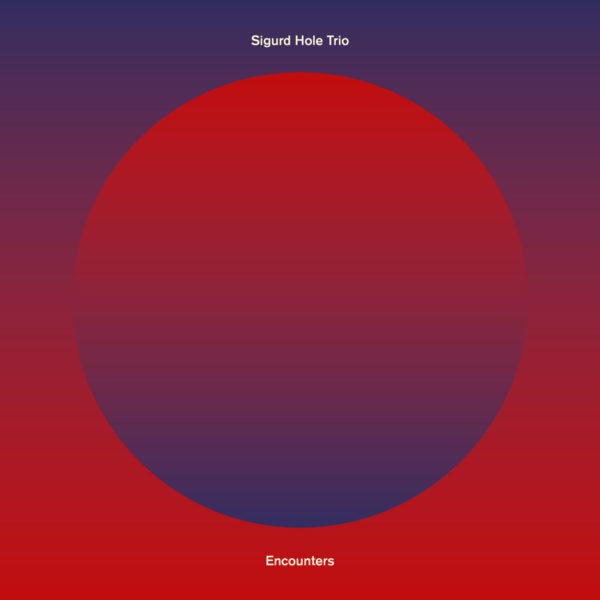
I was not prepared, however, for such a unique trio recording: Sigurd recorded Encounters with Jarle Vespestad (whom he got to know through Gustavsen’s trio), who has already inscribed himself into recent Norwegian music with countless idiosyncratic projects and an always mesmerizing personal style of playing drums and percussion, and the younger Håkon Aase (whom Sigurd got to know though his teaching at Oslo’s music academy), whom I had briefly met in Kongsberg this summer, whose own bands (Yūgen, Filosofer) have shown innovative approaches between jazz, improvisation and folk and whose playing in other people’s bands (Mats Eilertsen, Thomas Strønen etc.) has caused Manfred Eicher to speak favorably of him. Which is why I was actually a bit surprised that Encounters was not released as an ECM album. It has all the necessary qualities for it. Anyway, Manfred Eicher probably likes it and I am positive that the next album by this trio will be recorded with him as a producer – and Encounters will have been „discovered“ by more people by then. It’s a truly beautiful and inspired recording, and their two-hour concert was a delight from beginning to end, with all of them playing jazz in sometimes unorthodox and always entertaining ways, while showing their best qualities as a band with unique instrumentation.
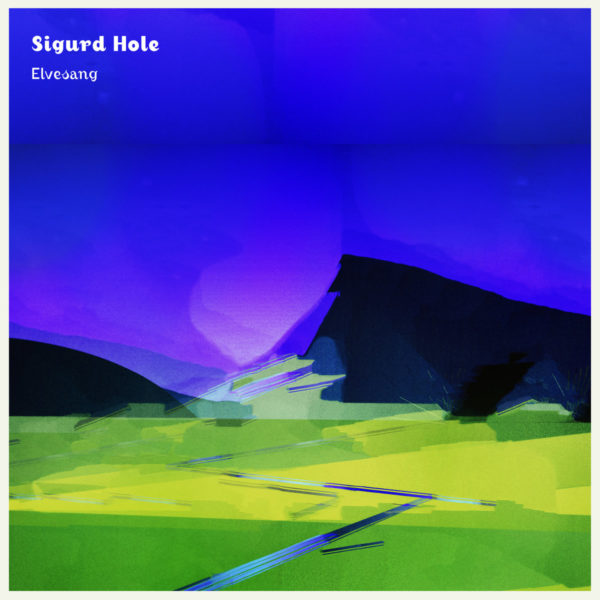
Elvesang, Sigurd’s other 2018 album is a more introspective album for bass solo, and even though it may not as immediately emotional, it is a very personal project, recorded in his home region, the rural municipality of Rendalen (Rena valley) somewhere between Oslo and Trondheim, „surrounded by farmland“, as he writes in his liner notes. This music seems to have grown out of this rural Norwegian place, you can even hear the weather and some birds.
I was curious to hear more about the background of this music:
- What is your connection to Japanese culture? I notice there are references on both these albums.
Well, it all started – triggered during my travels/tours in Japan – as a fascination with the Japanese culture and the history of Japan, especially focused around the role Zen Buddhism has played in both the Japanese society as a whole and in different kinds of Japanese art. This fascination has also lead to a keen interest in Zen Buddhism in particular, resulting in the reading of many books, experimenting with Zen meditation and visiting numerous temples in Japan. I find Zen temples a great source of quiet inspiration. I have walked down this road not to become a hardcore Zen Buddhist, but because I find in Zen ways of dealing with different aspects of life that I believe can be of great benefit both on an individual and collective level in a modern, western society. Not a groundbreaking discovery in itself as Zen has been adapted into the western world for a long time and has grown to become quite popular, however it has been an important discovery for myself.
Zen’s relationship with nature, and the key insight that human beings are a completely dependent on and an inseparable part of nature and all life on earth, and therefore should act accordingly in treating all our surroundings with the utmost care and love, is in my opinion the most important wisdom derived from Zen that we should strive to make part of our own lives. Looking around me, I sometimes feel like modern man, in general, has lost track of this sensation of unity with nature. Instead of being a part of nature, we strive to control and manipulate nature just to serve our own needs, without taking into consideration nature’s vulnerability. I believe it is of the utmost importance to renew our relationship with nature, as a humble, caring and inseparable part of a greater whole. Only then, with this starting point, I believe can we find the inspiration and motivation needed to change our way of life into a truly sustainable relationship with our surroundings.
- So how did this become an influence on your music-making?
The aspect of meditation has always, I believe, been an important part of my approach to music – both in practicing, playing solo and in playing with bands. Working more often than not with rather soft dynamics in minimalistic movements, long shapes and static situations in music, one may say that my general approach to music has an introvert quality. However, I do also enjoy the more playful aspects in music. I see no conflict between the two, quite the contrary, I see opportunity for developing meaningful dialogues between the meditative and the playful – within an aesthetic whole.
In Shakuhachi flute music, Honkyoku (traditionally used in the Fuke sect of Zen Buddhism in the practice of suizen – blowing meditation), I found many elements in the way of shaping sounds, phrasing, the use of quarter tones, and also in the aspects of time and silence, similar to what I was already doing in my solo work (this discovery happened maybe some four or five years ago). My airy and almost flutelike approach to arco playing has similarities to the sound of the Shakuhachi, making it a very natural approach in many ways. I also found inspiration in some of the written musical material for the Shakuhachi that I have tried to translate the double bass.
Another thing I find inspiring in Zen, is the approach to the now – the immediate way of responding to ones surroundings being completely in the now. For me, this is something very akin to being an improvising musician – always listening to ones surroundings with the utmost care, ready to respond to whatever happens. All in all, I find great resonance in Zen for what I want to express in my music on a deeper level. I hope to invite my audience into an almost meditative state of listening, giving a feeling of tranquility and inner peace – and at times also a feeling of restlessness and curiosity that might aspire to evolve a closer and more caring relationship with nature.
-
- What was the original starting point for the solo album? Where did the set of solo compositions start — and when was the point in time when you noticed it needed to be a solo album?
Ever since starting with Eple Trio in 2003, and later also in particular in my collaborations with Karl Seglem, I searched for ways of expressing myself on the double bass that had a relationship somehow with Norwegian traditional music. After a while, in every concert with Seglem, I was given a spot to play completely solo based on this musical approach. This became an important playground for me to experiment with the double bass as a solo instrument, trying out different approaches both on the practice room and then on stage – the best way of learning through getting an immediate response on communicating the music to an audience. Apart from the pure instrument-specific aspects, the aspect of time and timing was a very important thing in this process, feeling how long the different parts and movements should be in the whole of a solo composition / improvisation. The idea to make a solo album was maybe lurking in the back of my head, and in 2012 I believe, Misha Alperin (r.i.p.) heard me play solo at an award ceremony in Oslo. Afterwards, he told me that I should make a solo double bass album. It was very inspiring to hear someone like him say this, and it made be believe that I really could do this. However, it took still four years before I got the actual recording done – in July 2016. I learned a lot from the recording process, both in distilling and preparing the material on beforehand, the recording itself, and then the selection of parts and making the order of the album – it felt very satisfying to get to explore and concretize my ideas on an album.
-
- I have heard quite a few solo bass albums (Barre Phillips, Nils Davidsen, Joel Grip, Adam Pultz Melbye, Håkon Thelin…), and in a way they sometimes tend to be somewhat austere as by nature the bass is not the instrument most people would go out and buy a solo album of… So did you actually feel the need to develop an overall vision or idea for this album before you recorded it, to give yours a specific, unique approach, to address your personal vision to an audience — or did you go the other way, i.e. just follow your intuition without thinking about an audience during recording and writing?
The creative and great work of Stefano Scodanibbio, and also Håkon Thelin, have in recent years become important sources of inspiration for me in learning playing techniques I did not know before. In some of their material I might also find ideas that I “steal” and use as a starting point for making something else.
I never think of an audience when I compose or practice. However, this is not entirely true. Because I am listening myself, right? So in a way there is an audience present at all time. You need learn how to become a good listener to your own music when you are making it, to make decisions, what is good, what is bad, what to keep, what to throw away, and so on… but I never think “this will probably sound good to the kind of audience I want to reach with my music”. For me, thinking like that completely destroys the creative process. If I love what I make, there is also a chance that others might also like it. Which is of course very important to me. That being said, I believe that unconsciously, as a result of previous experiences performing music for an audience, the audience might play a minor role in the decisions I make in composing even though I am not aware of it.
The overall idea for Elvesang, for a long time, was simply to make an album where I explored the different playing techniques I used in my solo playing, giving each composition its own character based on the playing techniques. This way I could learn about my own playing, decide what is and what is not a clear enough musical idea to be something. So, it basically came from an idea to explore and distill the ideas in my own playing. Then, while preparing the different ideas in the days leading up to the recording, walking along a river on the way to my borrowed study in Rendalen, came the idea to make a piece called Elvesang (Riversong). To imitate, in an abstract manner, the sound of a river as the basis of an improvisation. This then became the bearing artistic idea behind all the pieces (apart from the opening track, Prelude, by far the most composed piece on the album): making small, abstract musical pictures of my own experience or sensation of different situations and different objects in nature.