This is the English-language version of a music docu by Reto Caduff, Ziska Riemann and Stephan Plank, finished in 2017. It is now on its way through selected U.S. movie theaters and festivals.
For Conny Plank, as the film shows at the beginning, every kind of noise had the potential to become music. Conny Plank, needless to tell, was one of Germany’s most important sound engineers and record producers during the 1970s and 1980s. He passed away in 1987 at the age of only 47. Only in parts this film is a portrait of Conny Plank. It is also a film of a son in search for traces of his father – a father who was never really present although he always was at home, and who sadly passed away from cancer when the son was only 13.
For sure it’s not easy to be the junior of a father who was seen as a legend already in his active years, who worked in his studio around the clock, was busy all the time and didn’t seem to care about his son as much as he probably had wished he could. Some of the interviewees, like Annette Humpe or Holger Czukay, go especially into this, which sometimes spread a veil of sadness over the film.
Now, 20 years after his father’s passing, Stephan Plank in Germany, Great Britain, France, the U.S. and Italy visits some of the musicians his father produced. Stephan Plank leads interviews with his father’s mentor Wolfgang Hirschmann (who modestly declines this role) or Daniel Miller of Mute Records as well as some of the musicians he met as a kid when he was playing around in the studio or around the house: Michael Rother, Hans-Joachim Roedelius, Robert Görl of DAF, David A. Stewart of Eurythmics, Midge Ure of Ultravox, Les Rita Mitsouko, Gianna Nannini, Devo, hip-hop duo Whodini and many others. Besides this, some snippets from radio or TV interviews with Conny are shown.
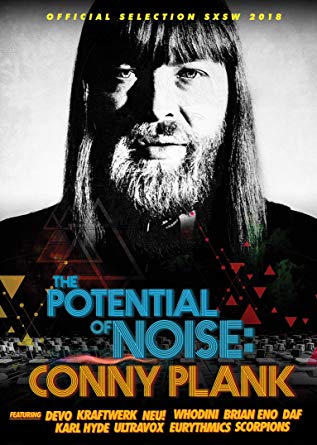
Some names one would have expected are missing, especially Brian Eno, as well as somebody of Kraftwerk. Some of the interviews are not very effective or show productions of „minor“ records – like Annette Humpe who talks about the production of the first album she did with her sister Inga (Humpe & Humpe), which is a nice record that somehow drowned, but no word about the second Ideal album which for my taste was much more important.
But of course the most recordings done at Conny’s Studio haven’t been filmed or documented otherwise, so there’s nothing that could be shown. However, between all this there’s space enough for personal keepsakes – home videos, old photos, record covers, posters et cetera. It becomes also clear very soon that without Conny’s wife Christa Fast the whole studio business would have been impossible.
The studio itself seemed to be surprisingly small, cramped and very dark, and I would really like to know why he needed no less than 56 channels on his mixing console. Not mentioned in the film is that many of Conny’s early productions were made in several studios; especially at Star Studio and Windrose-Dumont-Time in Hamburg where Conny lived at that time. He opened his own studio in Wolperath not before 1974.
The Potential Of Noise is worth seeing, but don’t expect any sensational news or deeper psychological insights. The DVD cover shown above isn’t the current one anymore. The name Conny Plank has been brought more to the foregound now and the name Kraftwerk is gone. Whatever the reasons may be.
Here’s the trailer (German language).