on life, music etc beyond mainstream
You are currently browsing the blog archives for the day Dienstag, 8. September 2020.
2020 8 Sep.
Michael Engelbrecht | Filed under: Blog | RSS 2.0 | TB | Tags: Buchtipp, Carla Bley, Weltliteratur | 3 Comments
2020 8 Sep.
Manafonistas | Filed under: Blog | RSS 2.0 | TB | Tags: Jon Hassell, Power Spot | 3 Comments
Ich entdeckte Jon Hassell durch einen Raga- und Sitar-Kurs, den ich am College besuchte, wo mir „Vernal Equinox“ sehr empfohlen wurde. Als ein von Natur aus trotziger Mensch beschloss ich, diese Platte zu ignorieren und mich in eine andere, weniger gehypte Platte namens „Power Spot“ zu vertiefen. Der Titel klang muskulös und bedrohlich, und ich erwartete, dass die Musik nach Blut riechen würde. Doch während ich zuhörte, wurde mir klar, dass dies eine viel schlüpfrigere und seltsamere Art von Musik war.
Der krasseste und unmittelbarste Titel für mich war ‚Miracle Steps‘. Was ist das für ein Lied? Wenn es ein Geschmack wäre, wäre es eine überreife Mango. Ein Geschmack, der zwischen süß und schleimig schwankt. Wenn es ein visuelles Erlebnis wäre, dann wäre es die verzerrte, verführerische Silhouette von Jessica Rabbit, die sich aus einer Zwangsjacke herauswindet. Auch wenn mir die Liner Notes sagen, dass dieser Track eine bearbeitete Trompete und Trommeln enthält, sehe ich nicht, dass diese Objekte diese Geräusche erzeugen. Ich höre eine Mischung aus Lemuren, Elefanten und Zugpfeifen, die neben den Ästen der Bäume, die auf die Erde fallen, zirpen.
Die Kargheit dieses Stücks fordert den Zuhörer auf, verwirrt zu sein. Ungebunden, versucht dein Gehirn schnell, Lücken zu füllen, und du wirst damit konfrontiert, wie seltsam du bist. Obwohl „Miracle Steps“ nicht gewalttätig oder bedrohlich ist, ist es herrlich unzivilisiert. In der Musik kann man sich nirgendwo hinsetzen. Keine Sicherheitsgurte in Sicht. Insgesamt ist diese Platte verwildert, frei, und ganz sicher aufsässig!
(Katie Gately über „Miracle Steps“ aus Jon Hassells Album „Power Spot; übersetzt von D.L. und M.E. – die einzige Produktion von Brian Eno und Daniel Lanois für ECM)
2020 8 Sep.
Michael Engelbrecht | Filed under: Blog | RSS 2.0 | TB | Tags: Eivind Aarset, Jan Bang, Snow Catches On Her Eyelashes | Comments off
The title could be from a movie, or a poem, or a thriller. But it comes from sounds. Ambiguity is a point on the second album of Eivind Aarset and Jan Bang. Always a delight if a certain sound is not linked to a clearly defined emotion. It all moves in between, in moderate tempi, and different modes of slow, slow motion. Daring and adventurous, the duo‘s musics doesn’t serve at all some listeners‘ needs for recognizable grooves or old school ambience. There‘s a free spirit wailing, and chances are good all these strangely constructed, floating pieces of pure imagination put a soft spell on you. Call „Snow Catches on her Eyelashes“ modern mood music if you want – and if you don‘t mind goose skin, a recurring sense of wonder, and moments of pure excitement.
Michael: This second duo album has a different feel compared to Dream Logic. How would you describe its overall mood, or subtlely changing atmospheres? The title of the album suggests a cinematic flair, though it‘s certainly not related to a certain movie.
Jan Bang: The album was recorded in the Punkt Studio in Kristiansand over a long period of time. Some of the first sketches (i.e. Asphalt Lake) started already in 2012. Others came during the main recording period between 2017 -2019. With the „Dream Logic“ album (ECM), the working process was shorter in span, but that was where we gained a good work flow together in the studio. A lot of the same techniques were repeated on „Snow Collected On Her Eyelashes“, but with different outcome. I like to think of the album and its title as a travelogue. The title refers if you will to a modern traveler in a Northern hemisphere, but can have different meaning to others.
It seems to me that most of the music grew out of improvisations, and post-production has been big deal here. How would you describe the process of these pieces finally finding its shape within a well-chosen sequence?
Not entirely true. Some of the pieces (i.e. Monochrome), and the two „Sphere“ pieces started with both of us in the same room. Serenade, Purplebright and Asphalt lake started with programming which was later carefully shaped with Eivind onboard. The pianist Hilde Norbakken and myself had done a few live performances of Before the wedding, before we decided it would be a possible candidate for the album with a guitar overdub by Eivind. A couple of compositions were more or less his, like „Nightspell“ and „Two days in June“, the latter being, at least in my book, the centerpiece of the album.
Can you describe the process of working on one track of your choice, to make clear how sometimes things fall into place organically, or, on the other side, need some treatments in the details to fulfil the expectations of the two of you?
The above mentioned Two days in June is based on a live performance Eivind did with dancer Christine Brunel who sadly passed away during the making of the album. I added cello and small treated sounds to give it more focus. In the coda I added some programming that I had originally done for the German theremin player Barbara Buchholtz, who sadly passed away far too young. The piece is a celebration in memory of them both. The two „Sphere“ pieces and Monochrome were done pretty fast.
Of course, you shy away from labeling such an album, because every branding narrows the perspective. But can you name some of the inspirations while working on an album that looks through a territory of sounds beyond standard experimentalism.
I guess the material comes together with inspirations from different angles: the baselines you can so often find in music from the past, from the 50´s when bass parts often played single notes without the virtuosity that with exceptions came came later. The other sound ideal comes from modern composition and the way both of us have incorporated a more European contemporary sound world that is an amalgam of the acoustic and electronic world of sounds. Working with the Ensemble Modern, different free improvisers like Sidsel Endresen, Hamid Drake and recently now in London with a recording session with David Toop and Confront label owner Mark Wastell – has given me inspiration to step into the unknown with curiosity.
2020 8 Sep.
Michael Engelbrecht | Filed under: Blog | RSS 2.0 | TB | 5 Comments
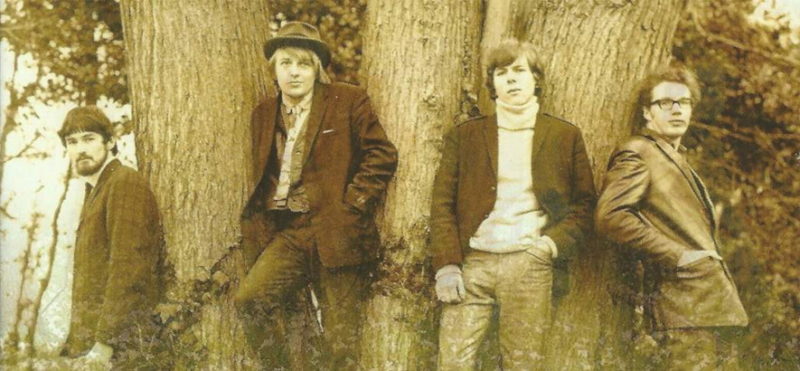
It is exciting to hear Jim Jupp’s hallucinogenic sci-fi storybook soundtracks taking root once again in the synthscape wonderland that he’s created for Belbury. With all its rusty strings and analogue hardware. And so far The Belbury Poly really did find some friends among Manafonistas and their readers, with the new album The Gone Away. Grounded in old fairy tales and TV children shows from the wilder side of the 60‘s, the album moves through its own parallel universe with distant echoes from Tolkien, Bo Hansson, and the more surreals side-kicks of early British prog rock and far-out mood music. Here‘s the riddle: what‘s the band‘s name on the photo? Simple as that. Readers who wanna win an official download code of The Gone Away from the Ghost Box universe have to leave their real name in the comment section and one guess only!