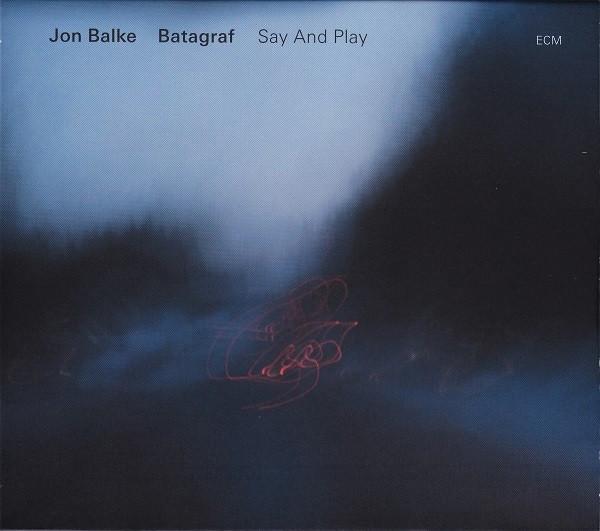
ME: Jon, in a rather strange way, your new album, „Say and Play“ (ECM 2245), brings together a kind of „easy listening“, easy in a very thrilling way, and some avantgarde principles. The music is highly accessible, but not in a well-known way. It is groovy, but without ethno-cliches … so, one could call it, with a smile, „easy-avant-music“…
JB: The departure point in developing this music is 100% rythm, as it appears in spoken language, poems, drumming, AND in melodic playing. I think the melodic „friendliness“ is a consequence of this approach: the melodies are rythmic tools to propel the music onwards, more than sculptural elements in themselves. We also tried to record and mix everything from this point of view: the melodic phrases as background for the solistic drumming and language. This was the dogma that producer Olav Torget and me reminded ourselves of again and again: rythm and language is king.
Brian Eno did publish so-called “speech songs“ on „Drums Between the Bells“, his cooperation with Rick Holland. You are also presenting four spoken-word pieces from a Norwegian poet. Why did you use his original language (your language) – and what was so special to work with the energy of spoken words?
JB: If you listen to „Statements“ (the first Jon Balke/ Batagraf album on ECM records; Anm. V. M.E.) there is a track with a long speech by Miki N´Doye in Wolof. This is a monologue of Miki speaking to someone imaginary that he meets. As I know very few who speak Wolof, but very many who like the melodics in the voice and language of this track enormously, I felt it right to follow this approach and use the poems and voice of Torgeir in the same manner: his sound, melody and the way he floats over the percussion in a kind of counter-rythm makes musical sense to me. As I hope it does to others … The poems in themselves are a kind of bonus, he is a very playful, subtle writer.
Is there, in the way you´re treating these poems, a parallel to African music?
JB: Not in the poems as such, but In all the tracks, as well as in all the music I have made, there is an influence and a parallel to and from Africa, especially West-Africa. But I have painstakingly tried to avoid copying the great music from there. I hope I have not unconciously patched in elements from things I have heard. If I found such things, I would have removed them, as it would feel like stealing … And I don´t like to be a musical thief :-)
You are working on several pieces with Jon Chistensen´s daughter, using a very different type of lyrics: riddles, surreal imageries, daydreams … how do they relate to the powerful drum patterns? The record sounds fantastic, by the way.
JB: This is actually the main building block in Batagrafs music : original Bakas. The Baka is a term from Wolof meaning short poem-like phrases that say something about life or a person, and these phrases can also be played by percussion groups. So the Wolof drum groups build up a complex system of these bakas that are mixed with grooves and patterns, and bakas serve as breaks to change energy or tempo in the music. I think it is a fantastically interesting way to organize music, so I have started to construct my own universe of Bakas, which is what you hear Emilie speaking or singing, and the percussion choir responding. I hope the listener can be rewarded by repeated listening to this album, I hope it constitutes a musical universe that you can „travel“ in by using your ear to focus around in different layers.
On some pieces your keyboards/synths are reminiscent (and I´m sure this was intended!) of Joe Zawinul and Weather Report. Nevertheless it sounds totally fresh. Can you illuminate this element of „hommage“ „or „nordic way“ of playing with some stylings a la Zawinul … Is the „Birdland“ now a music club in “Oslo 13”, the non-existent area of Oslo? (“Oslo 13” the name of an early Jon Balke album; Anm. v. M.E.)
JB: I owe enormously to Joe Zawinul, especially from the Weather Report era, but as with the Bakas, I feel like stealing if I go for his sounds. So I try to squeeze other stuff out of what I have, mostly just developing by ear. But in Say and Play the overall use of synths is there to make depth: drums/voice up front, and layers of keyboard sounds floating inwards in the soundscape, from solo lines inwards all the way to „melodic“ reverb layers. Melodically Zawinul is a European, with strong echoes of romantic music and harmonizations. Olivier Messiaen is another important voice, when you speak of sustained keyboard sounds. The vague notion of „Nordic sound“ is an echo of both these voices, as well as the melodic traditions of the north.
Are you making use of some of the old, famous keyboards/synths, some sounds ring a bell …
JB: I accidentally ended up with a DX7 in a theatre performance in 1982, so this has been with me since then. I feel familiar with the inner structure of that instrument. And somehow I have been continuing using Yamahas from different times: AN1x, FS1r, and now the Motif XS. Maybe this also has to do with keeping a distance to old Joe, all the Moogs and Prophets in the world tend to pull towards his sound. I also have an ambivalent relation to synth music: I get easily tired by an overall synthetic soundscape, and feel the need to mix with acoustic sounds that are richer in timbre. There is no ideology in this, I just go for the sounds i like by research and discover.
You are making, on this new album, a very careful and thoughtful use of jazz piano playing. But this also adds to the different textures of the compositions …
JB: The piano here is used as a single line solo instrument, in order not to fill up the soundscape but keep it transparent. So I play very economically and rather add electronic shadows to the lines that blend with the electronics … that is the idea … again depths of melodic and rythmic polyphony punctured by powerful drums phrases and voices …


