Richard Williams’ fine music blog is now on our blog roll („thebluemoment“). By chance, he has posted, today, a background story about a Barney Wilen album that has just been reissued (with a short appearance of young Jackie Terrasson, whose album „Smile“ has recently been praised by Mr. Klinger). Here‘s my old story (the Deepl version with some refinements) on another Barney Wilen classic, „Moshi“, from August 2017. Etliche Wege führen derzeit zum Schwarzwald, zum Bodensee. Nach Afrika, und nach Paris.
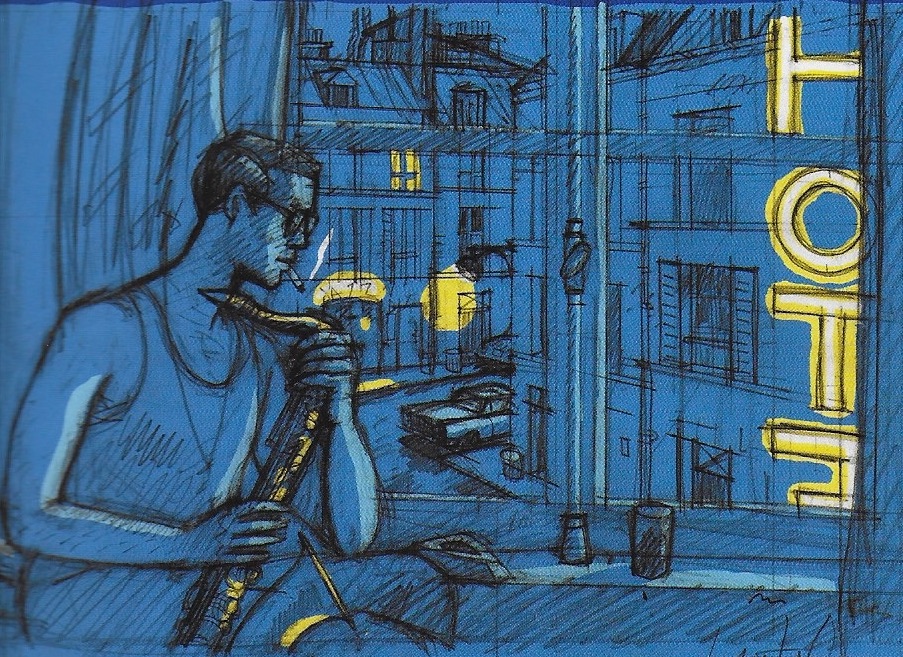
They called him Barney, but he was French. Bernard Jean „Barney“ Wilen, born in Nice in 1937. A wanderer between worlds, with a saxophone in his suitcase. Early on he accompanied Miles Davis to the running pictures of the Louis Malle classic with Jeanne Moreau, „Fahrstuhl zum Schafott“.
He played with three quarters of the Modern Jazz Quartet, free jazz and fusion music in the sixties. Jazz history in high-speed mode. Joachim Ernst Berendt brings him to Donaueschingen (1967) for „Jazz meets India“, and while we’re in that corner – he also plays in the legendary Lindau jazz club „Zur Fischerin“. Young Manfred Eicher helps organise the club’s programme and sometimes gets in on the action with his double bass. I was at this very place weeks ago, now a good restaurant, I would have preferred a time machine to my „Forelle Müllerin“.
In the wild year of 1968, the underground also arrived in the Black Forest. At MPS, „Barney Wilen and his Amazing Free Rock Band“ came into being – with Joachim Kühn, Aldo Romano and other cracks, he recorded „Dear Prof. Leary“. Leary was never a professor, as Jan Reetze recently noted.
His dream: Africa. With the former model from a wealthy family, flag-waver 68 in Paris, girlfriend and filmmaker Caroline de Bendern and a rather large entourage, he set off in 1970 – funds flowing from a cultural foundation. That’s the big dream, the destination: Zanzibar. They sing about the island, but they never get there. If you had followed the planned route, you would have easily died in war zones. Life, jazz, adventure, all one. In 1972 they return.
The result: the album Moshi. Released by a small label at the time, it is celebrated, remembered, almost forgotten, and an expensive collector’s item. Now the label Souffle Continu has reissued „Moshi“ as a double album on vinyl, with an illustrated book, noted memories and a documentary film by Carolin de Bendern on DVD.
Barney Wilen and his companions spent two years travelling through the Sahara and the Sahel. For African-American jazz musicians, Africa is either their original home or a myth. Pharoah Sanders, Art Blakey, Randy Weston, Don Cherry and many others had been there, some of them for quite a time, and so did European free spirits. The African roots, nourished politically or romantically, were supposed to create a new consciousness during and after colonialist turmoil, utopias of a free life were in demand, but the continent, despite all the changes, still experiences political, social and existential nightmares today.
Countless rock and jazz musicians were drawn to Morocco at the end of the sixties, but not all of them were happy. The foreign country often takes its toll, the intoxication can turn into fear. The double album „Moshi“ is a dazzling collage that does not pretend a fusion of worlds. One plays with locals, makes friends, studies new percussion instruments, sings old and new hymns. The musicians from France get involved with the foreign country skin and hair, get to know the blue people, tribes that stage surreal masked balls.
At some point, the French foundation turns off the money tap, but Caroline de Bendern finishes her film, which is as fragmented as the music and dispenses with any clever off-screen commentary. There have already been enough ethnologists who spread distorted images of Africa with their Western thinking of domination. In some places, life with African friends has something communal about it, jamming through the nights, erotic frenzy, friends for life, and they also encounter death in their close circle.
Barney Wilen died in France in 1996. Only in the last few weeks have I taken a closer look at his life, I got hold of an old soundtrack from a French film noir with Lino Ventura, and I can very well imagine him as a young slag in the jazz club „Zur Fischerin“, in 1968, in Lindau, on the Swabian Sea. Manfred Eicher told me he once had the idea to produce a Barney Wilen record. Never happened. Time runs fast.