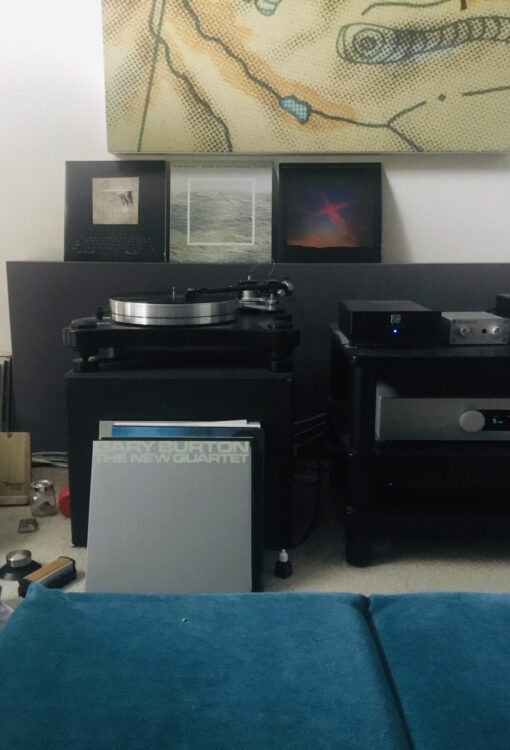
Das, was ihr im folgenden findet, ist ein Teil meines „Interviews“ mit dem Mann, der hinter dem fantastischen Album „Craven Standers“ steht. Eine weitere Passage daraus wird zu hören sein in meiner Ausgabe der „Klanghorizonte“ am 20. Juli im Deutschlandfunk, um 21.05 Uhr.
At the beginning of that radio hour, you will hear a track from the forthcoming album from Jan Bang and Eivind Aarset. Jan‘s background story will inspire you, amongst everything else, to give Miles Davis‘s „In A Silent Way“ another deep listen.
Jan Bang & Eivind Aarset
Dudu Tassa & Jonny Greenwood
Old And New Dreams
Rickie Lee Jones
Nils Økland & Sigbjørn Apeland
Josephine Forster
Matthew Herbert
PJ Harvey
Craven Faults: Standers
And, when at the end, the curtain falls with Craven Standers, Craven‘s words may lead to another look into your archive, for Can‘s „Future Days“. Holger Czukay once called the album “an electric symphony group performing a peaceful, though sometimes dramatic landscape painting”.

Michael Engelbrecht: Hello, „Craven“! You’re a bit of an enigma. I don‘t mind if you just speak into an iPhone or ancient Neumann microphone to lift the fog of your anonymity (you would stay anonymous anyway, cause who would identify you here in Germany, except your are Brian Eno or John Foxx. So, think twice…) Sam Richards‘s review in UNCUT is utterly brilliant, by the way. When Brian worked on ON LAND (another album with an archaic vibe of nature), he felt Miles Davis‘s HE LOVED HIM MADLY as a hugely inspiring track (the mix, the space). Can you name an album or composition that you have a similar feeling for, a kind of soulmate work, even a blueprint for STANDERS, in regards to a certain aspect of the music? And tell a bit around that affinity? In addition, can you name five desert island pieces or tracks, or albums that you can listen to again and again, and tell what you find so fascinating about them?
Craven Faults: There is no single album or piece of music that could be seen as a blueprint for Standers. Each individual track on the album probably takes inspiration from several sources. I don’t really think about anyone else’s music when I am writing and recording, it’s only later in the process, or afterwards when the tracks are finished that the influences appear to me. My own music comes from listening to other music, I’m sure this is the same for every musician, what goes in will come out, and I have an eclectic store of inspirational music inside me. I also didn’t really think of the album as a whole when I was working on it, it’s a collection of disparate parts which slowly came together to form a single entity. There are always, with every release, tracks that are left behind and many unfinished pieces. Just as there was no single piece of work that inspired Standers, there was also no overall plan or vision for how I wanted it to sound. It developed as I went along.
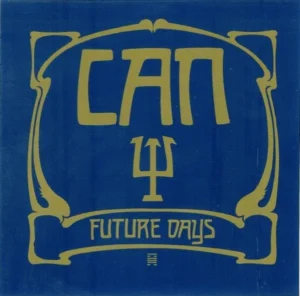
1. Can – Future Days. Probably the single most influential track on all the music I have made over the years. The rhythm is key, the way drums, sounds and instruments interlock. The end section where the band play on top of a speeded up version of the track, the different tempos from 32nd beats to a single bass note every 4 bars. The way it fades in at the start, almost unfolding and opening up to release new sounds over several minutes, the slightly unclear audio quality, the edits, everything is perfect. Future Days is simply one of so many wonderful pieces by Can, who are, and have been since the 1980’s my favourite, most inspiring group of musicians.
2. Pink Floyd – Interstellar Overdrive. A piece I have listened to regularly since the 1970’s when I was quite young. Syd Barrett was one of my first musical heroes. I came to the music first, without knowing anything about his health problems and difficulties, and I think about Syd and his music often. Syd was also a great guitar player, Interstellar Overdrive appears random, free, but I think the more you listen, the more you begin to understand that it is creativity through controlled spontaneity, Syd knew what he was doing. Controlling the music but allowing it to guide you is part of my own methodology. (I feel as though this track is almost a blessing, that EMI could have said no ‘freak-out music’ on Piper At The Gates Of Dawn!).
3. The Beach Boys – Cabinessence. I could have chosen Surf’s Up, Cool Cool Water, Trader, All This Is That, The Lonely Sea, Let The Wind Blow, ’Til I Die, any number of songs… I have periodic Beach Boys obsessions, the current one has been continuing since last summer. A band I have almost infinite patience for, I even enjoy the songs I don’t like (I realise that makes no sense!) It started for me with the Smile sessions, bootleg tapes acquired in the 1980’s. Cabinessence is representative of a large body of work, the structures, edited sections, constructions. Brian Wilson’s description of ‘feels’, song ideas, unfinished sections of songs, works in progress. It’s this idea of ‘feels’ that I personally identify with. (I also love Surfin’ USA, Little Deuce Coupe etc too)
4. International Harvester – Skordetider. I could have chosen almost anything from Parson Sound through to Trad Gras och Stenar, also anything from Arbete och Fritid or Archimedes Badkar etc? Discovering the late 1960’s/early 1970’s Swedish underground, ‘Progg Movement’ has been a revelation. This track – an outtake from Sov Gott Rose Marie LP 1968 – builds slowly and gradually over 25 minutes, guitars, bass, cello, drums etc playing simple cyclical patterns. The basic recording technique, 2 microphones in a room whilst the band play live. The drums, so simple and so perfectly placed. The drummer – Thomas ‘Mera’ Gartz (1944-2012), multi-instrumentalist, brought beauty to most everything he did.
5. Terry Riley – Poppy Nogood. Another one I have listened to regularly since the late 1970’s, it still fascinates. Another long piece (whichever version, they’re all good) which seemingly changes very little but in fact is constantly moving and altering. A perfect symbiosis of musician, instruments and technology – the tape recorder. The tape recorder is simultaneously a simple device and also very complex. This track could be why I use tape recorders (I have a pair of Revox B77s amongst other things) for sound processing, echo effects that are not sync’d to the track tempo and generate new harmonics and rhythmical complexities. It is an experimental piece in which the final result is as important, or more important than the process. It is not simply an experiment which investigates the processes regardless of the outcome.
(If I were to add a 6th track it would be The Velvet Underground – Sister Ray, or maybe some late 60’s English folk-rock, or Indian classical music, or something from composer Charles Ives.)
Thank you so much, i hope this post arrives at your place in the wide, wide north of England. Michael. By the way, Trad Gras och Stenar is a favourite of mine from the Swedish Underground!