Dreierlei hat mich zum Kauf des Albums bewogen.
Gregor Mundt
Gregor öffnet seinen Plattenschrank
nicht selten ist das ein understatement
was da aussieht wie eine Platte im Schrank
ist in Wahrheit die Tür in eine andere, unerhörte Welt
Marc André Hamelin
Ein großartiger Pianist & Komponist, hochgeschätzt von mir
Morton Feldman
Ich kenne diesen Komponisten aus der Beschäftigung mit John Cage. Man kann sagen, dass Feldman zum engeren Kreis um Cage gehörte. Ein interessantes Dokument dieser Verbindung findet man hier.
In den späten 70er Jahren besorgte ich Notenmaterial, um Musik von Morton Feldman mit der ‘AG Neue Musik‘ meiner Schule aufzuführen. Daraus wurde nichts, denn die Anforderungen waren zu hoch. Es gab zwar reichlich Freiheiten, aber dadurch wurden die Kreativität der Ausführenden und die instrumental-technischen Fähigkeiten eines Perkussionisten über die Maßen heraus gefordert. Für einen Eindruck mögen ein paar Bilder zu The King Of Denmark für einen Perkussionisten sorgen.
 Front
Front
 Instructions
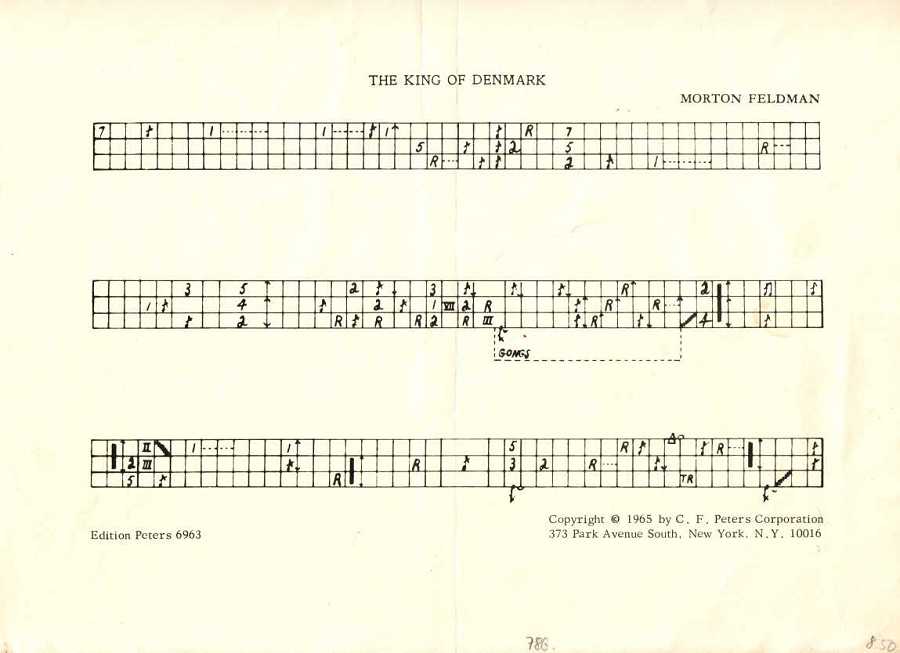 Page 1
Ich habe mich seitdem kaum mehr mit Morton Feldman und seiner Kunst beschäftigt. Von Bunita Marcus habe ich durch Gregors Empfehlung zum ersten Mal gehört. Das ist wohl eine sehr interessante Persönlichkeit, wie man ihrer Biografie entnehmen kann. Es gibt so gut wie keine Tondokumente ihrer Kompositionen. Man braucht nur einmal bei Amazon auf die Suche nach Bunita Marcus zu gehen. Bis auf eine Ausnahme wird nur Morton Feldmans For Bunita Marcus – gleich in mehreren Einspielungen – angezeigt. Auch Spotify & Qobuz lassen von Bunita Marcus nichts hören.
M. Feldmans Komposition reiht sich ein in eine Folge von „For … “ – Stücken
Unter den genannten Personen scheint Bunita Marcus eine besonderen Rolle in Morton Feldmans Leben gespielt zu haben. In Zeiten des Präinternetikums hätte ich kaum etwas über Mrs. Marcus in Erfahrung bringen können, nunmehr aber schon. Den folgenden Text findet man leicht. Er ist niedergelegt im Booklet einer Aufnahme des Werks, gespielt von Ivan Ilić.
On the title of ‘For Bunita Marcus’
From the beginning of his career, Morton Feldman made dedications into titles. The earliest was ‘For Cynthia’, a short piano piece named for his second wife. Then came ‘For Franz Kline’, dedicated to the abstract expressionist painter.
Feldman was proud of his association with artists he met through John Cage in the 1950’s. “The temperaments of artists like Rothko, Pollock, [de] Kooning, and Kline are very similar to mine,” Feldman said. “I know their research intimately”. By naming his pieces after them, Feldman cemented his link with a veritable who’s who list of artists living in postwar New York. Names he used include Frank O’Hara (the poet), Mark Rothko, Willem de Kooning, Philip Guston (painters), Aaron Copland, John Cage, Christian Wolff, Stefan Wolpe (composers), and Samuel Beckett (the writer, poet, and playwright). One name sticks out: Bunita Marcus.
Marcus was Feldman’s student from 1975 to 1981 at the University at Buffalo, where she earned a PhD in composition. In 1983 Feldman said, “I’m very enthusiastic about this girl. And I think she’s something to be enthusiastic about. I’m never going to have [another] student like her as long as I live. Never.” Although Feldman could be viciously critical of other composers, he had nothing but praise for Marcus and her “natural penchant for doing what she does very, very well.” Her compositions, which he said he “learned a lot from” were “gorgeous” and “elegant”.
Marcus was also Feldman’s intimate companion, on and off, from the time they met. She refused Feldman’s marriage proposal in 1981, but they remained close until his death in 1987. Marcus was by no means his only muse; on the contrary, by all accounts Feldman was a compulsive womanizer. But Marcus, who commissioned and premiered his last piano piece ‘Palais de Mari’ (1986), and to whom this CD’s composition is dedicated, will always be inextricably linked to Feldman’s legacy.
From the booklet of Ivan Ilić’s recording of ‘For Bunita Marcus’
Catalogue number PTY135305D
Mich hat das Notenbild von For Bunita Marcus interessiert. Ich konnte mir nicht vorstellen, dass es grafisch notiert ist, es musste konventionell notiert sein, denn Vergleiche der Hamelin-Einspielung mit zugänglichen Streaming-Angeboten zeigten nicht ein „offenes Kunstwerk“, wie es aus der Realisation einer grafischen Partitur resultieren würde.
Bei Universal Edition (offenbar der zweite große Verlag für Feldman, zuvor war es Edition Peters) sind die ersten 4 Seiten als Muster einzusehen. Daraus erschließt sich mir auch Feldmans Anmerkung zur rhythmischen Gestaltung.
For Bunita Marcus besteht hauptsächlich nur aus 3/8-, 5/16- und 2/2-Takten. Manchmal hatte der 2/2 musikalischen Inhalt, so am Ende des Stücks. Manchmal fungieren die 2/2-Takte als Stille, entweder auf der rechten Seite oder der linken Seite oder in der Mitte des 3/8- und des 5/16-Takts, und ich benutzte das Metrum als Konstruktion: nicht den Rhythmus, sondern das Metrum und die Zeit, die Dauer, die etwas beansprucht.
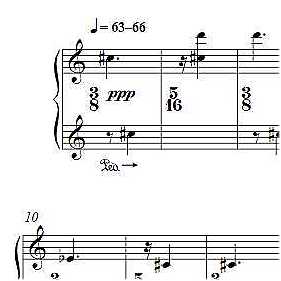
Die Taktwechsel sind das notationstechnische Mittel, um den eigentlich pulsfreien, kaum greifbaren Zeitstrom schriftlich zu vermitteln. Das ist vertrackt zu spielen !!! Fingerfertigkeit im Sinne schneller fingerbrecherischer Passagen à la Liszt / Rachmaninov (oder auch Hamelin) wird nicht verlangt, Anschlagskultur schon.
Ich habe For Bunita Marcus heute 2 Mal angehört. Es passiert fast nichts in dieser Musik, es gibt keine dynamische Entwicklung, es ist irgendwie ziellos. Ich war nahe am Aussteigen, doch das feine Timbre einzelner Töne und luzider Zusammenklänge hat mich doch nicht entlassen, gewann mehr und mehr meine ungeteilte Beachtung. Allmählich stellte sich ein Zustand von Selbstvergessenheit ein, ein Gefühl von schwebendem Verweilen in gedehnter Zeit. For Bunita Marcus ist so leise, dass mein Tinnitus hörbar mitmusiziert. Morgen lege ich das Stück wieder auf. Morgen höre ich es etwas lauter.