„Coyotes — We lived for awhile in a house in the hills. Coyote hills. The coyotes would start their song at dawn. Dawn and dusk were their main appearance times. Our dog would sleep outside sometimes in the morning and our boy was still bite-size. The coyotes would come take notes, edging closer each day. Mornings on the kingsize outdoor daybed. Like a righteous floating tide the coyotes would drift into our world. Predator and prey, blurred. Past and present, blurred. The young, the aged are to be snatched and devoured. Past lives edge in closer to try to speak to us. Current lives eye the past ones like sleeping dogs. And love spans all, that is why the feeling is so deep — deeper than one lifetime.“
– Bill Callahan
Author Archive:
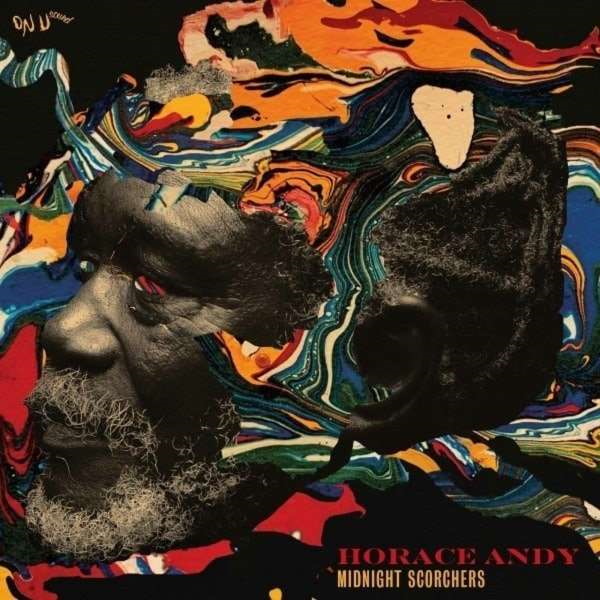
The best reggae album 2022 (in my ears, and no. 20 in my 33 parade; see blog entries on August 30, for the numbers 20 til 33). Horace Andy‘s „Midnight Rockers“, might only have one true rival, its own dub version, „Midnight Scorchers“, to be awaited in the second half of September. „Midnight Rockers“ reaffirmed Horace Andy’s regal reggae status, irrespective of his latter-day Massive Attack and Rhythm & Sound fame.
Its producer Adrian Sherwood will now complete the picture with Adrian‘s sound-system-style refashioning, breaking tracks open, resetting them in eerie dubscapes, as he did with Lee Perry not long ago. And, just go back in time to put it all in perspective: looked at as one of reggae’s most distinctive voices, vocalist Horace Andy has made fantastic albums. Andy’s 1977 album In the Light may be his strongest.
The album’s ten tracks found Andy’s quivering vocals floating in a dreamlike tension above tightly wound rocksteady rhythms, looming darkly on pensive tracks like „Problems“, exploding on fun jaunts like „Do You Love My Music,“ and lingering meditatively on the lighthearted anthem of self-awareness and cultural pride that is the title track. Understated synthesizers and a simmering rock & roll-minded production denote the evolution roots reggae was undergoing year to year by the late ’70s, showing up on the especially swaggering „Collie Herb.“
As razor sharp as the record is on its own, the dub album mixed by King Jammy, „In the Light Dub“, offers even thicker versions of the tunes, swimming in psychedelic reverb and splintered echo effects, bringing instrumental contributors like Augustus Pablo more into the spotlight. About as nuanced and motion-heavy as dub albums get, In the Light Dub transcends mere companion-piece status and stands beside the original mix as an equally interesting (and on some tracks even superior) artistic statement. Compiled and reissued in 1995 by first-class reggae label Blood and Fire, the collection delivered one of Andy’s finest hour from the obscurity that poor distribution and shoddy manufacturing had hoisted upon the record in its time.
Skillfully remastered and even stronger with both originals and dubs occupying the same space, In the Light/In the Light Dub is a triumph of roots reggae and a necessary chapter for anyone even remotely enthusiastic about Jamaican music and culture, especially at this critical point of reggae’s evolution in the late ’70s.
(written by Fred Thomas and M. E.)
2022 30 Aug.
Neil Young: Citizen Kane Jr. Blues
Manafonistas | Filed under: Blog | RSS 2.0 | TB | Comments off
Ich besitze eine High-End-Anlage.
Ich schätze sehr gute Aufnahmequalitäten.
Ich habe mich in diese LP hineingehört.
Eigentlich klingt sie furchtbar.
Ich stehe in diesem Club, 1974, mit einem Bier in der Hand.
Vor mir der junge Neil Young.
Fantasie ist einfach die stärkste Kraft.
Ein wunderbares Hörerlebnis.
Danke!
Peter.
Praesciptum, Blog, 2013: I met a young woman from Bulgaria in a Starbuck’s cafe in Cologne. We talked for a while: the jobs, the past, the holidays. She will be in Sri Lanka now. Or in a short time from now. I played „Cinnamon Girl“ for her, the trailer of the new Neil Young album „Live from the Cellar Door, 1970“. Immediately she liked the music, love (attraction at least) at first sound, she had never heard that voice before, first time. I’m listening to the record now, „Live At Massey Hall“, pure magic in the ways it transcends the genre of just confessional songwriters. Two months before his solo perfomance at the Cellar Door (Miles Davis was also there, 1970) AFTER THE GOLDRUSH had been released. Anti-matter and Southern Man. Only love can break your heart. Beware, guys: flying on the ground is wrong. (m.e.)
2022 20 Aug.
Sidseliana (7) – „Didimoy Dreams“
Manafonistas | Filed under: Blog | RSS 2.0 | TB | 1 Comment
Singing in her very own language (free of semantics and any oldfashioned business of message) she is the greatest female shaman of the northern atmosphere, and the experimental guitarist at her side knows how to paint a landscape for a voice. A wild, wild world. („Quick shot review“ of a Rune Granmofon highlight by m.e.; drawing by H.B.)
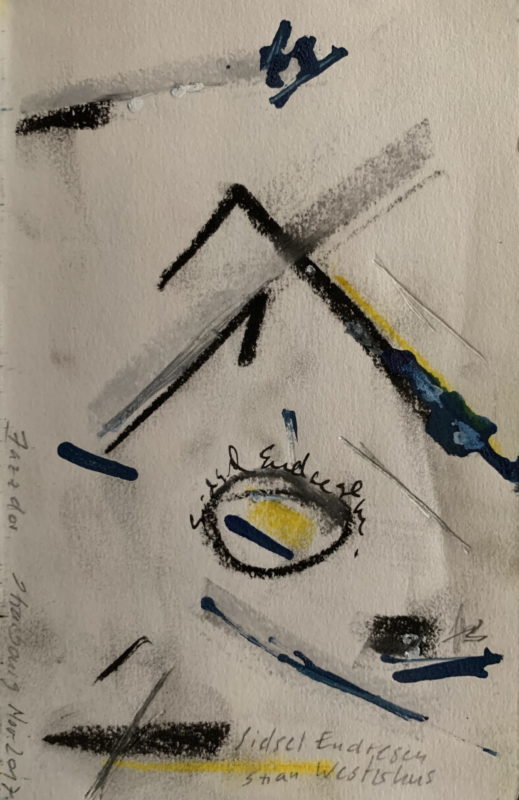
(May 2015, Deutschlandfunk). Timing is part of every radio production, even in live broadcasts. And that’s where it got interesting last night: I realised half an hour before the start that I had far too much text, and it was important to me to play the final track of the night show from start to end, one of those stunning pieces from „Didimoy Dreams“ by Sidsel Endresen and Stian Westerhuis. Not giving it a fucking fast fade-out. So I proceeded like a berserker, throwing out sentence after sentence, a lively deletion of whole passages, adding a new short thought or sentence here and there to re-establish lost context. My favourite technician behind the glass and I had a lot of fun, and in the end, after a longer piece from the ECM album „Dream Logic“ (with those other Punkt Festival pioneers Jan and Eivnd), and before „Didimoy Dreams“, the seconds merciless proceeding, I improvised freely into the microphone because I couldn’t read my own scrawl. And, interesting, I even surprised myself with what I said on Sidsel‘s singing. It was much more personal than intended, but, then again, no reasons for „academics“ when you follow a voice you love, in dimmed studio lights. (m.e.)
2022 20 Aug.
Sidseliana (6) – „Sidsel‘s Life in The Forest of Ghosts“ (2015 / 2017)
Manafonistas | Filed under: Blog | RSS 2.0 | TB | 2 Comments
In 2015, I did catch the „remix crew“ of Jan Bang and Erik Honoré with the eminence of Norwegian vocalist, Sidsel Endresen. It is hard to say what is the difference between experiencing Sidsel Endresen for the first, the fifth or tenth time. You will never be (really) prepared for what is coming. The performance again proved how abstraction can get utterly concrete and cut deep.
Generically speaking she is not just producing plosives and stuttering guttural sounds, playing around, nor is she imitating instruments. Her expression moves with basic vocalizations combined in a non-arbitrary way, to syllables freed of conventional meaning placed and articulated with great urge, driven by a deep musical intuition. She digs deep into the essence of the human voice and creates a strong visceral coherence. Melody is always in the air (or triggered vaguely in listeners‘ minds), sometimes touched upon or even fully articulated. She is one of the most extraordinary post-bop vocalists and the source for younger Norwegian jazz and improv singers.
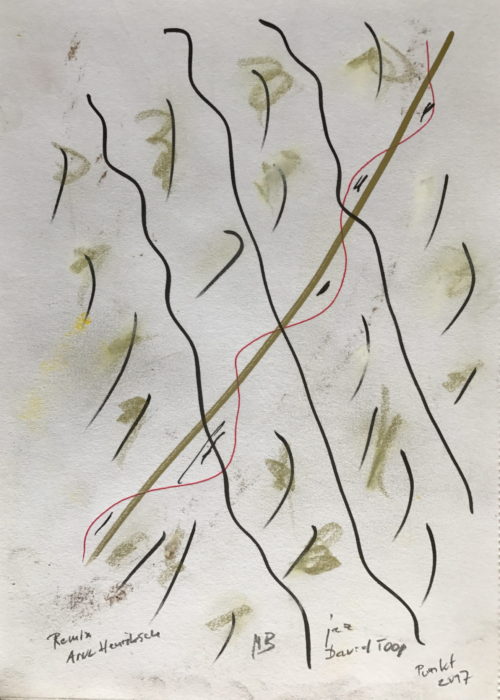
Fellow musicians have to listen carefully and take quick and effective action to achieve this coherence and strength of expression. Bang and Honoré know exactly how to and they know each other so well they can go into any direction with each other. Armed with her voice and just a microphone flanked by two electronic wizards, she cut her way through the electronic shades, the spume, threw it into abysses and led the music to a higher plane. It was breathtaking and relieving. You could almost forget about the O-performance that was recognizable still. Thus the remix lead even deeper into the forest.
– Henning Bolte (text, drawing)
2022 19 Aug.
Neil Young zwischen Erntemond und Eldorado
Manafonistas | Filed under: Blog | RSS 2.0 | TB | Comments off
Etwas Zeit vergangen, seit ich meine Nase 1971 oder 72 an einem Plattenladen in Paignton plattdrückte, und „After The Goldrush“ mein Einstieg in die Welt von Neil Young wurde. Wie Joey und Steely Dan, wie Martina und Pan American, wie Brian und Oregon, wie Ingo und Radiohead, wie Olaf und Lee Perry, wie Jan und Kraftwerk, wie Lajla und die Kinks, wie Uschi und Bob Dylan, wurden wir ein unzertrennliches Paar.
Und ähnlich wie bei Brian Eno Songs und Ambient Music zwei Pole seines noch viel verzweigteren Schaffens darstellen, so gibt es den Neil von „Harvest Moon“ und den Neil von „Eldorado“, die sanfte akustische Seite, und den „mad, guitar- and feedback driven rock“. Und so findet sich in der Diskografie des gebürtigen Kanadiers, manchmal auf einer einzigen Schallplatte (z.B. „Rust Never Sleeps“), jene Unberechenbarkeit, von der Jeff Tweedy von Wilco spricht, wenn er ein Spätwerk der Beatles sein „platonisches Ideal“ nennt:
Die heftige Seite von Neil Young brach besonders in den Achtzigern vehement durch und bescherte uns u.a. jene magische E.P. namens „Eldorado“, die Ende 1989 nur in Japan erschien und hier als teurer Import gehandelt wurde. Seit Freitag gibt es das furios-lärmende Opus als Vinyl, und ich hörte die Scheibe zum ersten Mal. Explosives in audiophiler Qualität – schöner klang „noise“ noch nie. Nur nicht erschrecken. Ganz im Sinne des „white album“ schimmert des öfteren der zartbesaitete Young durch, in Momenten des Atemholens, einer wie selbstverloren wirkenden Songzeile, und in der Stille zwischen zwei Krachern, „on dead quiet vinyl“.
Danach bekam ich Lust, wieder das jüngstaufgetauchte „Toast“ aufzulegen, eine Zauberplatte, sowie das allseits unterschätzte Album „Reactor“, letzteres natürlich auch aus den Achtzigern, mit der grossartig minimalistischen Hymne an „mashed potatoes“, und einem jener Sehnsuchtslieder, die er wohl ewig, wenn nötig, nachts, aus den Ärmeln schütteln kann. 1982 in Bergeinöden „on heavy rotation“. Am Ende der Welt braucht man halt ein „Survival Package“, und Neil Young gehörte eindeutig dazu. Wie auch der Holundersekt von Hansjörg. Und Julio Cortazars „Rayuela“.
2022 18 Aug.
The art of understatement
Manafonistas | Filed under: Blog | RSS 2.0 | TB | Tags: ECM, Enrico Rava, Fred Hersch, The Song Is You | Comments off
Many inspired jazz recordings come out of combinations of instrumentalists – usually the more unexpected, the better. What’s most fascinating are the ways players adapt to each other’s emotions and inventiveness. This pairing, which is exactly the kind of fusion that has made ECM such a distinct entity lo these many years, was likely inspired by ECM founder and inspirational presence Manfred Eicher. American pianist Hersch, who can do wistful as well as he does sprightly and is as strong melodically as rhythmically, is easily one of the finest pianists in jazz today. Italy’s Rava, who debuted on ECM with 1975’s ‘The Pilgrim and the Stars’ and who began as a bopper before falling under the sway of free jazz, has mellowed into a trumpet master with astonishing range, able to command nearly every permutation in jazz, from avant-garde to soul jazz. Both men are sentimentalists in the best sense, and both are lyrical players, which is what makes their pairing in ‘The Song Is You’ so captivating. […] The sound here is breathtaking: spacious, natural, impeccably balanced, with glorious resonance and just enough of the sound of the room to add presence. It is – as is the standard with ECM – an audible tutorial on recording done right. Thoroughly enjoyable and instantly essential.
Robert Baird, Stereophile
2022 18 Aug.
Kleines Interview mit Lambchop (Kurt Wagner) zu seinem Album „The Bible“
Manafonistas | Filed under: Blog | RSS 2.0 | TB | Tags: My 10 albums of 2022 | 3 Comments
Vor der Aufnahme von „The Bible“ hast du über deine Möglichkeiten als Musiker nachgedacht. Warst du irgendwann kurz davor, aufzuhören?
Es gibt einen Punkt, an dem viele von uns ihr Leben in Frage stellen und sich fragen, wo wir inmitten von Widrigkeiten und überwältigenden Umständen, die sich unserer Kontrolle entziehen, stehen. Ich hatte nie das Gefühl, dass ich aufhören würde, Dinge zu machen, sondern eher versuchen würde, einen Weg zu finden, dies im Rahmen meiner Möglichkeiten weiterhin zu tun, da ich in eine Altersgruppe eintrete, die nicht gerade für ihre kreativen Durchbrüche bekannt ist.
Hattest du ein Ziel, ähem, eine Mission, als du mit dieser Platte angefangen hast?
Ich hatte die Idee, dass Spiritualität, wie die Kunst selbst, etwas ist, das uns allen innewohnt. Sie hilft uns, die Welt aus unserer Perspektive zu betrachten und damit umzugehen, dass wir ein Teil von ihr sind. Wenn wir außerhalb der organisierten Religion leben, schließt das nicht aus, dass wir diese spirituelle Erfahrung durch unseren Ausdruck machen. Dies und die Idee, dass das Album einen vielfältigen Ansatz für die Songs haben sollte und die Zusammenarbeit mit Ryan und Andrew, die Teil des Schreibprozesses und der Produktion waren, widerspiegeln sollte.
Wenn dies ein Album ist, das viele Fragen aufwirft, habt ihr dann irgendwelche großen Antworten gefunden?
In gewisser Weise ist das Finden von Antworten nicht immer der Punkt. Es geht um die Betrachtung, das Hinterfragen der eigenen Existenz, und darum, die Dinge ins rechte Licht zu rücken. Wenn ich etwas mitnehme, dann ist es die Tatsache, dass es mir immer noch möglich ist, etwas zu machen, das sich anfühlt wie der frische Atem eines Säuglings, der in eine neue Decke eingewickelt ist, wenn er seine Augen für einen neuen Tag öffnet.
Was bedeutet diese Platte für dich?
Da fällt mir die Überraschung ein. Dass noch Leben in dem alten Hund ist. Und auch, dass es immer noch unglaubliche Künstler da draußen gibt, die bereit sind zu sehen, was passiert, wenn wir etwas zusammen machen. Es ist wirklich eine Freude und ein fröhlicher Lärm, den wir zusammen gemacht haben.
2022 17 Aug.
„A laboratory of music brimming with life“
Manafonistas | Filed under: Blog | RSS 2.0 | TB | Comments off

Studio-as-instrument science from the labs of Kingston’s pioneering Studio One, where the team of engineers, DJs, and artist assembled by Clement “Coxsone” Dodd changed the shape of music as it was known.
My good aquaintances at Boomkat allow me to share their „expertise“, from time to time, on this blog. In this case, my all analogue listening to the bravura of „Studio One Lab“ confirms every line they’ve written. This record shows en detail, for example, why I prefer old reggae to John „Seppel“ Bach. That old music from Jamaica contains in my ears more life, death, vulnerability, heat, passion, twilight, sex, wilderness, imperfection, obliqueness, sense of wonder than the „holy canon“ of that Mr. Slave-To-The-Rules. No doubt, Jonathan was fucking genius, but I am so happy I don’t have to bow my head when boredom is a price too high to pay. (m.e.)
Soul Jazz HQ put their inestimable compiling skills to work reaping the intense experiments in sound projection and groove of some 17 artists, many sharing common ingredients, put tweaked out in myriad manners of style and pattern built for the dance, radio and back yards. They’ve dug especially deep for this one, plucking ever-salient pieces of reggae spanning roots to funky and dub, vocals and instrumentals, that highlight the way Jamaica punched well above its weight, considering the size of the island and its population, in contrast to almost anywhere else.
There are fittingly lucubrate liner notes from „On The Wire“ legend Steve Barker to bury your nose in, and we’ll highlight but a few of these nuggets to get you in the mood. From the earliest ska days Cedric Im Brooks’ horn and organ-led skanker ‘Glory To Sound’ is a joy, and there’s a nice & easy, modal beauty by Jackie Mittoo on signature keys in ‘Lazy Bones’, contrasting with his slant on US funk chops in the up-and-bustling ’Sunshine of Your Love’, or the soul jazz lilt of Roy Richards’ spin on the standard ’Summertime’.
For the dub nuts, Dub Specialist’s ‘Message From Dub’ also riffs on classic US vibes with unmistakeable JA accent, and takes it groggy as on ‘Chainey Roots’, with Sound Dimension trading in overproof bass and psychedelic mixing on ‘Face Man Version’ and heaviest roots trod located in ‘Dread Head’ by Pablov Black, and if you aren’t bobbing and reeling to ‘Surfing’ (Part 2)’ by Ernest and The Sound Dimension, we can’t help ya.
“My voice has changed: it’s lowered, it’s become a different personality I can sing from. I don’t want to sing like a teenager; it can be melancholic, a bit regretful. As for writing songs again? It’s more landscapes, but this time with humans in them. I like creating worlds – that’s what I do as an artist – creating sonic worlds. Now after quite a long absence of humans in those worlds, I have tried putting one in and seeing how they feel in the world I’ve made.”
„In der kurzen Zeitspanne einer Pandemie scheint Brian den eskapistischen Tendenzen von Mixing Colours abgeschworen zu haben, seine Agenda ist jetzt nicht nur dringlicher, sondern auch realitätsbezogener. Das ist nicht ohne Präzedenzfall: Das 2005er Album Another Day On Earth befasste sich mit dem Terrorismus und das 2016er Album The Ship mit dem Krieg, und mit ihrer Betonung des Gesangs sind diese Alben wohl auch die offensichtlichsten musikalischen Vorläufer dieses neuen Werks. Aber der Mann, der manchmal als Brain One bekannt ist, hat nun, wenn auch vielleicht widerwillig, akzeptiert, dass ein mitfühlender, intimer, weniger zerebraler Ansatz vielleicht effektiver ist, um die düsteren Verzweigungen der Klimakatastrophe zu vermitteln, die viele von uns, einige absichtlich, zu vergessen scheinen.“
Wyndham Wallace, Uncut November 2022, album of the month review (FOREVERANDEVERNOMORE erscheint am 14. Oktober)
Kurze Anmerkung zu dem Zitat der Besprechung: Eskapismus hat meist einen negativen Beigeschmack, ist aber hier anders gemeint: Mixing Colours wirkte wie ein beseelter Tranquilizer in der ersten Horrorzeit der Pandemie. Und, es lohnt sich auf jeden Fall, im Vorfeld der Veröffentlichung zu den beiden Alben „The Ship“ und „Another Day On Earth“ zurückzukehren. Man könnte „Foreverandevernomore“ beinahe für den dritten Teil einer Trilogie halten. (me)