Is there a way to say how much I love this song, this whole album, now for the first time officially released, as expanded part of another „killer album“, „Nerve Net“. „My Squelchy Life“ is a beautiful paella of styles, allusions, crossings, a wild beast without any clever agenda or fixed formula. The first song, loud, crazy, provocative for any decent thinking, reminds you of the sheer power of Eno’s first collaboration with The Talking Heads, „More Songs about Buildings and Food“. „More volts!“, Eno shouts out, „I’m sucking the juice from the generator / More volts! More volts!“ No chance to stay quiet in your lazy chair. „It’s all up! / I’m living beyond the warnings / It’s all up! / I fall up!“. High tension-track that might make you think of collapsing refridgerators or a trip to the black heart of Africa, with a lot of damaged guitars and broken loudspeakers in rotten vans. „I’m cackling off to the Congo“. Key line, followed by another message for surreal truth seekers. „Find God in a big fat water-melon.“ And then, no breath later: „Give up! Give up!“ We’re in Surrender City. Marc Bolan sends his big applause from the Great Beyond, from a town called „Ashes-to-Ashes“.
Archives: Januar 2015
2015 7 Jan.
Stretching the moment
Michael Engelbrecht | Filed under: Blog | RSS 2.0 | TB | Comments off

2015 7 Jan.
Heute im Deutschlandfunk, ein gemischtes Doppel
Manafonistas | Filed under: Blog | RSS 2.0 | TB | 2 Comments
Er ist Jazzpianist, sie klassische Cellistin. Musikalisch war es zwischen beiden Liebe auf den ersten Blick. Im Duo gelingt François Couturier und Anja Lechner eine subtile und selten so geglückte Fusion beider Welten. DLF, 21.05 Uhr. Von Karl Lippegaus.
2015 7 Jan.
Die Balance von Field-Recordings und Post-Production
Michael Engelbrecht | Filed under: Blog | RSS 2.0 | TB | Comments off
Gelungen, dieses Gleichgewicht, das immer auch ein Spannungsfeld ist, auf der tour-de-force des aktuellen Albums der Kasai Allstars, das nun, etwas verspätet, zu unserem „album of the month“ geworden ist. Alles begann mit Konono No. 1, dieser rhythmisch vertrackten Perkussionsmusik, die alles ins Klangpanorama schob, was an heimischem Trommelarsenal, beschädigten Klangkörpern, zur Hand war. Im Kongo zu leben, ist hart, die Zeiten mal dunkel, mal schwarz, irrsinnige Despoten, verrückte Stammeskriege. Der ganze fundamentalistische Irrsinn, der durch alle Welten zieht, feiert teuflische Urständ, überall: hierzulande, in der Ferne, alles verblendet, verpeilt, und dumm. Dumm ist gefährlich. Solche Musik wie die der Kasai Allstars bricht den Irrsinn, und sendet (die eigene Verstörung gleich mitliefernde) Trancerituale in andere Welten, und man versteht, wie viele „missing links“ es gibt zwischen javanischer Puppenspielmusik, amerikanischem Minimalismus, und kongolesischem Trommelrausch. Machen Sie nur keine Mode daraus, keinen Trend, keine In-Musik! „It’s a breathing, living organism.“ Und so freue mich mich auf einen anderen Brückenschlag, wenn in Kürze Terry Rileys „In C“ von afrikanischen Instrumenten in andere Klangreviere gelockt wird. In eine Ferne, wo wir uns an ersten Tagen, vor Ort, womöglich bangen Herzens bewegen würden. Egal, wie vertraut uns Kora und Co. mittlerweile wären … gibt es afrikanische Paukenschläge? Wie schön, wenn an die Stelle des Wissens das Erschrecken tritt, und die die Frage, ob man träumt oder wach ist, die erste ist, die sich aufdrängt.


2015 5 Jan.
„The Electronic Griot“ – Lecture in Kristiansand (part 1)
Michael Engelbrecht | Filed under: Blog | RSS 2.0 | TB | Tags: The Electronic Griot | 2 Comments
1) Musik (Vinyl) Ensemble Economique: Interval Signals
(Dark room. All people present. Reading the last two paragraphs of Richard Brautigan’s short story „Pacific Radio Fire“ in a corner of the room, then returning to the place with the old lamp …)

„I had never seen anybody set fire to a radio before. As the radio gently burned away, the flames began to affect the songs that we were listening to. A record that was #1 on the Top-40 suddenly dropped to #13 inside of itself. A song that was #9 became #27 in the middle of a chorus about loving somebody. They tumbled in popularity like broken birds. Then it was too late for all of them.“
VINYL STARTS 15 MINUTES BEFORE THE BEGINNING OF THE LECTURE – THE MUSIC IS LYING UNDER MY VOICE AT LEAST ONE MINUTE, THEN SLOW FADE OUT
Griot 1 – Hello, everybody. Just take care for a good sitting. The best thing would be the beach chair of Hakon Stene´s album cover ((the cover can be seen in the audience)), but it´ll be okay anyway. Wish you an unsafe journey, the music will send you places, this is Punkt Radio.
Sometimes I start a record show with a piece of music announcing nothing, setting the mood with the music alone. There are two factors that kill even good music shows on air: an all too smart Alec on the microphone, and constantly happy-sounding DJ voices.
This is music to get lost in, Brian Eno once coined the word for it: „where-am-I-music“! „Ensemble Economique“ is a funny name for one-person-project. Broadcast signals, rain, conversational voices, distant drumming, All India Radio, alien chants …
And congratulations, Mr. Brian Pyle, for placing a piano into the landscape of this 40-minute-track that doesn`t do its sweet Erik Satie exercises. Melancoly like in an old crime scene, shot in black and white, echoes trapped in a deranged telephone network …
Brian Pyle is Ensemble Economique. He lives in an isolated part in Northern California not too far away from the light tower where John Carpenter made his horror film THE FOG. Killing soundtrack, by the way, and Adrienne Barbeau is playing a radio DJ on a deserted light tower. My dream place for making radio: the sea before your eyes…. Brian Pyle´s album is also about fog, the fog of radio waves – people lost in the fog like in Ingram Marshall`s „Fog Tropes“, „apparitions like petals on a wet black bough“…
(fade out of background music)
In 1972 another young man was in the South of France. By that time film director John Carpenter made a first, short version of a future classic „Dark Star“.
The young man had eaten bad fish and became very ill and then had a recurring vision of a hotel where everything was scanned by an electronic eye. Several rooms: in one room two people were fucking, kind of cold fucking.
In another room full of electronic equipment a composer was listening through earphones, but all was silence. Next day the young man felt better, went to the beach sunbathing, and suddenly a poem poped into his head. The first lines:
„I`m the proprietor of the Penguin Cafe, I will tell you things at random.“
Years later, I met Simon Jeffes in London and he told me the story of the poem. It was all about the unexpectedness, the unknown, the killing of dead patterns and dead rituals, the irrationality, and how that makes life precious.
2) Penguin Cafe Orchestra: Milk
Griot 2 – Milk, from the first album of the Penguin Cafe Orchestra. Simon Jeffes was disappointed by the rigid structures of new classcal music and rock, stayed close his own Penguin dreams and found a mentor named Brian Eno who published Simon’s surreal „coffee house avantgarde“ on his label OBSCURE RECORDS.

OBSCURE RECORDS published ten album within a very short span of time in the midseventies: not a commercial, but an artistic success: the idea behind was to close missing links between experimental music and leftfield pop, between musique concrete and ambient music.
What a playground for great albums: cold academic egghead music replaced by lush, warm textures, a floating quality of minimalism instead of epigonal 12-tone-gymnastics or some real prog rock bullshit of that era. Several records became classics: Eno’s Discreet Music, Gavin Bryars‘ The Sinking of the Titanic. Harold Budd’s „Pavillion of Dreams“…
Laurence Crane was surely influenced by Gavin Bryars‘ sound textures and some of Mr. Crane’s compositions found their ways into yesterday’s concert of multiinstrumentalist Hakon Stene. His new album has the wonderful title LUSH LAMENTS FOR LAZY MAMMAL, and lush laments they really are.
Decaying sounds, music on the verge of falling apart, tunes like ghosts, music for deck chairs: is it slow motion, is it abstraction, is it Northern melancoly (long history!), is it valium without prescription, is it a suggestion carved in sound for postmodern times: the things that last shine from the margins …
And they vanish with dignity …
And they vabish with dignity … (Slow voice)
„The apparition of these faces in the crowd
Petals on a wet black bough“
Listen, Hakon Stene’s See Our Lake …
3) Hakon Stene: See Our Lake 1
2015 5 Jan.
„The Electronic Griot“ – Lecture in Kristiansand (part 2)
Michael Engelbrecht | Filed under: Blog | RSS 2.0 | TB | 1 Comment

Griot 3 – Yes, this record is about decay and disappearance, but every tone, every little hush, has a strong presence. Nice paradox. And theses lamentations come along without words.
„To see the waves on white capped sea
To see the days that we failed to seize
To see a world of muddle and scrawl
To see the things that will happen to us all“
We’ll return to this lament. Hakon’s album has a beautiful cover, a deckchair, a place for meditating, music for thinking, no kitsch involved. Erik Honore’s new album appears on the same label, Hubro, and has a beautiful cover, too. Look! Somewhere in the city, the entrance area of a house, the sun shines through, fractured, two bicycles, maybe a music student of Kristiansand is living on the first floor who’s finally about to write the book that still will have to be written, about the influences of one of my favourite composers ever, Gustav Mahler, on leftfield genre-crossing music sind the Midsixties.
In the early years of Punkt I had quite a surreal encounter and talk with Jon Hassell, and the grand-grand or grand-grand-grand-daughter of Gustav Mahler. No kidding. Though Jon once studied with Stockhausen, he surely has no doubts about the Mahler´s role modeling, for example ib the art of letting pathos and fully blossoming textures fall apart to point zero.
But I digress. Weeks ago, I wrote an email to Erik Honore:
Ya remember our conversation about the decline of the fascination ECM-covers once had. I know: strip down the things, keep it mininmal, but all these fucking lonely nightscapes, all these grey shadow worlds. In the beginning i was a big fan of ECM-covers, but now they’ve, for the most time, become, a living cliche, not a real signifier for the music, more a sign of corporate identity. Now, Erik, Hubro, rising star of the Norwegian labels, Hubro also does this „“corporte identity thing“ with their cover art, don’t they?
Erik answered:
Hi, Michael, regarding the cover: Yes, I generally prefer the other way, where the design signifies the album, and not the label. But apart from that, I like the somewhat naivistic approach of the Hubro designers (Yokoland), and in my eyes this particular cover represents ONE possible „reading“ of the music and the album’s narrative: a fantasy travel, something from the imagination of a child, or stories remembered or half-remembered from childhood. That’s not necessarily how I interpret the musical narrative, or did when I was recording it – and I’d like to keep it open for others to read into it other things. But still, the cover itself works for me, as one possible reading.
Sanctuary, from Erik Honore’s debut HELIOGRAPHS …

4) Erik Honore: Sanctuary / Pioneer´s Trail
Griot 4 – Another reading of Erik Honore´s HELIOGRAPHS might be induced by a casual look on the tracklist: Pioneer Trail (this track is now about to fade away) – Red Cafe – Last Chance Gas & Water – Departed … there are no American signature sounds here, well, but for a short moment I was – in my mind – on a road through Edward Hopper Country.
IMPORTANT: (HERE, THE RHYTHMIC SECOND PIECE OF ERIK HONORE HAS BY NOW DISAPPEARED, AND THE THOMAS KÖNER TRACK STARTS NOW DOING THE SOUND CARPET FOR MY READING BEFORE THE MUSIC STANDS ALONE)
Hallo, Michael, nicht so leicht ein 5-Minuten-Stück für dich zu finden, Hello, Michael, not so easy to find a new 5-minute track for you, because my pieces in recent years were all made for the big screen. Now this is from a series of tientos, an old genre of piano-related compositions … it´s called TIENTO PARA ELMA
When my grandmother Elma died, I had been in Brazil in the hinterlands of Pernambucco, and when I finally had a phone- and internet connection again, she already had been buried. Returning to Bochum some weeks later, I was straying through at her immaculate, flawless apartment. i sat down at her piano and played a few tones.
I couldn’t say farewell to her. Before flying to Brazil she seemed so healthy and full of life. Now I was sitting there, added a few tones, nearly a melody. Before the grand piano left the house, I returned with two microphones and a recorder. Liebe Grüße winkt Thomas Köner
5) Thomas Köner: Tiento para Elma
6) Kim Kashkashian: Hoy, Nazan
2015 5 Jan.
„The Electronic Griot“ – Lecture in Kristiansand (part 3)
Michael Engelbrecht | Filed under: Blog | RSS 2.0 | TB | 4 Comments

Griot 5 – Last year Armenian pianist Tigran Hamasyan and sample maestro Jan Bang perfomed here at PUNKT: it was fabulous. Tigran used eastern roots and melodies, and – obviously – played with some ECM 70´s record memories, Jan Garbarek, Ralph Towner, Keith Jarrett … Jan provided ghost echoes.
Afterwards I asked Jan to send me a tiny two minute excerpt for my radio review about Punkt No 9. I emailed to the headquarter for ECM Records and Manfred Eicher not to miss the JazzFacts at the Deutschlandfunk. Manfred was impressed. Weeks later, the famous studio in Lugano was booked, for Tigran, Jan, Arve Henriksen and Eivind Aarset. I was invited and became a witness of one of the most stunning ECM productions of the 21st century. No kidding again, no fishing for compliments, I mean it. I think Tigran´s quartet music will be released as a double album at some time in 2015.
Manfred Eicher is experienced with the history of Armenian music, the Armenian blues, so to speak, the still officially denied genocide – and prepared the production, for example, by sending Tigran a copy of the record you´ve just heared: the album Hayren is dedicated to the music of Komitas and Mansurian, and on this short song the Kim Kashkashian´s viola is accompanied by the piano and the untrained voice of Mr. Mansurian. I think they´ve recorded a version of this in Lugano, too. Better said, I know.
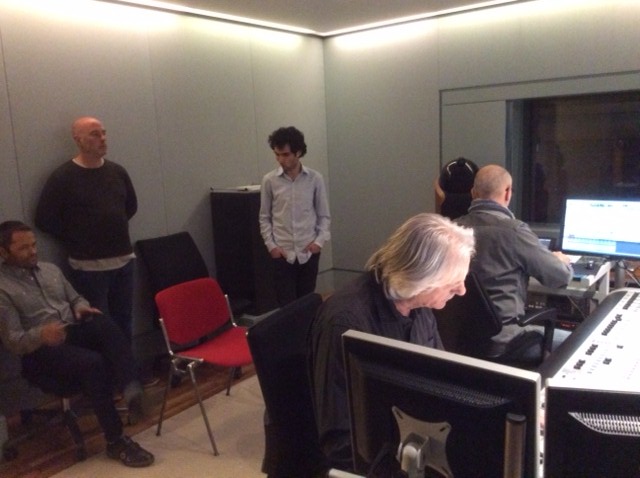
At one point in the mixing (Arve was meanwhile on his way home), Jan Bang very kindly said to Manfred something like this: „Manfred, ahem, I think the intro of Arve was a little bit too long, it was beautiful and everything, but there was a bit too much Jon Hassell in it. Can we make it a little shorter?“
Manfred listened, and then something „quite nice“ turned into something breathtaking: they cancelled the opening part of the trumpet solo, and let – after a while – the trumpet appear slowly out of a fog or a bush of the electronic ghosts Eivind Aarset had created with his guitar. The emotional impact was immense. And I think Jan and Arve are still friends :)
(Drinking water)
A day later Evind Aarset and I sat in comfortable chairs im the Senator Lounge of Zürich airport. We were in a quiet mood, may be a bit exhausted or fulfilled, i dunno. We spoke about our favourite TV series: TRUE DETECTIVE SEASON ONE. Deepest noir, great actors, fantastic soundtrack. T Bone Burnett.
Three weeks ago, I received another noirish piece of art. I listened to its 31 minutes, then I listened again, and again, and again. And again. I listened to nothing else for days. Everything`s stripped down. It´s about seduction, rape, deception, murder, dying, suffocating, loneliness.
And then I heared a fucking egghead commenting this album on air: „Oh yeah, she´s the real thing, the unknown daughter of blues man Robert Johnson, It´s dark, yeah, but it´s groovy. A real feel good album.“
The production is crisp. (…) The producer of Mirel Wagner´s album WHEN THE CELLAR CHILDREN SEE THE LIGHT OF DAY is a member of the extended Punkt family, you don´t expect him here, in a purely acoustic world. Sasu Ripatti, known as Vladislav Delay. „The Dirt“
7) Mirel Wagner: The Dirt
Griot 6 – Stone-cold masterpiece. When it comes push to shove and someone asks me for my desert island journey: Mirel Wagner’s „Cellar Kids“-album or Schubert’s „Winterreise“: Mirel’s record would be part of my trip, for sure. I may now see now some raised eyebrows …
In the same way Tom Hardy said near the end of that terrific movie „Locke“: „If i’ve learned one thing tonight, it’s this: Fuck Chicago!“ – I would say after a lifetime of listening to music: „Fuck canonisations!“
April in London. 2014. Five great days. Living in Guy Sigsworth’s house. Discovering a new favourite Indian restaurant in Upper St. Martin’s Street. Sitting on a deckchair in Hyde Park.
Going underground, a station of the Metro, thinking of Ezra Pound´s poem:
„The apparition of these faces in the crowd,
Petals on a wet black bough“.
Preparing an interview with Brian Eno and Karl Hyde. Memories.
8) Eno Hyde: TO US ALL (LAST SONG) STARTS (the first two minutes are instrumental and shall provide a nice background texture for my reading)
In 2006 Simon Jeffes, the proprietor of the Penguin Cafe visited me in my home in Dortmund. I did the first blindfold test of my life with him. One track I played was Eno’s „Alhondiga“ from his album THE SHUTOV ASSEMBLY. He commented on it something like that:
„Oh, I’m not so fond of electronic music, but this piece has a charming atmosphere, even something haunting. And there is this one sound, ting, that sounds like you´re clinging a spoon at a cup of tea. It’s pure electronic music, but, surprise, I love this one. You know, Michael, I’m dreaming of new worlds for the Penguin Music that might even include electronics. I call it „Organic Garden“. Simon Jeffes was full of ideas. One year later he died of brain cancer.
The last song on „Someday World“ from Eno & Hyde is called „To Us All“. You´re listening to it now. Do you hear the smooth sounds, the incredibly warm, embracing texture? Isn´t it something that reminds you of Children TV programms in the Sixties?
And then the vocals … like pop music before pop lost its innocence, think of the whistling tune of „Winchester Cathedral“, think of Flipper and Porter Ricks and the Monkees on TV … Bygmesger Bob, Lukas und der Lokomotivführer, Peter Pan …
But, well, it´s more of a „lullaby for the end of the world“, there´s yearning, there´s sadness, there´s bitterness in it … As Laurie Anderson once told me: „Eno can be an expressionist“, and I may add, sometimes he can hide the expressionism in a quite disturbing way …
„From the blood that we just we couldn’t spill
From the ones that we just couldn’t kill
We spin a world in a dizzying fall
To see the things that will happen to us all.“
8) Eno/Hyde: To Us All (final part with singing)