Manafonistas

on life, music etc beyond mainstream

You are currently browsing the blog archives for the month September 2016.

Archives: September 2016

2016 4 Sep.

Far away

| Filed under: Blog | RSS 2.0 | TB | 1 Comment


This Faroese is burning the feathers of a Fulmar. I have seen Fulmars on the street not able to fly, because they are too fat. In the Harbour of Tórshavn they sell them beside potatoes. The birdlife is interesting for those, who enjoy watching it. Sunleif Rasmussen, the Faroese contemporary classical composer, finds his inspiration in the nature, especially from birds, when they sing in a choir, while nesting. On my hike today I´ve heard many different sounds, I could get close to a Puffin Group and saw some Oystercatchers. I am afraid of birds.


2016 4 Sep.

Gregor öffnet seinen Bücherschrank

| Filed under: Blog | RSS 2.0 | TB | Comments off

Paul Murray: Der gute Banker


`Ein mitreißender´, okay, `eine hochkomische Betrachtung der Betrügereien, die im Namen der Kunst, der Liebe und des Kommerz geschehen´, das ist zum geringen Teil durchaus richtig, `und wahrscheinlich das lustigste Buch, das über die andauernde Finanzkrise geschrieben wurde´, dazu: habe ich ein anderes Buch gelesen? Es geht um den Klappentext des neuen Romans von Paul Murray, der nun wirklich nicht sehr hilfreich Interesse für ein in der Tat großartiges Buch zu wecken sucht. Auch wenn ich im Klappentext erfahre, dass der Autor 2016 mit dem Wodehouse Prize für Komische Literatur ausgezeichnet wurde, so empfinde ich sein neues Buch – wie übrigens auch den Vorgänger-Roman `Skippy stirbt´ – alles andere als komisch. Viele Ideen, die Paul Murray in seinen Büchern entwickelt, mögen wirklich komisch sein (vor allem sein Erstlingswerk `An Evening of Long Goodbyes´ ist in der Tat komisch), aber deshalb sind seine Bücher nicht einfach nur lustig, vor allem nicht sein jüngstes.- Als quasi Vorfilm zum Buch empfehle ich Michael Moore´s `Kapitalismus: Eine Liebesgeschichte´. Dieser Dokumentarfilm (2009) versucht die Finanzkrise von 2007 zu erläutern, übrigens auch auf sehr humorvolle Weise, aber dennoch sehr engagiert und überaus ernsthaft.


Die Finanzkrise von 2007, die im Herbst 2008 ihren Höhepunkt erreichte, wird in ihrer ganzen Tragweite von Paul Murray für Irland, wo der Roman `Der gute Banker´ spielt, korrekt dargestellt (auch, wenn wir heute wissen: es war alles viel schlimmer). Paul Murray gelingt es unglaublich gut, komplizierte Vorgänge, wie sie die letzte katastrophale Finanzkrise nun einmal darstellt, allgemeinverständlich in eine Romanhandlung einzubinden. In der Tat war es doch so, dass sich die Regierung Irlands in dieser Zeit von der Bank Merill Lynch hat falsch beraten lassen. Bei Murray ist es die BOT, die Bank of Torabundo, die gefälschte Empfehlungen zur Rettung des irischen Bankensystems herausgibt. In ebendieser Bank versucht der Held des Romans, Claude Martingale, sein Glück als Banker. Er, ein gebürtiger Franzose, arbeitet als Analyst in der BOT-Investment-Bank in Dublin. Eines Tages wird unser Protagonist von einem gewissen Paul aufgesucht. Paul hatte vor sieben Jahren einmal ein wenig erfolgreiches Buch veröffentlicht und möchte erneut versuchen, ein Buch zu schreiben. Seine Idee: das Leben eines Jedermann zu erzählen. Paul sieht sich in der Tradition von James Joyce, der in seinem Ulysses einen Tag und eine Nacht im Leben eines Jedermann erzählt hat, Leopold Bloom nannte Joyce ihn und ließ ihn als Annoncenakquisiteur arbeiten. Wer könnte heute dieser Jedermann sein?: ein Banker!, so die Überzeugung unseres Literaten Paul. Nun ist Claude natürlich nicht gleich begeistert davon, von morgens bis abends von einem Autor beobachtet zu werden, um anschließend als Hauptperson in einem Roman zu landen, aber nach längeren Überlegungen und Rücksprachen mit seinen KollegInnen ist er bereit, an diesem Experiment teilzunehmen.

Es entwickelt sich eine witzige, durchaus komische Geschichte, deren weiteren Verlauf ich mich hüten werde, hier zu verraten. In diese Rahmenhandlung eingebettet, erzählt Paul Murray von den Geschehnissen in der Bank of Torabundo in der Zeit der Finanzkrise 2007/2008 in Irland. Dabei stehen die einzelnen Mitarbeiter dieses Geldinstituts für durchaus verschiedene Geisteshaltungen im Bankgeschehen. Da haben wir Sir Colin, Chef der BOT, allerdings gerade gefeuert, hat zwar der Bank dazu verholfen, die Finanzkrise unbeschadet zu überstehen, sei aber viel zu vorsichtig, hätte Angst vor toxisch gewordenen Investments und riskanten Derivaten. Neuer Chef: Porter Blankly. Er war zuvor Leiter einer amerikanischen Bank, die den Crash nur durch ein Fünfzig-Milliarden-Rettungspaket überstehen konnte. Ihn jetzt als Boss der BOT zu bestellen, ist so, „ als ob Sie den Kapitän der Titanic aus dem Wasser ziehen und ans Ruder von Ihrem Katamaran stellen würden“(S.51).

Porter meldet sich bei seinen Leuten gerne mit rätselhaften Mails, die dann die Mannschaft in der Bank eifrig entschlüsselt und deren Inhalt dann unhinterfragt befolgt wird, auch und wahrscheinlich gerade, wenn doch bekannt ist, dass jener Herr es liebt mit Hilfe komplexer Finanzinstrumente die Wirklichkeit in einen Glücksspielautomaten zu verwandeln (S.82).- Ish arbeitet in der Abteilung unsres Protagonisten, sie erinnert sich oft an ihre Vorfahren, die keinen Besitz kannten und den Kreislauf des Schenkens hochhielten. Heute droht ihnen, den Bewohnern einer Pazifikinsel, auf Grund des Klimawechsels die reale Gefahr des Untergangs. Sie wagt es Porter Blankly um Hilfe zu bitten. Dieser tobt („Wer glaubt denn diese kleine Schlampe, wer sie ist?“S.409) und findet in Ish´s Kollegen Howie ein passendes Sprachrohr: „Herrgott, Ish, was hast du dir dabei gedacht? Porter zu bitten, eine Horde Höhlenmenschen mitten im Pazifik zu retten. Hattest du deine Tage oder was?“S.409.

Howie steht für den zynischen Banker ohne Skrupel. Er sieht im Klimawandel erst den Anfang der Katastrophe, was bevorstehe sei der komplette Kollaps der Ökosysteme, Ausbreitung von Epidemien, der Zusammenbruch des ganzen Finanzsystems. Nach Meinung von Howie würde es dann hochinteressant: mit dem menschlichen Elend könne man erst richtig Geld verdienen. „Was soll daran falsch sein“(S.414)? Nach Meinung von Howie wird es Zeit, in Katastrophen zu investieren: „Eine große, mächtige Flut wird kommen, und wir haben das Rettungsboot. Eine Arche für die wenigen Auserwählten, auf der sie sich mit einem Martini entspannen und dabei zuschauen können, wie alle anderen absaufen. Das ist genau das, was sie wollen. Schon ihr ganzes Leben lang haben sie genau das gewollt“ S.415. Und welche Position vertritt Claude Martingale? Wie steht er zu den Ansichten von Porter oder Howie? Ist er der `gute Banker´ oder seine Kollegen Kevin oder Jürgen …?

Paul Murray tritt auch aus der Bank hinaus und beschreibt überaus eindrücklich die Verliererseite des Crashs in Irland, besonders in Dublin und anderswo auf der Welt.

Murray hat, wie der aufmerksame Leser auch schon in `Skippy stirbt´ feststellen konnte, hervorragend recherchiert und eine durchaus realistische Darstellung der historischen Situation der Zeit der Finanzkrise in eine mehr als unterhaltsame Story gepackt. Das ist dennoch alles andere als lustig. Andererseits, welchem Autor gelingt es so, eben durchaus humorvoll, über den Zustand unserer Welt zu schreiben? Mir fällt da allenfalls David Mitchell ein.

Mit anderen Worten: Paul Murray hat nach `Skippy stirbt´wiederum ein sehr gutes Buch geschrieben, ich wünsche ihm sehr viele aufmerksame Leser.


P.S. Wer, wie in Mitchells `Knochenuhren´ Hinweise auf Musik erwartet, wird bei der Lektüre von `Der gute Banker´enttäuscht werden, es wird nur ein einziges Mal Musik erwähnt. Ariadne erinnert in einem Gespräch mit Claude über Francois Texier an das griechische Wort für `Wahrheit´: „Jeder versucht zu vergessen, was er während des Booms gemacht hat. Stattdessen tut jeder so, als wäre er ein Opfer. Das griechische Wort für Wahrheit ist Aletheia. Lethe, das ist der Fluss des Vergessens, also ist die Wahrheit, Aletheia, das, was du nicht vergisst. Aber hier passiert genau das Gegenteil. Die Wahrheit ist das, woran du dich nicht erinnerst.“ „Liffey oder Lethe“, sage ich (Claude), weil mich das an den alten Streit über den Song von `Radiohead´ erinnert.“

Wir erinnern uns: In dem Song `How to Disappear` sah sich der Sänger der Gruppe den Fluss Liffey (Dublin) hinunterschwimmen …. „I walk through walls // I float down the Liffey // I`m not here // This isn`t happening // I´m not here, I´m not here.


Paul Murray: Der gute Banker (Kunstmann Verlag)

2016 4 Sep.

Punktfestival

| Filed under: Blog | RSS 2.0 | TB | 1 Comment

TEXT ONE- Do you trust your music memories, your musical memories? You may or not want to close your eyes. No worry. These minutes flying by are no rip off from a typically 70’s go-lose-your-self-and-come-to-your-senses-session – this happens anyway, from time to time.

Did you know that Joni Mitchell who painted all her masterpieces in the 70’s (a musical power spot, that era!) once met an infamous spiritual teacher, at the American West Coast, Chögyam Trungpa, and she told him about her confusion with love and life.

And, all of a sudden, Trungpa said one thing, did one thing, and for days young Joni was running through the world without her ego. Asked about it, later, she couldn’t place the experience: Enlightenment? Mini-Sartori? The aftermath of drugs still working her brain after a crazy circus tour with Bob Dylan?

Joni Mitchell then started traveling though the USA, afterwards the created the magic of HEJIRA. Quite at the beginning of 2016, I travelled to the Scotish Northwestern Highlands, only a short time after severe rainstorms.

When I sat at the Düsseldorf Airport, I got an email from a good friend, a jukebox collector: David Bowie has died. WHAT? The cover of his album BLACKSTAR, just released, looked down from a lot of walls, and turned into a death notice. In Glasgow, the headline was the most poetical in years: the stars will all look different tonight. The next day I took the train to Thurso, found me some Bed and Breakfast and had weird dreams…

King Creosote & Jon Hopkins: Diamond Mine

TEXT TWO – I breathe in the sounds of the sea and the cold-starred air. The highways, the dead end roads, the cold dark cliffs on the edge of the Highlands. The remains of endless rain give me a warm welcome.

And it all means: no photos anymore, no diary, just slowly letting in the world without filters, blind habits, but – I do have my cultural survival kit, soul food, my carefully selected 4-cd-collection being the only soundtrack, for four days and nights in a row, on the train, in my hired Land Rover with 8-speakers and a great surround sound.

„Darkstar“ , „Astral Weeks“ , „Taking Tiger Mountain (By Strategy), and, the record you have heard while entering the room, „Lord of the Rings“ (from my teenage „evergreens“), Bo Hansson’s classic.

This was all for days and nights to come – embracing the most lonesome areas, the music a lifeguard. The music a second horizon, and from time to time it would keep my world in a nutshell.

The name of town pubs always have familiar names, like they never escaped old Robert Louis Stevenson novels. „Admiral Dirge Crown Pub“. I start to unfold a map of small paths that might lead to some outlook post. Nowhere Land. Faraway places.

Brian Eno: On Land

TEXT THREE – I had another constant companion on that trip, „Beatlebone“, a profound, lovely and disturbing novel by Kevin Barry – the topic: John Lennon in 1978, and his trip to a desolate Irish island. Far from home. Far from love. Tomorrow never knows. Haunted. He encounters a dog and calls him Brian Wilson. He fights inner demons, he hears tracks for a great unmade album.

„– What ́s on your mind?

Not easy to say.

– Love, blood, fate, death, sex, the void, mother, father, cunt and prick – these are the things on his mind.

How many more timeshare they going to ask me to come to the fucking Muppet Show?

He will spend three days alone on his island. That is all that he asks. That he might scream his fucking lungs out and scream the days into nights and screams to the stars by night – if stars there are and stars come through.“

John Surman: Road To St. Ives

TEXT FOUR – Speaking of screaming your fucking lungs out, Trethevy Quoit, from another record that sends you places, John Surman ́s ROAD TO ST. IVES. Inspired by childhood memories, the history of Cornwall. Produced by Manfred Eicher in April 1990.

By the time I arrived at a really deserted house at a cliff near Dunnet Head, another guy, named Darren Hayman, had just finished his travel project which took him quite long – he was traveling through 54 small Engkish towns and ended up with 54 short stories and 54 pieces of music.

PLEASANT VILLAGES VOL. 1 – the name is coined for those villages where all inhabitants sent to the First World War came back alive. Maybe one-legged, traumatized, but alive. Now far away from local patriotism, Darren Hayman wanted to sink deep in the British hinterland. One story.

„Chesil Beach, Dorset, provides shelter from prevailing winds and rain and often pulls away completely from the coast to produce a neat line through the sea.

Langston Herring stays behind above it amongst small lanes and signs that beg you to go elsewhere. PRIVATE LAND – NO ACCESS TO THE BEACH. The pub was closed, and so was the church. So I took the sign ́s advice and walked out of the village along a high windy lane towards the sea.

My friend Mark found a story on a gravestone about four children who died whilst playing near a lime-kiln in 1830. The fumes overcame the four young boys and they quickly perished. We made a song in two parts, one for the accident and one for the funeral procession of 18 children in white.“

Darren Hayman: Pleasant Villages, Vol. 1

image

TEXT FIVE – In Stocklinch, I sat on a church bank with a blank mind, doodling with sounds of an Ipad, feeling out of place and lonely.I was exhausted and possibly having my first doubts about the project. Ros Harding walked into the church and looked me up and down. She had a cloud of white hair and bright, wide eyes. „Would you like come to round my house and have ac heese sandwich?“

They were the most beautiful opening words I ́d heard from a stranger, and right then there was nothing I wanted more than a cheese sandwich. Ros was a church warden. I helped her turn on the gas heaters for the evening service before walking back to her home. Ros told me a story about the upper and lower church and a paintng that travelled between them.“

Darren`s album is a fine example how lo-fi recordings, full of mistakes, noises, accidents can have an extra value in terms of audio verite or old school realism – now Darren Hayman is not religious at all, but he made the experience that churches always offered shelter for him. A place of peace.

Now the next music is recorded in a church, and you immediatley hear the difference, another kind of sound. It has always been branded as the „ECM sound“ (such a term simply igores the fact that this sound has a broad spectrum, and is part of another kind of vision… Recorded a the Toyen Kirke, Oslo, one of my three favourite albums with saxophone player Trygve Seim.

Trygve Seim: Purcor

Peter Broderick: Partners

Rolf Lislevand: La Mascarade

TEXT SIX – In Lugano, in the same studio where tonight’s act with Tigran, Arve, Eivind and Jan had come into being, Rolf Lislevand (you just heard him) performed music of two 17th century composers from the court of Louis 14. le quatorzieme. It was interesting to listen to the music before and after reading the charming liner notes of the artist.

The two instruments he is playing, Baroque guitar and theorbe, were special tools in their salad days. Though the artists had the task to delight the ears of the roi du soleil, the old days ́ user ́s manuals for playing or taming these instruments suggest a constant play with disaster. On the small guitar, every note should sound like a dying note. And the theorbe with its many strings (impenetrable is the word here!) seemingly was made for getting lost when trying to play the right notes.

But instead of listenng to the most miserable music of the world – you hear wonderful ornaments, lines, and even Rolf Lislevand seems beeing carried away by the notion he could – modern studio technology involved – create and simulate his own chateau and enter the halles of Versailles – in the big studio in Lugano!

Now, the answer why this music is utterly beautiful and not a way to drive the eccentric king mad – maybe , it ́s in the title: LA MASCARADE. Everything ́s a kind of hide-and-seek, escaping from darkness with improvisation and soft suggestions.

Creative people living in an envoronment where it is so easy to be happy as it is to be bored set the bar higher. They create risks. As if they had pulled out a card from Brian Eno’s OBLIQUE STRATEGIES, with the clear instruction: „Into the impossible!“

It’s in fact a highy evolved play with failure, similar to, for example, the Beach Boys PET SOUNDS, with all its double bottoms – happiness surfing the surfaces, covering the dark sources. Darker things lurking in the back.

Scott Walker: The Childhood of a Leader

TEXT SEVEN – Days unshaved under grey skies. The only talks were the ones with local pub-owners and poor, haunted, fictional John Lennon. Fell in love with ghostlike echoes of loneliness. Strolling around without any good reason.

Near Dunnet Head, the most Northern point of Brittania, I dicovered a house on the cliffs, not far away from a light tower. Climbed out of the car, shaving my criminal beard, ending the 652nd listening of „Taking Tiger Mountain“ in my lifetime, rang the door bell.

No one there. Went around the house – nothing, took place in a big wooden chair looking over to Orkney Islands, nearly invisible behind curtains of fog. Sat there for hours, big coat, pure amazement. Single malt whisky. Stories falling from the mountains. Heaven is a place where nothing really happens.

Months later, I got a record. Didn’t even know the artist`s name. A friend had sent it to me adding a smile with the cute comment: listen, Michael. this is one of your beloved suicidal albums. I listened, and this became one of my beloved life-affirming records – naked, brutal, isolationist, overpowering, fragile, heartwrenching stuff sending me back to the North.

Ian William Craig: Centers

– TEXT EIGHT – Do you trust your music memories, your musical memories. Any nostalgic modus operandi might be at risk now. I had a dream weeks ago about what seemed to be a „happy-go-lucky“-jukebox, placed on a carefully prepared evening area at a beach on the island of Sylt, a rich holiday resort in Germany.

There was the quiet sea, and, with the distance required, a bunch of people were gathering on the sand waiting for a large jukebox to play its oldies, but goldies. Nothing happened at first. They had had their gambas and cocktails and were happy to see the sunset: we all love our sundowners, don`t we?

They started talking with one another about the songs that soundtracked their lifes. Penny Lane, Sunny Afternoon, Happy Together, Winchester Cathedral, the Fitst Time I Ever Saw Your Face, Thank You For Sending Me An Angel, Heaven – an endless list… Suddenly a women came out of the crowd , and she said something like this:

„You remember the first times musical magic came turning your life upside down with a song. Over night. Out of nowhere. Out of an old radio. No experts around.

„Now do you have the faintest idea what comes close to listening to one of your all time favourite songs for the first time in your life!?Well, what comes very close, kind of, is when you know this will be the last time – the stars all look very different then.

The crowd felt silent.

„How come you may have listened to the following song possibly very often, and though the singer is nearly crying his fucking lungs out singing „you’re all right“ again and again, the key word is DEAD.“

The Kinks: Dandy

2016 3 Sep.

Mein 3. September in Kristiansand

| Filed under: Blog | RSS 2.0 | TB | Comments off


Fast ein Bilderbuchtag. Etwas vom mitteleuropäischen Sommer ist auch hier in Kristiansand angekommen. Schade, dass Manfred Eicher nicht kommen konnte, ein Teil meiner „electronic campfire session“ war auch dazu da, den Boden zu bereiten für das Gespräch eines norwegischen Kollegen mit dem Produzenten. Neben ganz anderen Dingen. Zudem ist Eivind Aarset mit einer Magenverstimmung angeschlagen, und Arve Henriksen muss sich plötzlich um einen verschwundenen Koffer kümmern.

So konnte ich immerhin mit dem frisch verheirateten Tigran Hamasyan und dem in diesen Tagen wohl an massiven Schlafdefiziten leidenden Jan Bang ein Interview im achten Stock des Hotels  machen, unter akustisch nicht ganz idealen Bedungungen, aber in entspannter Stmmung. Seit den Aufnahmetagen in Lugano im Juni 2014 habe ich keinen der Vier wiedergesehen, und das Release-Konzert am Abend war der Magie des Albums nahezu gleichwertig, voller Überraschungen.

Das Foto (s. oben) habe ich nach dem Auftritt der Vier aufgenommen. Ich fotografiere lieber leere Bühnen, in denen noch etwas von dem „Feuer“ nachglüht, als die endlos vertrauten Motive von Bühnenpräsenz feilzubieten. Das Nachspiel von Simon Løvgren enthüllte eine fesselnde elektronische Gegenwelt, mit einer nicht minder spannenden Choreografie des Lichts. Pan Sonic hätten applaudiert!

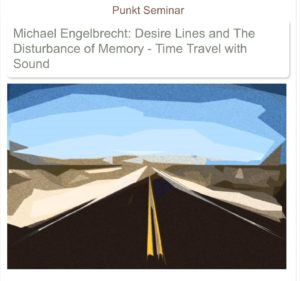
Meine „Vorlesung“, betitelt „Desire Lines and the Disturbance of Memories“, war mein zweiter Auftritt dieser Art beim Punktfestival, und, trotz zweier kleiner technischer Pannen, eine helle dunkle Freude. Ich sah nicht nur einige alte Bekannte wieder, die gute Freunde wären, würde ich sie nicht nur so sporadisch treffen, sondern lernte auch etliche „music travellers“ kennen, von Lübeck bis Seattle, von Lausanne bis Nizza, die sich alle gut auf meine Geschichten von Herumtreibern und Hinterlandbesessenen einlassen konnten (von Joni Mitchell bis John Lennon, von Darren Hayman bis zu meiner Wenigkeit).

Die beiden „Short Stories“ von Darren Hayman las ich in einem speziellen englischen Dialekt, zu dem ich nicht fähig gewesen wären, hätte ich nicht aufmerksam, und in Originalsprache, die TV-Serien „Shetland“ oder „Hinterland“ (!) gesehen.

Beeindruckend war auch Erik Honores Auftritt beim Punkt Seminar, der die Geschichte (und die „Punkt-Geschichten“) von David Sylvian aufrollte, ehrlich, eindringlich. Auch dem Leser dieser Zeilen dürfte aufgefallen sein, wie still es um den ohnehin auf Zurückgezogenheit bedachten Sylvian in den letzten Jahren geworden ist. Aus seinen letzten Äusserungen Hoffnungen auf einen Neuanfang herauszulesen, fällt nicht ganz leicht. Ein Brief etwa, der eine bittere Abrechnung der hasserfüllten Art mit seinem alten Weggefährten Mick Karn darstellt, lässt einen schon leicht zusammenzucken.

Und eine seiner letzten, unveröffentlichten Aufnahmen (mit Jan Bang) ist nichts weiter als ein Gang durch eine Riesenhalle, die womöglich den Charme der brachliegenden Insdustrieanlagen aus Tarkowskis „Stalker“ ausstrahlt, flüchtig belebt von wirrem Rauschen aus alten Luftschächten und defekten Radios. Das alles klingt nach Abschied, doch Erik Honore verweist auf zwei, drei Zeilen eines letzten Textes, der auf anderes hindeuten könnte – ausserdem arbeite DS an neuem Material.

Später am Tag ging ich durch die grosse Einkaufsstrasse, und sowohl Wildfremde wie vertraute Gesichter kamen auf mich zu und verloren liebevolle Worte über meinen Vortrag. Solche Dinge passieren mir nicht mal im Westfalenstadion, wo ich ja auch unter meinesgleichen bin, als Fan von Borussia Dortmund. – Was machst du, wenn du kein Radio mehr machst, fragte mich Malu. – O, das wird nie ein Problem sein. Ich liege auf einer Weide und schaue in den Himmel.

Und, da streiche ich doch das „fast“ aus dem ersten Satz mit dem Bilderbuchtag; wann hat man schon mal die schönste Begegnung eines Tages auf dem Weg zur Toilette in einem vollbesuchten Musikclub!? So werde ich dann doch im nächsten Jahr, wie John Lennon in „Beatlebone“, auf einer einsamen, dann jedoch norwegischen Insel, ankommen, bevor das 13. Punktfestival seine Pforten öffnet. Zumindest eine Spielart von möglicher Zukunft.

The Music (in sequence):
 
01) Bo Hansson: Sagan Om Ringen

02) King Creosote & Jon Hopkins: Diamond Mine

03) Brian Eno: On Land

04) John Surman: Road To St.Ives

05) Darren Hayman: Thankful Villages Vol. 1

06) Trygve Seim/ Andreas Utnam: Purcor

07) Peter Broderick: Partners

08) Rolf Lislevand: La Mascarade

09) Scott Walker: The Childhood Of A Leader

10) Ian William Craig: Centers

11) The Kinks: Dandy


The Lonesome Coast Collection:
 
1) David Bowie: Blackstar

2) Brian Eno: Taking Tiger Mountain (By Strategy)

3) Van Morrison: Astral Weeks

4) Bo Hansson: (see above)


„That was quite a strange Highlands drive you took Michael. I’ve never heard Bo Hansson’s Lord of the Rings and indeed know nothing about it. But what a nice group of albums. I’ve never owned a car in my life, and the only regret I’ve had is that I therefore haven’t been able to drive off into the mountains and listen to music. There’s something about the confinement and concentration of a car interior that makes it an especially good place for listening. I think it’s also that the music really occupies the space of the car three-dimensionally, so you’re really inside the experience ( – it’s not happening on a sort of stereo ’screen‘ in front of you). / I also love David’s last album. In the light of his death it becomes quite heroic that he got it done. He wrote to me a few days before he died … we had been talking in the last couple of years about revisiting the album OUTSIDE which was a sort of unfinished project. Or perhaps I should say a ‚half-finished‘ project. It’s clear to me that he knew he was about to die – and that he decided to be as active and creative with it as he would with any other piece of art. Very inspiring. / Have you heard Julia Holter’s new release on Domino Records? It’s very impressive.“

XXB


The Books:
 
1) Kevin Barry: Beatlebone

2) Robert Macfarlane: Places of Wilderness
 
 
The Movie:
 
„From The Sea To The Land Beyond“

(a documentary by Penny Woolcock on hundred years of coastal life in Great Britain; music) 


Flughäfen sind Zeitungsparadiese …

It’s an old saying that music is sending you places, great music to very special ones. We’re all time travellers when it comes to deeper listening. Nevertheless dejavues and old ways are all around us. Call it postmodernism. Distant decades even ring a bell when you’re listening to the most recent hot or cool stuff. But if we do follow our desire lines, we’re not trapped in the advertising of the extraordinary and canonical – we’re back on „boogie street“ (from downtown to the wilderness). Our memory may easily skip from nostalgia to disturbance, from telling old stories to simply changing the stories. What has all been fixed in history books (or the comfort zones of your mind), is losing its power, becomes purely academical. In this slightly hypnotic lecture (beware of a trained psychologist and music journalist in a rather dark room!), a genre-defying collection of broadly Norwegian and British music spanning several decades will be placed in different settings and tales, from desolate areas at the Northern coast of Scotland to the fully air-conditioned studios at the RSI, Lugano … (the play- and booklist can be found here, on Sept. 3rd).


image


This introductory text for my „campfire lecture“ at PUNKT was the inspiration for the poet and one-time-Eno-collaborator Rick Holland („Pattern Man“) to write this mini-essay about our „taxonomic systems“ and the way magic can transcend them. He only used one expression from my text, „boogie street“, and that’s the only thing I had stolen from another poet, Leonard Cohen. In writing mode, Rick delivered quite an interesting list of singers and song writers, and again, a funny coincidence: I’ve been crossing ways with John Lennon on my trip northwards, while Rick had an epiphany (kind of) with an old Beatles aka Paul McCartney tune. (M.E.) 


The dominant strands of the history of western thought (also known as „History“) focus on attempts to suspend the uncapturable in amber, and give it a name that relates it to other names, to classify and control it.

A society whose culture and counter culture exists like taxonomy (and whose means of control is linguistic) maintains control by reviewing and classifying, often labelling escape in value terms (the devil’s music, ecstasy, mania).

What about the counter-culturalists, the songwriters? To survive, must they not find a reliable way to „repeat the act“? To breathe life into the amber, while also ensuring it remains controlled enough to summon at the right time, on demand. To persuade people to come and join the live ritual or to record a version of the magic that we can replay whenever the feeling takes us, or link into in radio friendly bite sized versions.

And where do we go? Where do we escape from? Are there layers of pleasure and different kinds of release? One viewpoint suggests we need to be led into the experience, slowly and gradually, like the ecstasy that descends when we lose ourselves and achieve flow.

Once there at the fabled „place“ (and on the journey there) syncopations play on neural fields like a harp, and happen upon accidents of harmony and tone that can play off the mental room you sit in right at that moment as if all is in sync. A lyric or a melodic line can send you joyfully away, in a never-to-be-identically-repeated concoction of ingredients.

The anticipation, and all of the half-happenings or suggestions along the way, our expectation, this too is pleasure isn’t it?

And does our relaxing into the discovery of this lead us to the next room as listeners? Does it matter what the ingredients are? Do we need to have developed skills of listening over years and decades, or do we just need the time and space to really listen? To answer these perhaps we look at our first musical memories, the first times the magic came to visit; when was it that simple?

The truth is, we enter that place at something as simple as a stick hitting a cardboard box (Buddy Holly – „Not Fade Away“).

If that sound becomes a „mechanical groove“ (thank you Fela) and we free ourselves to it, everything we can possibly imagine becomes possible.

My earliest musical instincts – as now – are a mixture of mechanical groove or heartbeat and, emergent from this, a human wail (probably in words) so ecstatic as to have never been found, or surprising with its race of image and sound.

There is no line in Harry Beck’s genre tube map to get there, but you could put your finger on some of the stops you might get off at to try and find it.

It is from the ever emitting hub. The DMT producing hub of the brain perhaps, our natural awareness of life and death in chemical form.

Indeed, Elvis sang „my heart beats so it scares me to death“ and my six year old self played and replayed it, wishing he could always sing with that release (I didn’t know hindi prayer songs existed at that time, or Konono No 1).

So, pop songs as transporters. Really great pop songs. Can they really transport in two minutes? The Silhouettes „Get a Job“ suggests so, Maurice Williams & the Zodiacs „Stay“. Recently I have been playing and replaying „Blackbird“ just for the line „Into the light of the dark black night“ which seems to me a line utterly co-opted from ancient cultures and the black american experience, placed incongruously in the structure of a western commercially framed album pop song (based on sequences written by Bach in fact). It fascinates and owns me though, I want to repeatedly escape with it from the relative mundanity of the rest of the song, and life.

Most pop songs take a few plays to become great in your brain. Perhaps then, the mechanical groove principle still stands, even in an artificial two minute ‚pop‘ song, as an instant gateway that – once the method of it has settled in your mind – can be triggered in the instant it is heard, as though it has been kept half alive and can be accessed quickly. I think of listening to a mix of Alicia Keys‘ „No-one“ on every bus I travelled on in Eastern Africa in 2009. Instant transportation, for everyone, all over Zambia, Malawi, everywhere it seemed.

This has obviously been studied by labels and producers (west), as well as griots, religious musicians, and adapted to the formats available and favoured by cultures at the time, to transport listeners to another, highly suggestible plain.

But „that place“ or „boogie street“ is not an awards show. It may have slotted in to a society of hierarchy and contexts, but a busker can crash into your inner world right there as you walk round a street corner, no transaction needed there except for attention (although our instinct is still to pay for that experience, but that is another story).

Where do we escape to? Where do we escape from? Perhaps we hold in mind the instinctive slapping of bare feet on dusty ground, drums and sweat. Perhaps our ecstasy is more cerebral and we imagine ourselves alone with it. Either way, it is arguably our most valuable gift. Arguably without it we die outside commune, with it we join and transcend.

As Bob Marley said, „this could be passed through me or anybody“.

Call it what we will, carnal desire, god, transcendence of self, groove, this thing is not for taxonomists. This is perhaps the revolution that is bringing down the walls we have all lived behind, however consciously, that the magic will not stay in amber, because it is everywhere.


2016 1 Sep.

Hubro im Herbst

| Filed under: Blog | RSS 2.0 | TB | Comments off


image


2016 1 Sep.

O

| Filed under: Blog | RSS 2.0 | TB | Comments off

O, November,
Du unansprechbarer Monat,
Möchte mit dir und einer
Perlmuttlackierten Schwarzhaarigen
An einem Grab hocken,
Aus dem Ghettoblaster
„Chairs Missing“ hören,
Später dann – ahhh –
die Braungebrannte
Bis zum Morgencappuccino
Vögeln – und heiraten, standesgemäss,
In Las Vegas!


Manafonistas | Impressum | Kontakt | Datenschutz