Manafonistas

on life, music etc beyond mainstream

Ein treibender Rhythmus reißt die Tür auf ins Iron Paradise, wo die vom Mond Besessenen (so der ursprünglich geplante Titel des Albums) seit Ende der 80er Jahre warten mussten bis ihre archaische, ungefesselte Energie wiederveröffentlicht wurde. Ein Gemeinschaftsprojekt von Midori Takada, die uns dieses Jahr bereits ein Reissue des Monats lieferte, und Masahiko Satoh, die Lunar Cruise nach einer intensiven Auseinandersetzung mit afrikanischer, arabischer und traditioneller asiatischer Musik nach einer Tournee durch Afrika, den arabischen Raum und Europa im Studio einspielten. Ganz organisch verschmelzen hier Stammesrhythmen mit asiatischen Melodien, Jazzelementen und einem sehr eigenwilligen Synthesizerspiel zu einer Weltmusik, die an subtiler Programmatik und Kompositionsfertigkeit ein würdiges Pendant zu Jon Hassells gerade erst reflektierten Schaffens darstellt.

Während wir bei Through the Looking Glass noch in einem Sushirestaurant weilten, sitzen wir nun im Weltcafé Nahm, einem Ancient Palace, in dem die bunten verzierten Bodenfliesen einen Rhythmus vorgeben, der beim näheren Hinschauen in A Vanished Illusion übergeht, zu dem eine bizarre Jazz-Tahine serviert wird. Jyomuran transferiert einen afrikanischen Puls in den japanischen Winter (hierzu wird ein traditioneller japanischer Cocktail serviert, in dem kleine lebende Quallen mit einem Schuss Alkohol zum Leuchten gebracht werden) und Monody liefert einen verhuschten Stammesbolero hinterher. In „D“ wird Terry Riley zitiert, um dann schrittweise zerfallen zu dürfen und in Madorone im Nebel eines nur scheinbar süßlichen Shisharauches auf der abgenutzten Ottomane abzudriften. Die Faszination des Reduktionistischen beginnt in Chang-Dra auf einem Blech zu tanzen, durchläuft wellenförmige Eskalationen gleich einem uralten Drachenritual, zu dem vermeintliche Gewissheiten ins Opferfeuer geworfen werden. Nun sind wir bereit zum finalen Lunar Cruise, der letzten Reise der Mondsüchtigen, die mit kristallinen Jazz-Pianoklängen, Marimbatremolos und unirdisch leisen Halbgesängen verklingt. Stille ist es jetzt, nur der Mond leuchtet, halb wolkenverhangen, Spuren noch wie ein vergessener Wegweiser in mein Schreibzimmer …



craziness is holy“
 

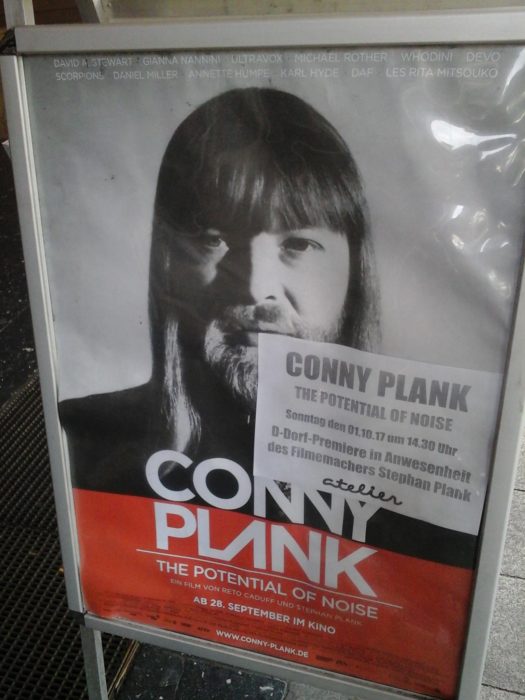
Stephan Plank hat einen Film über seinen berühmten Tonmeister-Vater gedreht. Er wurde heute in Anwesenheit des Produzenten in Düsseldorf gezeigt. Der Film beginnt mit einer Szene in einer Spielhalle in Tokio, im Hintergrund läuft Brian Enos Music For Airports, im Vordergrund steht Conny und sagt: „Alle Geräusche können in Musik verwandelt werden, wenn es gefällt, ist es gute Musik.“ Brian Eno war nie in seinem Studio nahe Köln, in Wolperath. Die beiden haben sich 1977 in New York getroffen. Eno gab dem Sohn ein langes Interview, das demnächst in dem Buch von Stephan Plank zu lesen ist. Conny und Brian sind Wesensverwandte: revolutionär, geistreich, regellos, der Suche nach neuen Klängen für die Welt verpflichtet.

Stephan machte sich auf eine lange Reise, um den Weggefährten seines Vaters Fragen zu stellen. Annette Humpe antwortet am einfühlsamsten. Der Vater sei eher abwesend gewesen, immer am Mischpult. Auch Gianni Nannini sagt, dass er sich wenig um seinen Sohn gekümmert hätte. Er sei wie sie ein Elefant gewesen, der immer auf der Suche nach dem richtigen Groove war. Alle Interviewten bewunderten Conny. Für seine perfekte Arbeit am Mischpult, für seine grandiosen Einfälle zu ihren Werken, ohne sich je einzumischen.

Conny Plank war für Kraftwerk auch als Produzent von entscheidender Bedeutung. (Wie nachlässig, nicht zur Premiere in der hometown aufzutauchen.) Conny ist es gerade mit ihnen – aber auch mit Neu, mit DAF, mit den Scorpions, mit Humpe und Humpe, Harmonia – gelungen, den Sound of Westdeutschland zu kreieren. Auch mit der wunderbaren Christa an seiner Seite. 1987 starb er mit nur 47 Jahren.


Hubro is my label of the year, this time. Andreas Meland is the man in the background. A programm of excellent, very good, and  good works that, in 2017, even surpasses last year’s output of a Nordic / Norwegian spectrum between free improvisation, chamber folk, electric wilderness, altered states of mind & sound, minimal drone studies, post-exotica, songs & sounds & atmospheres. They even put out an album by the band aptly called „1982“, including a church organ being deprived of all its gravitas.

Now Erik Honoré’s second Hubro album ist out, „Unrest“, and, as he has told during bis lecture in Kristiansand about making music in dark and turbulent times, he sees it as the „dark-eyed sister“ of his excellent first solo album „Heliographs“. In fact, it’s  a shadowy affair, with a spoonful of atonality and testing the limits of high-pitched violins, free floating, slow piano runs – and a theatre of voices, hiding,  murmuring, wondering. Not to forget „The Sheriffs of Nothingness“!

Erik Honore and his companions (yes, a great cast!) know how to build up suspense and release, and the sequence of the tracks is immaculate. You have to listen to it as an album, and, if you want to do yourself a favour, in the dark. While being immersed, you’ll easily be haunted by the thrill of dissonant textures, well placed grooves and swirling melodic lines that happen when you least expect them to appear. The last track is the perfect closer, an apparently simple song with an irresistible tune. And, well, part  of the magic of Hubro albums is the cover art of Yokoland (Aslak Gurholt and Thomas Nordby) – for „Unrest“ it works as warning sign – and invitation!


2017 1 Okt.

„Power Spots“ – Mellrichstadt / Dartmoor

von | Kategorie: Blog | | Comments off


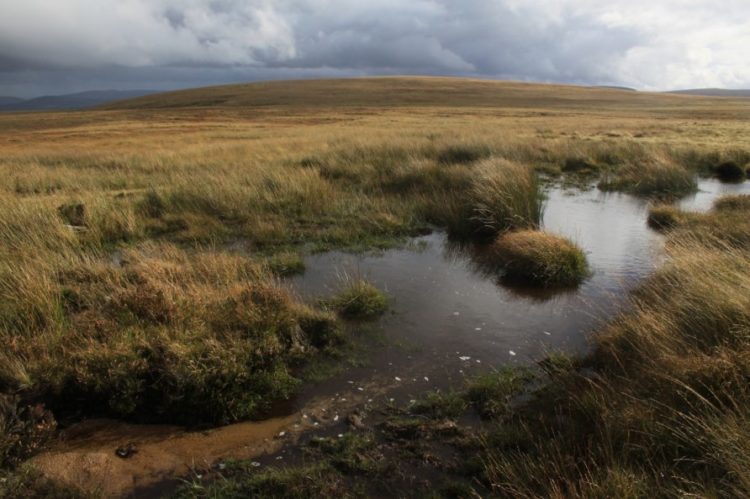
Within the fields of existential, or possibly pagean experience, or even occult spirituality, different physical locations are believed to be holy / existential sites because they possess an access to spiritual (resp. a certain, rarely unearthed human) energy. Common power spots often include mountains, caves, springs, the (often) windstill areas of small village backyards (Mellrichstadt!) – and other locations of unusual natural phenomena.

Recognized power spots are places that intensify whatever people bring to them, so that spending even short periods of time in them can lead to spiritual / existential transformation. Carlos Castaneda was a devoted searcher of power spots. „Power Spot“ is the name of a fantastic record by Jon Hassell, too. Though often connoted with holy places, power spots can sometimes be hardly recognized by their quite ordinary appearance (photo 1).

A good aquaintance of mine nearly lost her life in Dartmoor weeks ago by foolishly undererstimating certain power spot features of an area officially marked with signs of danger. She (a trained post-Freudian therapist) was even warned to enter the moor by a small, „strangely looking“, old woman, but downplayed the advice by thinking she would be kind of foolish. She wasn’t. The result: my aquaintance was white like a ghost after returning very late – for more than half an hour, she thought, every step could be her last.


In my memory, it was a hot summer afternoon in Schwabing, 1981. There was a record shop in the underground, and I remember, on my regular visits to the city, to stop by and look for exciting new albums. And I remember at least two records I bought there, Egberto Gismonti’s „Solo“ (the material on the cover had a special feel), and Jon Hassell’s „Dream Theory in Malaya“. Both stayed with me ever since.

I had my special Hassell experience, when nearly diving into „Possible Musics“, the Hassell-Eno-collab from the year before, on a never-ending bathtub session in Würzburg, all candles on! So, to hold this album in my hands (I stumbled upon it, didn’t read anything about an imminent release), to look at the surreal Mati Klarwein cover, to see the names of Eno (gongs, bells, bass) and Lanois (mix) on the backside – that all was the perfect ticket to ride.

And this was my first contact with the world of lucid dreaming, Jon Hassell’s story about anthropolgist Kilton Stewart (dating back to 1935, a golden era of Malaysian life, before brutal colonialism left its marks) made it very clear that Freud’s dream theory urgently needed some up-dates from the everyday culture of distant, ancient tribes. Two years later I became a serious student of lucid dreaming, had read the standard books of Stephen LaBerge and Prof. Tholey (the German pioneer).

In this quite short span of time, between early 1981 and early 1983, I lived in a tiny village in the Bavarian wood. This was hard stuff for a townie, and, playing smart Alec, I tried to learn my lessons  from Henry David Thoreau. In fact, I learned more from a bunch of records, and „Dream Theory of Malaya“ belonged to the top of the pile. Now, the re-release of the album contains an extra-track, „Ordinary Mind“ (a quite misleading title for such an oceanic piece), offering, 36 years later, an undisputable, perfect ending of that classic.


P.S.: To work as a psychotherapist in Furth i.W. with alcoholics in the early ’80s, following a well-planned research program based on modern extensions of behaviour therapy, seems like a decent first stage of a career in psychology. On the countryside. Looking back, it was a heaven-and-hell ride, including secret road maps, love and desaster, witches and shins and hypocrites, mushrooms, dragons and, well, volleyball. Not to forget the first, very raw album of the Go-Betweens, „Send Me A Lullaby“.

„Scary stuff usually seems tamer in retrospect; Hassell’s masterpiece is ever more shivery and fraught, a perfect soundtrack to mad and bad times, and not in the slightest consoling.“

(Brian Morton, The Wire)
 

„When has Jon Hassell painted his masterpiece? There’s more than one actually. Certain shades always prevail, the twilight zones for sure, with their  sense of threat, otherness and lost paradise.“

(MHQ)


2017 29 Sep.

Hans Zimmer meets Radiohead

von | Kategorie: Blog | | 3 Comments


v i d e o


2017 29 Sep.

Mellrichstadtblues

von | Kategorie: Blog | | Comments off

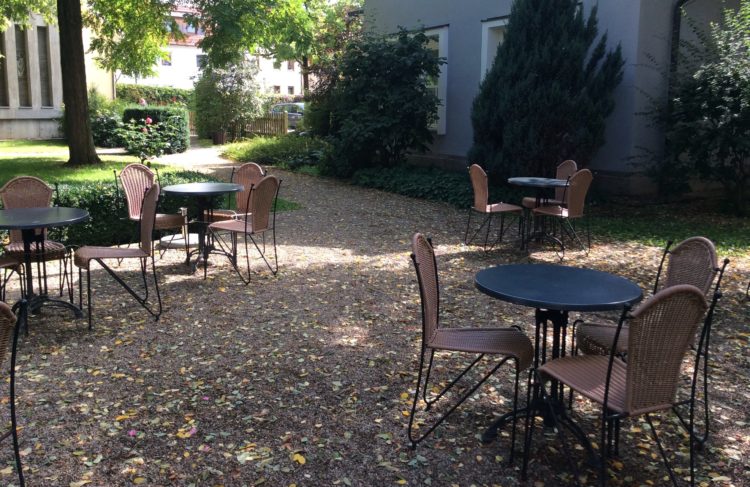
Ich wäre noch tiefer in die Rhön gefahren, aber nach der Begegnung mit einigen Pilzsuchern in teilweise Handke’schem Outfit (habe ich je verraten, dass Pfifferlinge meine Lieblingspilze sind?), und einem Besuch einer geschätzten Lautsprechermanufaktur, wollte ich nur noch meine 800-Kilometer-Tour durchziehen, als ich plötzlich doch den kleinen Hunger verspürte. Leider hatte das leise vor sich hin sinnierende Örtchen Mellrichstadt schon am Mittag Marktplatz und Bürgersteig hochgeklappt, und es bedurfte einiger Pfadfindertugenden, noch eine offene Pforte ausser der des lokalen Beerdigungsinstitutes zu finden. Wenn alles so herrschaftlich ausgestorben scheint, fällt noch rascher auf, was für eine Stimmungskanone ich sein kann. Also ergaben sich, im gewitzten Dialog mit der Diensthabenden eines kleinen Museumscafés auf der Hauptstrasse, die auch Hinterlandstrasse hätte heissen können, ein paar Einblicke ins fast völlig zum Erliegen kommende Treiben ringsum. Lugte die Sonne mal kurz durch die Wolken, wurde es richtig warm, und ich ertappte mich dabei, uralte italienische Schlager hören zu wollen („mit der süssen Vera an die Riviera“). Isabella stellte dieweil Stühle im kleinen Hinterhofgarten auf. Sie erzählte von Senioren, die regelmässig kämen, mit treuen Hunden, und diese „Oase der Stille“ geniessen würden. Mittlerweile war mein Traum von einer fangfrischen Forelle ausgeträumt, ich gab mich mit einem Stück altdeutschem Käsekuchen zufrieden, schoss noch ein Foto von der von jedem Windhauch befreiten Idylle des Hofes (die Alten würden sicher bald herbeiströmen, die Szenerie in ein Konzert von Kuchengabeln verwandeln, ich hatte schon mein Solo) – und machte mich, nach erstaunlich munteren Abschiedsworten, auf den Weg. Am Rand nahm ich noch wahr, wie verriegelt die Dorfpizzeria war (ein Schild mit der Aufschrift „GESCHLOSSEN FÜR IMMER“ hätte mich nicht aus dem Gleichgewicht gebracht) – doch erst im Nachhinein wurde mir klar, wie leicht ich hier, am Ende der Welt, die Zeit hätte anhalten können. Ein idealer Ort für Liebende und Verlorene. Hinter der Ortsgrenze hiess das erste Lied, das ich hörte, „Hawai“, von Neil Young, er sang es 1976, in einer Sommernacht, auf seiner kleinen Ranch nahe Malibu.

2017 28 Sep.

Maarja Nuut auf dem Düsseldorf Festival

von | Kategorie: Blog | | Comments off


Skydeck, 19. Stock im Düsseldorfer Hafen. In einer Rechtsanwaltkanzlei. Was für ein F (f)all!

2 Violinen and all these loop tabs.

And there she is: Maarja Nuut. Sie ist jung, hübsch, sehr schlank, hat Birkenherbstblätter Haare und graublaue Ostseeaugen.

„UNE MEELES“ heisst ihre neue, zweite CD auf Estisch – und wie auf Deutsch? Auf Englisch klingt das nach luzider Traumerfahrung:“ In The Hold Of A Dream“ … In dieser Welt lebt sie im Norden von Estland. Was ist Ihr Geheimnis? Maarja steht -singt, geht-spielt, tanzt-erzählt auf der Bühne. Ihr Aschenputtel grauer Plisseerock wirft Wellen über ihren Goldschuhen. Ihre Stimme schaukelt wie eine rostige Barke. Wie macht sie das? Sie erzählt auf Englisch ein Märchen aus den Wäldern von Estland und verwandelt sich selbst dabei immermehr mit ihrem Violinspiel in Cindarella. Sie summt, sie dront, sie steppt und loopt sich selbst in die nächste, offensichtlich traurige Geschichte, mit einem Gesicht, das an Liv Ullman in „Die Stunde des Wolfs“ erinnert.

Maarja baut ihre Musik interessant zusammen. Sie schafft allein durch Hauchen ins Mikrofon einen Klang von leichter Brise, loopt ihn, zupft ihre Geige und spricht wie zu sich selbst, bevor sie mit ihrer betörenden Stimme anhebt. Ihr gelingt es mit minimalistischem Einsatz einen großräumigen Echosound herbeizuzaubern. Wer Maarja Nuut in der weiten Musiklandschaft entdeckt, sollte sich von ihr hypnotisieren lassen.


Lanzarote, eight o’clock in the morning, October 10th (!) – Papagayo Beaches (we’ll meet on the second bay from the right side, be careful while climbing down – this happens in collaboration with the former head of the festival Musica Visual de Lanzarote)

The sandy beaches are a unique natural feature between mighty lava rocks. You can drive by car almost to the beach itself. For the more ecologically inclined, a walk over the hills will bring you to one of the many bays. You won’t need a bathing costume here, but you will need water to drink to take with you. Little bars and snack restaurants are only on the hill next to the last parking area at the end of the dirt road. 

… the weather will be fabulous, the sea another invitation … swimming, talking, scrambled eggs with canarian potatoes … part of the morning program will be a deep listening session of Lucinda Williams‘ re-recording of her old time album „Sweet Old World“ – and a brand new interview with her (to be listened to on smart, waterproof  UE BOOM boxes drifting on the surface of the sea nearby.) She talks on  childhood, re-visiting the past, and the ghosts of Highway 20.

This is definitely no joke, but Ildefonso (the special guest) and me might be the only ones regarding the short time of preparation. Just check your time resources. Unexpected guests are welcome, too. It never rains in Southern Lanzarote. I will stay there between Oct. 8 and Oct.15. – and live in a house by the sea that César Manrique built.

In the early years of the century I was the go-between between the Deutschlandfunk (Harald Rehmann’s jazz- and far-out-of-jazz-department) and the annual festival, buying the best concerts from the caves for broadcasting, and meeting beloved musicians, David Darling, Eberhard Weber, young Christian Wallumrod, Arve Henriksen (who, in a hotel in Costa Teguise, invited me to come to the first Punktfestival of Kristiansand) – Bang on a Can performed „Music For Airports“ – and Brian E. did a live-concert at the bottom of a volcano. „Asanti habari habari habari / Asanti nabana nabana nabana“ … 


Manafonistas | Impressum | Kontakt | Datenschutz