Manafonistas

on life, music etc beyond mainstream

You are currently browsing the blog archives for the month Februar 2018.

Archives: Februar 2018

2018 8 Feb.

Defining ambient

| Filed under: Blog | RSS 2.0 | TB | 2 Comments

How do you define ambient?

The closest I could ever get wasn’t really a definition, more a kind of description of one of its occasional attributes: that it’s not easy music to hum along to. There’s too much space in it, and the space is where the magic happens.

So, reading this ambient piece on factmag.com, a piece of the jigsaw puzzle fell into place:

The composer and the listener must recognise that total control can never be realised and the identity of the music is never wholly owned, but rather it is constantly becoming. Upon each re-visitation, in a different place, at a different time, through a different playback situation, the music evolves. It lives within the complexity of these relations and is primarily about, to use Eno’s initial provocation, “to accommodate many levels of listening attention without enforcing one in particular”.


Sometimes an artist just sneaks up on you. You know about him, listen to him on different recordings, and one day, you just realize just how special he/she is.

I first became aware of Marc Copland on Songs Without End, a 1994 duo album with Ralph Towner. Copland was the perfect partner for Towner’s evanescent guitar. It’s not always easy to find that balance between piano and guitar, two chordal instruments that share a lot of the same sonic space, but these two found more than balance – they found the creative flexibility to sound almost orchestral, not just avoiding stepping on one another’s toes, but finding a synergistic platform that goaded each of them on, a good example being their interpretation of “Nardis,” which ascends to greater heights with every chorus.

When I think of Copland’s playing, words like elegant, understated and lyrical come immediately to mind. Copland uses his head and thinks on his feet, yet never loses touch with his heart, making for an appealing listening experience that is at once both intellectually stimulating and emotionally compelling. Although he continued to record through the 90s and into the new century, I lost sight of him until he began recording on the ECM label with John Abercrombie. Abercrombie found the perfect foil in Marc Copland. The two seemed to have a telepathic connection, and Copland delved deeply into Abercrombie’s obtuse harmonies. He was on only 2 quartet albums with Abercrombie on ECM, 39 Steps and sadly, John’s very last album, the stunning Up and Coming (easily of the best albums of 2017.) Both are essential albums for any lover of contemporary jazz.

Copland is one of those pianists who is forever on the road to new discoveries. He never seems to go for the obvious thing; he is simply incapable of playing a lick. A supple and elastic player who can be surprisingly muscular at times, he is also one of the most melodic pianists on today’s scene. He is one among a shortlist of players who, over the years, have honed their unique voice in an overcrowded field of post-Evans sound-alikes.

After rediscovering Copland, I was dismayed that there were only two albums of him with John Abercrombie. Or so I thought – then I happily discovered there are earlier associations with Abercrombie that go all the way back to 1990. I recently spent an unnaturally warm winter afternoon cycling to Sebastopol, listening to Marc’s album Another Day (Pirouette-2008) which features Abercrombie, Drew Gress, Billy Hart, and it’s every bit as rewarding as either of the ECM quartet albums. (Incidentally, there’s also a duet album with Abercrombie, titled Speak to Me, which I am trying to get ahold of.)

I also discovered Alone, one of several solo titles on his Pirouet label. Nestled between reimagined standards such as „Soul Eyes“ and „I Should Care“, are completely reharmonized versions of three early Joni Mitchell tunes, „I don’t know Where I stand“, „Rainy Night House“ and „Michael from Mountains“. Not many jazz pianists are drawn to folk artists for inspiration, but here Copland finds a lot of play with. Above the subtly applied dissonance and metallic voicings, it’s all about melody. In her early days, Mitchell wrote beautiful melodies and Copland finds much to dig into. His originals, such as the mysterious „Night Whisperers“ and the evocative „Into Silence“, fall nicely between the cracks.

I discovered another gem on TIDAL, an album he made with the late Michael Brecker, entitled Marc Copland And … It’s a real find. Oddly enough, the aggressive post-bop sound that characterizes much of this recording is punctuated by three distinctly different versions of Paul Simon’s “Old Friends”. Each of his reharmonizations of one of Simon’s most heartfelt tunes is a little miracle.

Another association worth mentioning is the collaborative trio with Abercrombie and Kenny Wheeler. They made two excellent albums for the Challenge label, Brand New (1999) and That’s for Sure (2008.) It’s a treat hearing these masters laying down Wheeler and Abercrombie tunes in an intimate trio with no drums or bass. Both are well worth picking up, especially if you’re a rabid Wheeler fan, as I am.

Before closing, I must also mention the Gary Peacock Trio, whose album Tangents was one of 2017’s best trio releases. I saw them in concert last spring at SF Jazz ECM festival, sadly in a way, because the Abercrombie Quartet had originally been scheduled, but John was quite ill and had cancelled his west coast tour. It was an incredibly dynamic performance, and one of the highlights of my concert going adventures last year. It was my first time seeing Copland live – a powerful and moving experience. Copland manages to be both delicate and visceral, his flowing lines fly like magical arrows that always hit their target.

At times I hear a little Richie Beirach, other times I hear the late John Taylor, yet the more I listen to Marc Copland, the more I hear Marc Copland. I’ll be exploring his back catalog for many years to come.
 

[Footnote: there’s a new trio album called ECV, with guitarist Roddy Elias, Copland and bassist Adrian Veddady that I’ve been hearing good things about. John Kelman reviewed it recently on allaboutjazz. Will report back after I live with it a while.]


Damals hieß er noch Südwestfunk, der SWR, als Achim Hebgen mit gerade einmal 27Jahren in die Jazzredaktion des Senders eintrat, Joachim Ernst Berendt war sein Chef. Wie Berendt, war auch Hebgen nicht nur am Sender tätig, sondern bei zahlreichen Musikproduktionen beteiligt, bei MPS zum Beispiel. Die wunderbare Platte „Got The Blues“ von Don `Sugar Can´ Harris (mit Kriegel; Rypdal, Dauner, Whitehead und Robert Wyatt!!) wurde von ihm und Berendt gemeinsam produziert. Er arbeitete ferner bei den Berliner Jazztagen, dem Free Jazz Meeting Baden-Baden und den Donaueschinger Musiktagen mit.

Ich erinnere mich, 1978, in einer seiner Sendungen zum ersten Mal von Philip Catherine gehört zu haben, auch legte er gerne Gianluigi Trovesi auf, den ich durch seine Sendungen zu schätzen lernte. Übrigens, dessen Album „Round About A Midsummer’s Dream“, wurde im Jahre 2000 von Hebgen produziert.

Achim Hebgen liebte, wie Michael Engelbrecht, Sendungen mit weitem, sehr weitem Horizont, er erfand für den SWF die Sendungen RADIOPHON (noch heute im SWR zu hören) und MUSIC AVENUE.

Zwischen 1991 und 2002 leitete er dann die Jazzredaktion. Das waren schwierige Zeiten damals, denn SDR und SWF wurden 1991 zur Fusion ihrer beiden Kulturprogramme gezwungen, aus SDR 2 und SWF 2 wurde dann S2 Kultur. 1998 entstand dann ein neuer Großsender, der SWR.

Als 1990 klar war, dass dank intensiver Untersuchungen der amerikanischen Wirtschaftsberatungsfirma McKinsey, die beiden Kulturprogramme des Südens aus wirtschaftlichen Gründen zusammengelegt wurden, da verabschiedete sich Achim Hebgen tief enttäuscht von dieser kulturellen Entwicklung während einer seiner Sendungen sehr persönlich. Über 60% der Jazzsendungen seien dem Rotstift zum Opfer gefallen, zahlreiche Sendeplätze aus dem Bereich NEUE MUSIK ebenso, auch das Format MUSIC AVENUE. Während der letzten Sendung der MUSIC AVENUE beklagte Hebgen öffentlich diese Entwicklung und legte dann eine Platte auf, die diese Sendung für immer beenden sollte. Diese letzte Platte hatte es mir damals angetan. Überhaupt, der Gedanke, einmal eine letzte Platte, ein letztes Musikstück zu hören, welches Stück könnte das sein und wird es dann letztlich wohl sein?


Peter Rühmkorf schrieb am 13.12.1989 in sein Tagebuch: „Eigentlich schade, wie viele Bücher wie einmal unaufgeschlagen an der Grabeskante zurücklassen müssen …“. Recht hat er, ich bedaure das auch schon jetzt. Mir fällt allerdings noch ein anderer Gedanke dazu ein: „Wie viele Musikstücke müssen wir wohl ungehört an der Grabeskante zurücklassen?“

Zurück zu Achim Hebgens MUSIC AVENUE und zurück zu seiner letzten Schallplate in dieser Sendung. Er legte eine Schallplatte von John Surman auf: „Road to Saint Ives“ und wählte das Stück „Tintagel“, ein Stück, das seit vielen Jahren zu meinen liebsten zwanzig Stücken gehört (meine Lebenshitparade).

Achim Hebgen starb am 25. September 2012 in Freiburg, er wurde 69 Jahre alt.

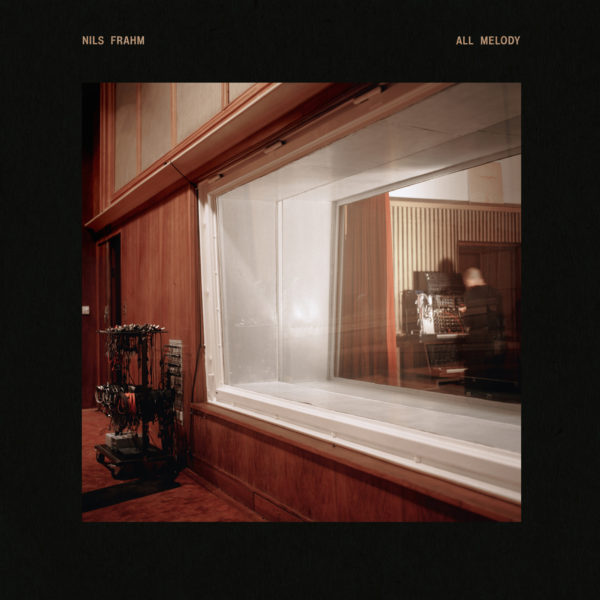
Ihm eingedenk höre ich jetzt „Tintagel“, lege zuvor aber noch eine ganz neue Scheibe auf, die ihm sicher sehr gefallen würde (aber freilich nicht alle Stücke, manche sind schrecklich, wie ich finde). Nils Frahm und „All Melody“, von dieser Platte werde ich „My Friend the Forest“ und „Harm Hymn“ hören.


2018 8 Feb.

„The healing picture“

| Filed under: Blog | RSS 2.0 | TB | Comments off

1

Etliche Jahre nun leben ich mit diesen Schmerzattacken, und derzeit verkürzen sich die Intervalle. Anfangs funktionierte es mit Runterspielen und Verdrängung, alle vier Wochen etwa meldete sich der Schmerz an, im linken Nackenbereich, schickte seine Vorboten, und verwandelte mein Dasein, zwei bis drei Stunden nach dem erträglichen Anfluten, in reinen Vierstundenterror. Manchmal sind es „nur“ drei Stunden – als könnte man die Uhr drauf einstellen!


2

Anfangs verdrängte ich die „Nackenmigräne“, die irgendwann begann, in den linken Hinterkopf zu projizieren, später auch öfter  im linken Hinterkopf begann, und die Schmerzsignale  runter in den Nacken sendete. Nach etwa einem Jahr besuchte ich meinen Hausarzt, der von den typischen Symptomen eines Bandscheibenvorfalls im HWS-Bereich sprach. Er verschrieb mir ein Muskelrelaxans und ein schwächeres Opioid, wohlwissend, dass ich eine umfassende Schmerzmittelallergie seit 1998 mit mir rumschleppe, und nur Opiate und Paracetamol vertrage. (Und Haschisch).

3

Ich hatte keinen  Vorfall in der Halswirbelsäule, wie sich beim MRT herausstellte. Eine erste Schmerztherapeutin verschrieb mir ein Opiumpflaster, und es war wirkungslos. Einmal, im Krankenhaus, mit einer akut bedrohlichen  Allergie (Reaktion auf Castellanis Pulver – mittlerweile verboten), bekam ich, zu meinem Schreck, nachts in der Intensivstation, die nächste „Nackenmigräne“. Der Stress? Egal. Ich rief nach der diensthabenden Ärztin, beschrieb ihr die Sachlage, und der blonde Rauscheengel verkündete mir, in zwanzig Minuten hätte ich Ruhe. Intravenös bekam ich 0.75 mg Dipidolor, ein starkes Opioid, und nach zwanzig Minuten war der Schmerz verschwunden.


4

Klar, dass ich nach diesem Vorfall Licht sah, aber meine Ärztin in Aachen weigerte sich, mir Dipidolor zu verschreiben. Das Mittel hätte kein Antidot, und ich könnte eine Atemdepression bekommen. Ich sagte ihr, dass ich dieses Mittel, das ich aus der  fernen Vergangenheit gut kannte, und mir bei einer früheren Erkrankung sehr gut geholfen hatte, bestens vertrage. Sie lehnte ab, und ich fand einen anderen  Arzt, der mir Dipidolor zur subkutanen Verabreichung verschrieb. Intravenös geht nicht im Privatgebrauch.  Subkutan ist nicht so wirkungsschnell wie intravenös, aber ich war glücklich. Bei der nächsten Attacke liess ich es mir subkutan verabreichen, die doppelte Menge, so war es indiziert, und ich war dermassen froh, dass der Schmerz sich gleich verflüchtigen würde. Tat er aber nicht. Wie  sich innerhalb der folgenden 18 Monate herausstellte, hilft mir Dipidolor nur IV. Ich bekam es ein zweites Mal, während des Aufenthalts in der HNO-Klinik im Alfried Krupp-Krankenhaus, und flugs verabschiedete sich der Terror im  Nacken. Kennen Sie schmerzhafte Nackenverspannungen? Die sind ein Witz im Vergleich.


5

Bei den nächsten Schmerztherapeuten, einem Team der RWTH Aachen, bekam ich Temgesic 0,2 mg. Ein starkes Opioid, ohne Antidot. Wirkte es, wirkte es nicht? Nur ein bisschen?  Auf Sicht gesehen merkte ich, dass es mir bei  dem Hammerschmerz nicht wirklich gut half – das High der Droge lernte ich schon schätzen, eine herrlich inspirierende Gedankenlosigkeit. Aber da es nicht wirklich half, auch nicht mit doppelter Dosierung, teilte ich das den Ärzten der Schmerzambulanz: eine green card für IV-Verabreichung sei nicht möglich, sagten sie.

Sie müssen sich das so vorstellen, in diesen vier Stunden: ich liege auf der Couch, dem Boden, ich schreie, ich stöhne, ich atme laut, ich klopfe fest mit der Hand auf harte Erde, um den Schmerz zu kompensieren und durch einen andern zu ersetzen, ich visualisiere mich aus dem Körper, zwecklos, ich experimentiere mit Hitze am Hinterkopf, mit Kälte, ich stöhne weiter, ich gucke auf die Uhr, ich weiss,  nach vier (oder drei) Stunden ist Schicht, der Schmerz löst sich in Luft auf, wie von Geisterhand. Und das nun über Jahre. Und egal, was ich tue in diesen vier Stunden: nichts bringt den Schmerz unter Kontrolle. Für  Momente kann ein Hitzekissen ihn mildern, oder eine seltsame Körperdrehung. Aber das wahrlich  berauschende Gefühl ist, wenn sich der Schmerz auflöst. Ein schöneres High als der Opium-Kick.


6

Parallel dazu habe ich in den letzten Jahren alles getan, um dem Terror im Nacken loszuwerden: Kieser Muskelaufbautraining, Traditionelle Chinesische Medizin (TCM), Physiotherapie, drei Praxen, drei Ausrichtungen, Ostheopathie, Chiropraktik, Korrekturübungen für Handynacken, das Spritzen von Betäubungsmitteln in die Schmerzzone (dazu gibt es in der Naturheilkunde einen Fachbegriff), und mitunter schien auch alles zum Guten zu wenden, aber da waren Herr und Frau Placebo am Werk. Nichts half mir. Die Schmerzintervalle wurden mit den Jahren kürzer. Nicht gut. Gar nicht gut.


7


8

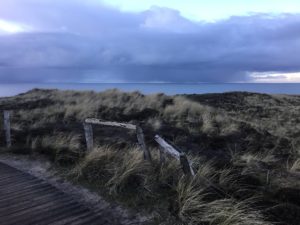
Es gibt ein Foto, das ich mein „heilendes Bild“ nenne. Ich schaue es öfter an, manchmal mehrmals in der Woche. Mit allem, was ich habe, was ich bin und nicht bin, stehe ich wieder dort. spüre alles, den Wind, das Gatter, das Meer. Es raubt den Atem, und der Atem fliesst. Ich versuche, alles zu erinnern, was ich von Milton Erickson gelernt habe. Meine Lust auf Leben ist ungestillt. Die Infrarotkabine eine Anschaffung mit Bedacht.
 

Dear Gregor,


my German is not good enough to make it public, but I’ve been reading your column for quite some  time now (with a little help of a friend from Hamburg). You are really keen on vinyl, aren’t you!? I think it’s been well established at this point that vinyl is the enduring physical medium. Vinyl has already been at death’s door a couple of times in recent history, both when cassettes became the most popular format in the early ’80s and then again in the ’90s when the CD grew to dominate the market. We can debate why vinyl keeps surviving these onslaughts, is it actual vs perceived sound quality, the collectible nature, the intangible cool factor, but the fact remains, records simply will not go away. Even during those eras when it was being forced out to a large degree by newer formats, a hardcore collector market remained and was still actively buying and selling vinyl.

Having said that, I do think certain segments of the vinyl market are not sustainable. The idea that every release needs to come out in multi-color limited variants or a deluxe box set nearing the $100 price point just doesn’t seem to have enough demand for it to be a viable concept long term. As someone who buys some of these products, I can tell you that a large percentage of these titles end up being drastically discounted several months down the road when retailers need to purge dead inventory.

Once we get over the paradigm that every record is a potential collector’s item and get back to it merely being a preferred way to enjoy music, I think the talk of the “vinyl bubble” will cease and we can get back to just buying records for more utilitarian purposes as opposed to investing in them. So that’s what I think the future of vinyl really is, I can definitely envision a time when it’s the only physical format and everything else is just digital, or brain implant or whatever crazy technology is coming next. But there will always be people who want to hold an album in their hands, put it on a physical player and kick back with the liner notes and album art. Those folks will be listening to vinyl for a very long time.

As for record of last  year, the champ to beat in my mind is Father John Misty – Pure Comedy. The production is just immaculate, perfectly balancing strings, horns, vocals and even some electronic elements into a coherent and lush whole. And lyrically the guy is just going for it, a truly scathing critique of modern culture and his own role in it. I was a big fan of I Love You, Honeybear, but he really took it to another level with this one, at the risk of alienating a lot of people as well, which in my mind really paid off. Sure it’s kind of a downer, but as an artistic statement, it’s definitely an ambitiously brilliant work.


XO, J. Hicks


(and my kindest regards for all „Manafonistas“ around whatever that name means, seems to be a riddle, ha!)

Das ist der Tag. Am Anfang / ist das Wort, es sitzt am Tisch, hinterm Fenster / und wartet/ auf eine freundliche Nacht.

Johannes Schenk: „Segeltuch“.


Mein neuer Drucker führte mich in die Versuchung, alle meine Posts seit 2014 zu materialisieren. Jetzt liegen 4 gebundene Teile meiner Schaffensschreiberei auf dem Tisch. Mein Schöpfernarzissmus ist zweifelsfrei befriedigt. Bei so manchem Beitrag wäre ich auch froh, er wäre nicht von mir. Trotzallem ist die Relektüre ein fröhlicher Genuss, auch wenn er nichts mit dieser Wissenschaft zu tun hat :) Dieses Gefühl beim Lesen der Texte im Netz ist längst nicht so sinnlich und vergnüglich. Mein Lesergehorsam ist in dem Gebundenen nicht vorhanden. Die Schwellen: Öffnen des Tablets, Passwort, Ladegerät sind nicht zu nehmen.


Here come The Mountain Goats  –  Going to Detroit

watch the T shirt of that spaceguy, he shows you the future.

We are going to listen to music under water, not the robots will push the bottoms,

the fish will tenderly serve us.


Eine Abschlussarbeit von dem Rundgang 2018


HOUR ONE (new albums) – Dictaphone / Dictaphone // Norma Winstone / Norma Winstone // Roger Eno / Roger Eno // Andy Sheppard  / Andy Sheppard // Nils Frahm / Nils Frahm


HOUR TWO (new albums) – (Sternzeit) // Tocotronic / Fire! (two tracks, „a stone-cold, hot-blooded cracker“ (Michael Engelbrecht, Bagles and Beans, Aachen)) // Elephant9 (two tracks) // Laurie Anderson with Kronos Quartet (two tracks) / Nicolas Masson // Kim Myhr 


HOUR THREE (close-up) – „Ozeanische Gefühle und andere Rauschzustände – die Musik von Flying Saucer Attack (from the albums „Distance“, „Further“, „Chorus“, „New Lands“ and „Instrumentals“) 


HOUR FOUR

(time travel 1) – „Paris 1975“, feat. space-rock band Heldon with Richard Pinhas, and the real and imagined reverberations of Fripp & Eno raising eyebrows among Roxy- and Prog-afficionados.


HOUR FIVE

(time travel 2) – Richard Horovitz: „Eros in Arabia“ – His career has seen him work with a list of names such as David Byrne, Jon Hassell, The Kronos Quartet, Bill Laswell, and Suzanne Vega. Contribute to Steven Halpern`s New Age creations. Records with Teheran-born vocalist Sussan Deyhim. Collaborate with Ryuichi Sakamoto on The Sheltering Sky. Score countless other films and installations. Eros In Arabia was originally self-released in 1981. Full of sustained harmonies and supernatural winds. Whispering ancient tales of heroes and heroines. Twisting chimes and percussion. Distorting into an Industrial mystic. Rhythmic chant colliding with bar room piano and harpsichord. Increasing in frequency, gamelan-like. Machines melting the hammered gongs to mercury. Steel screams and close mic`ed stress fractures.

(time travel 3) – A selection of bird recordings, with solo performers, communal displays and soundscapes containing many different species, including two tracks that feature mammals. The recordings come from locations as diverse as Moroccan deserts, the Canadian tundra and the Siberian taiga. Selected highlights from 17 years of recording the sounds of birds and other animals. Whether it’s a thawing lake in the Canadian Arctic, a narrow plateau on a desert island in the Atlantic, the eaves of a house in a Spanish village or the roof of a yurt on the Mongolian steppes, these bird sound recordings will take you to places you’ve never been. Previously unpublished highlights from 17 years of travelling and collecting, with almost twice as many tracks on the accompanying USB. And, in between, from another vinyl revelation by EEC Records, one song about the end of the world (oh, there are birds, too!), and, perhaps, another one that has yet to be chosen. 


2018 3 Feb.

Roxy Who …?

| Filed under: Blog | RSS 2.0 | TB | 3 Comments


„Very few people are aware of this fact, and it’s something that you will never hear referred to in press or media profiles of Brian Eno, but he actually began his 1970s musical career as a member of the group Roxy Music. Marvel as EnoWeb brings you another obscure item of Pop’n’Rock trivia! Anyway, the band’s eponymous first LP has been re-released as a four-disc 12 x 12 Super Deluxe Edition featuring previously unreleased demos, outtakes, radio sessions, rare footage, 136-page book and a 5.1 remix by Steven Wilson.“ 


2018 2 Feb.

Earthbound

| Filed under: Blog | RSS 2.0 | TB | 1 Comment


G

g

Producer and sound engineer David Singleton has maintained an excellent overall balance when remixing the Summit Studio sessions from the original multi-tracks, providing a very live quad audio mix. Even the boxy club feel of Ian Wallace’s drums which spread across the front channels while reflecting in the rears add to the appeal of this live performance. Staples include “21st Century Schizoid Man,” “Pictures of a City,” and “Sailor’s Tale.” You may find yourself repeatadly spinning “The Creator Has a Master Plan” with its hypnotic jazz groove that spills into a nasty 12-bar blues lick, then returning you back to where you started.

(Wesley Derbyshire)


Manafonistas | Impressum | Kontakt | Datenschutz