
Archives: März 2016
2016 20 März
Yesterday Never Knows
Michael Engelbrecht | Filed under: Blog | RSS 2.0 | TB | 1 Comment
July 1970. Hätte ich in London gelebt, hätte ich natürlich John Peel gehört, Extraschichten nach der Schule eingelegt („carwash“), und mir das Taschengeld verdient, um achtmal im Marquee Club aufzulaufen. Ein paar Kracher hätte ich im Juli ausgelassen, und vielleicht wäre ich da mit 15 Lenzen gar nicht reingekommen. Ein, zwei Jahre später sah ich dort Steamhammer, die wohl zu den Stammgästen gehörten. Ich habe noch nie zu den Intellektuellen gehört, die sagen: „Ach, nein, noch einmal so jung sein, das brauche ich nicht.“ Ich brauche das auch nicht, aber ich nähme das Ticket sofort, alle acht Tickets. Leider könnte ich das Grüne hinter den Ohren nicht wegretouchieren, auch gute Feen haben ihre Grenzen, und entlassen Zeitreisende immer auch in die alte Naivität. Es wäre mir egal. Yesterday Never Knows.
02 Caravan
06 Medicine Head
09 Steamhammer
12 Genesis & Osibisa
15 Gentle Giant
28 Hardin & York
30 Caravan
31 MC5

2016 18 März
Laurie Anderson
Jan Reetze | Filed under: Blog | RSS 2.0 | TB | Tags: Heart of a Dog, Laurie Anderson | Comments off
Live, yesterday night at The Late Show with Stephen Colbert, talking about her movie and performing music for dogs.
Ich hoffe, der Clip ist außerhalb der USA nicht gesperrt.
2016 16 März
The noir, the music, and the faraway gone – an interview with Lou Berney
Michael Engelbrecht | Filed under: Blog | RSS 2.0 | TB | Tags: Lou Berney | 2 Comments

„The two key players in Lou Berney’s superb mystery suffer from separate but equally crushing cases of survivor guilt … Lou tells both their stories with supreme sensitivity, exploring the ‘landscape of memory’ that keeps shifting beneath our feet.“
Marilyn Stasio has nailed it in her „New York Times Book Review“. Memory can play tricks, deceive you, charm you, haunt you. Memory can let you invent your own stories, create riddles, existential dramas, castles in the air. Truth might be a different thing after all. A fantastic read. Unforgettable. Uplifting and shocking. Shortlisted for this year’s Edgar Award.
Michael Engelbrecht: Can you remember what, in the first place, made you want to write crime novels? Was it a TV show, a book, an event of personal history?
Lou Berney: I think I gravitated toward crime novels because I have a bit of a criminal mind myself. Nothing violent! But when I was a kid I had a natural aptitude for thinking of schemes and figuring out how to break rules. Now I’m happy to use those talents for good fiction (I hope) and not evil.
Michael: „The Long and Faraway Gone“ seems to be a very accurately planned and plotted novel. Is it right to say, there was a lot of pre-structuring the topics, themes and side-plots, and writing was kind of breathing life into all of this?
Lou: Yes, I did a lot of planning and outlining with this novel, at least a couple of months of it. There was just so much to keep track of, and I didn’t want any characters or stories to get lost in the shuffle. That said, during the actual writing process, quite a lot of the story changed and evolved. For example, I ended up cutting a major character and sub-plot.
Michael: By the way, I like the cover, the simple painting of a little corner / hillside of a town, and that it is called „novel“ – the visuals don’t use the standard repertoire of fright and thrill … Did you make some suggestions?
Lou: My publisher came up with the cover illustration. I liked it right away because there was something both gently nostalgic AND ominous about an empty Ferris wheel at sunset.
Michael: A main theme of the novel is the fragmentary nature of memories. Did you read books (fiction, non-fiction) about the fabric of memory? Could have been Oliver Sacks, Proust, Freud … .
Lou: I’ve read Proust and Freud, years ago, so I’m sure some of those ideas were lurking in a corner of my brain. But, no, I didn’t really do specific reading on memory for this novel. Mainly I just used my own experiences with memory – how it can fade, how it’s not always reliable, how a sensory experience can bring a long-forgotten moment back to vivid life.
Michael: You’re living and working in Oklahoma City. City of the Flaming Lips. I once saw „The Feerless Freaks“, a very moving documentary about the band. As wild and surreal as their performances are (Yoshimi is my favourite album, and, not many would say that, The Terror, another one), I don’t think that Lyle Finn, lead singer of the Barking Johnsons was inspired by Wayne Coyne?! :) So: invented figure?
Lou: I love that documentary about the Lips! Lyle Finn is not based on Wayne — I’d say he’s inspired by him, in the same way the crimes in the novel were inspired by real crimes that happened in Oklahoma City in the 1970s and 1980s. But I knew a lot of people would think Lyle Finn WAS Wayne, so I wanted to make sure I did the character justice. I didn’t want just a caricature, but a real, complex human being.
Michael: I like the balance you find in this novel between humour and drama. Is that a lesson from Elmore Leonard? I’m a huge fan of the Leonard-inspired six seasons of „Justified“. Aside from the question regarding humour and drama – what are your two, three favourite TV-series for getting lost in in a good way?
Lou: I love Elmore Leonard, and I love Justified. Another TV series I though was just spectacularly good was Breaking Bad. It’s also funny and harrowing and heartbreaking and … everything, really. Those are the kinds of shows and movies and novels I like best, the ones that present the full spectrum of human emotions and experiences.
Michael: I suggest that music really is part of your life and „soul food“ for you, not only because of the Springsteen story on your blog. The way you soundtrack this novel always seems en passant, never contrived. Adrian McKinty does that very well in his Sean Duffy novels. Do you have a strategy how to use songs and records in a book?
Lou: Thanks for that! Much appreciated. I don’t have any rules except that — the music has to be an organic part of the story or the character, and not something I’m imposing. Sometimes I’m really influenced by what I’m listening to as I write. While I was writing The Long and Faraway Gone, I listened to a lot of Lindi Ortega, a fantastic roots-country singer-songwriter whose music really helped me get in the mindset of my characters. So I put her in the novel. She’s the singer in the red cowboy boots, at the Land Run, in the background of a conversation between Wyatt and Candace.
Michael: A singer/songwriter that belongs to my favourite ones, derives his style from old school „noir“. From this quote, you think you know who he might be? „My language came from watching Humphrey Bogart movies as a kid and wondering, Who is this Raymond Chandler guy? A lot of it just has to do with the metre, the way the sentences are put together. I outgrew Chandler once I discovered (US-hard boiled authors) Cain, Hammett and Woolrich. Some of the Hammett short stories are almost like Beckett, and Woolrich was kind of like Poe. Those writers speak to me in a way Shakespeare doesn´t.“ (I will return to this, later, just think a moment. Any idea?)
Lou: Hmmm. I’m terrible at guesses like this. Steve Earle?
Michael: What music are you currently grooving to?
Lou: Right now, I’m into Lake Street Dive and Nikki Lane. And a band called Them Darlins.
Michael: What, if push comes to shove, is your all-time favourite album? (One you still return to today, not one that sountracked some, whatever, „golden years”)
Lou: Impossible question, but a great one. I’m going to say Bruce Springsteen’s The River. Or London Calling by the Clash. I will probably change my mind tomorrow.
Michael: Has there been a record that has helped you through dark times?
Lou: Well, as I said in my blog post, discovering Springsteen’s Darkness on the Edge of Town definitely helped me connect at a time, age thirteen, when I felt very DIS-connected.
Michael: The singer who is inspired by „noir“, is Bill Callahan – before that he was the band „Smog“. From reading your novel and some texts in your blog, I have the idea you would make a discovery!
Lou: I will check it out. Thanks!
Michael: Back to this book that might win the Edgar award in May, and hopefully will. I developed a deep affection for a lot of the figures involved. Can you tell a bit more about those dark events in your city?
Lou: Yes, the crimes in the novel were inspired by two crimes that happened in Oklahoma City in the 1970s and 1980s. In 1978, six employees of a family steakhouse in Oklahoma City – four of them teenagers – were murdered during a robbery. That really shook the city up, and it shook me up too.
I was thirteen years old at the time and working across town at an ice cream and burger place. I remember thinking about how terrified those kids must have been. I guess I never stopped imagining what they must have been thinking that night they died, and what their lives had been like before that.
A few years later, I was working at a movie theater when two teenage girls disappeared from the State Fair of Oklahoma. It turned out the mother of one of the girls sometimes worked at my theater, checking box-office numbers for the studio. I didn’t know her, but I remember watching her from across the lobby and trying to imagine what she must have been going through.
Michael: Can you name the last novels/thrillers that really blew you away?
Lou: THE CARTEL, by Don Winslow, one of the absolute best books of 2015. I loved HOW TO A START A FIRE by Lisa Lutz, and can’t wait to read her new one, THE PASSENGER. I just re-read Kate Atkinson’s A GOD IN RUINS and LIFE AFTER LIFE because I love them so much. I can’t wait to read Laura Lippman’s new one, WILDE LAKE. And I thought a debut novel by Viet Nguyen, THE SYMPATHIZER, was fantastic. Oh, and Megan Abbott’s DARE ME and THE FEVER. Brilliant.
2016 15 März
Die Begegnung mit David Mitchell
Michael Engelbrecht | Filed under: Blog | RSS 2.0 | TB | Tags: David Mitchell, Fear of Music | 2 Comments

„Sehr rituell zubereitet, der Cappuccino“, sagte Katja Riemann, und ich antwortete: „State of the art“. Am Abend liest sie an der Seite des Briten bei der LitCologne aus David Mitchells famosem neuen Roman „Die Knochenuhren“. Das Gespräch mit dem Verfasser dieses alle traditionellen Genregrenzen überschreitenden Schmökers mit Tiefgang war von der hochunterhaltsamen Sorte. Wir hatten uns viel zu erzählen, von unserer Liebe zu ECM-Platten, wir sprachen über das Album „Fear of Music“ von den Talking Heads, das schon im ersten Kapitel seinen grossen Auftritt hat, über den Preis, den man zu zahlen bereit wäre, um Unsterblichkeit zu erlangen, über das Aufeinanderprallen von knallhartem Sozialrealismus und Fantasy, über die rare Tradition, in der sich der Roman bewegt. Und, natürlich, über Holly Sykes. Aber die sass ja schon zuvor neben mir an der Cappuccinobar.
Für die wilden Kerle Gregor und Michael hier eine Schüler Präsentation über Peter Handke’s Jukebox (ausgestellt im Literaturmuseum Marbach).
Ende. Danke für die Geduld.


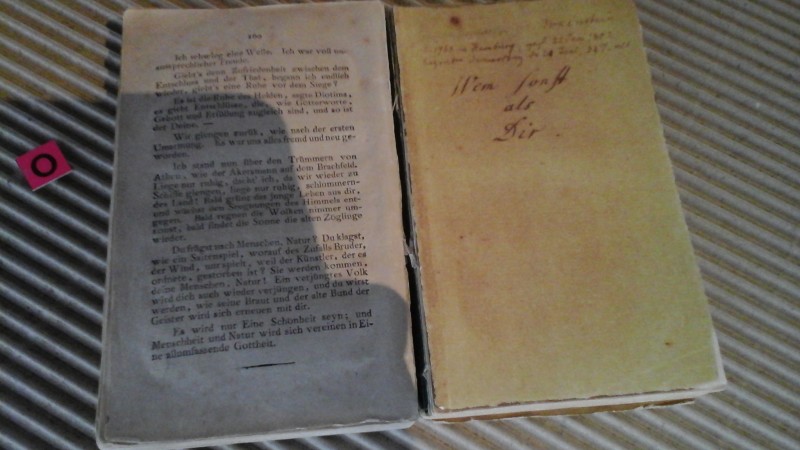
„Zur Märzenzeit
Wenn gleich ist Nacht und Tag,
Und über langsamen Stegen,
Von goldenen Träumen schwer
Einwiegende Lüfte ziehen“
Das ist von Friedrich Hölderlin. Oder von Holder, wie ihn seine große Liebe Suzette Gontard nannte. Bei ihr war er Hauslehrer. Die erwiderte Liebe fand keinen Gefallen bei ihrem Gatten. Hölderlin war erfinderisch.
Seine Widmung: WEM SONST ALS DIR schrieb er zwischen zwei Ausgaben von Hyperion.
Ich weiss es nicht. Lass uns umkehren, unser Weg ist zu steil.
„You can always come back, but you can’t come back all the way.“
Was sollen wir tun?
„Wenn die Rätsel einander drängten und kein Ausweg sich bot, half der Feldweg.“ So lautet der phänomenale Zuspruch, den uns Heidegger finden läßt. Den kleinen Text DER FELDWEG widmete Heidegger Hannah Arendt. ( Ich hatte die Ehre den Enkel von Heidegger im Literaturarchiv zu treffen. Ich musste mir die Genehmigung fuer die Briefe seines Großvaters einholen.) Die Briefe von Arendt zeigen sehr deutlich, welche Rolle sie später innehatte: sie war seine Manuskript Managerin.
Heidegger hat sehr viele Briefe an Elisabeth Blochmann geschrieben. Er legt den Briefen Gedichte von Mascha Kaléko bei:
Right at the end you always called me „Sie“
And never „du“
I learnt to wait, to suffer …
Nun, da du fort bist, scheint mir alles trübe
Hätte ich geahnt, ich ließe dich nicht gehn.
Was wir vermissen, scheint uns immer schön.
Woran das liegen mag. – Ist das nun Liebe?
Brisanterweise liegt diesen Briefen ein Genehmigungsbrief zur Übergabe ans Archiv von Heidegger ’s Frau bei.
Wie einfallsreich man an die heimlich Geliebte Klartext schreiben kann, zeige ich in Marbach H3.
„Well, my sense of humanity has gone down the drain /
Behind every beautiful thing there’s been some kind of pain.“
Das sei eine Strophe von Bob Dylan, in der der Abschied von der sozialen Freiheit beginnt. Das meinte der Philosoph Axel Honneth am Sonntag auf 3sat. Daran dachte ich heute, als ich durch das Geburtshaus von Friedrich Hegel ging. Es ist in Stuttgart. Hegel und Marx, der eine Theoretiker, der andere will in die Praxis umsetzen. Haben sie an ihre Liebe geglaubt? An die Freiheit als Recht für Alle? Schopenhauer, so lese ich in den Fluren des Geburtshauses, fand Hegel ekelhaft, Kierkegaard nennt ihn unter Vorbehalt einen Faselhans. Befreundet und geschätzt wurde Hegel von Hölderlin, Feuerbach und Goethe.
Hegel war also Schwabe. Er war es gerne, immer wieder kehrte er nach Stuttgart zurück. „Wer die Treue zur Heimat hält, hat ein starkes Ich.“ „Wer im Innersten frei ist, kann seine Gedanken bauen.“
„Wir müssen die Freiheit neu denken“, fordert nun Axel Honneth. In der Liebe und in der Freundschaft stoßen wir auf Resonanz unsrer Wünsche, in dem anderen erfahren wir eine eigentätige Erfüllung.
Ist das so?
Set me free little girl
This could be the last time
Black bird
She wrote me a letter and she wrote it so kind
She put down in writin‘ what was in her mind
I just don’t see why I should even care
It’s NOT DARK YET but it’s getting there.
Wie vermag man in der sozialen Freiheit zu bleiben?