on life, music etc beyond mainstream
2022 20 Okt.
Henning Bolte | Filed under: Blog | RSS 2.0 | TB | 1 Comment
2022 14 Okt.
Henning Bolte | Filed under: Blog | RSS 2.0 | TB | Comments off
Am kommenden Sonntag Live Drawing zusammen mit dem Chironomic Orchestra in der Abtei von Valserana.
Das recht große Orchester von klassischen Musikern und Jazzmusikern erfindet zusammen mit einem Zeichengeber in Echtzeit Musik. Der Spielansatz ist durch den legendären Conduction-Erfinder Butch Morris inspiriert und andererseits durch uralte Techniken aus der Renaissance und davor.
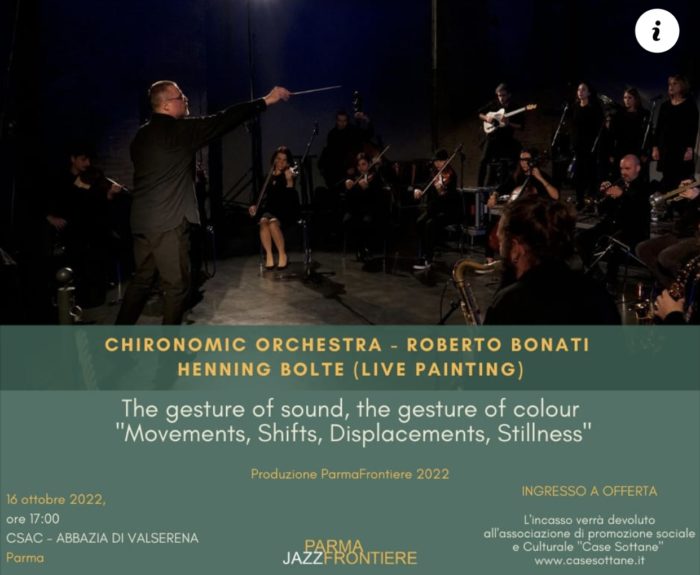
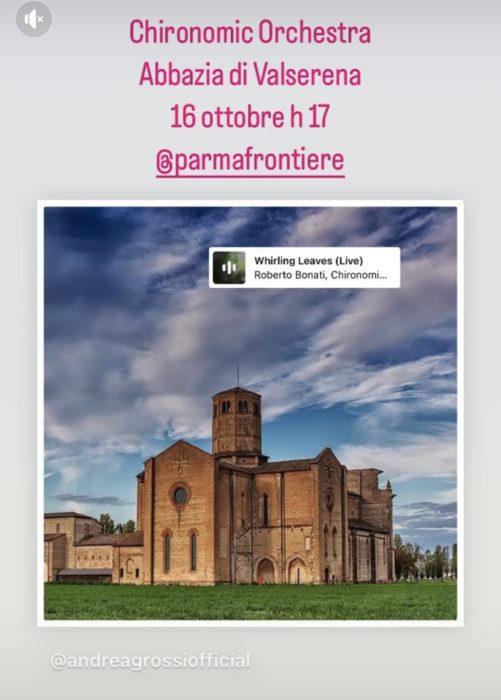
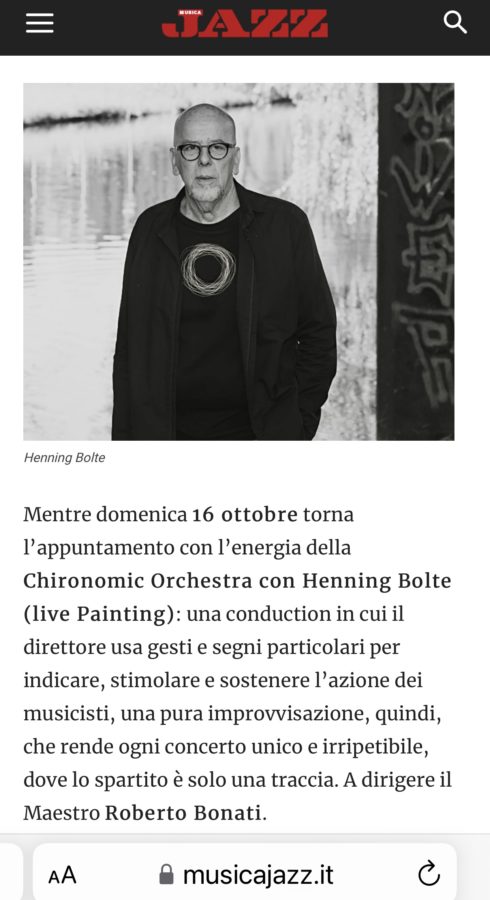
Chironomic Orchestra con Henning Bolte
The gesture of sound, the gesture of colour “Movements, Shifts, Displacements, Stillness“
L’ensemble, attivo dal 2015, presenta, in un concerto di improvvisazione, guidata da Roberto Bonati, il progetto “The gesture of sound, the gesture of colour”, il risultato della residenza e del laboratorio di Improvised Chironomy (improvvisazione diretta attraverso un vocabolario di gesti) tenuto all’interno del Festival.
Questo concerto fa parte del progetto “Relazioni Improvvise” che vuole mettere in dialogo linguaggi artistici diversi attraverso l’improvvisazione. In questa occasione l’orchestra incontrerà l’artista/pittore tedesco Henning Bolte che, durante il concerto, produrrà una serie di disegni proiettati in tempo reale su uno schermo. L’orchestra, che raccoglie musicisti provenienti da esperienze musicali diverse, dal jazz come dalla musica classica e contemporanea, ha al suo attivo due produzioni discografiche: “Il suono improvviso” e “Whirling Leaves” per l’etichetta ParmaFrontiere.
Henning Bolte
Scrittore, radio maker, visual artist, consulente (Performing Arts Fund NL, Dutch Arts Council), presentatore di concerti (Pianolab.Amsterdam) e insegnante/ricercatore universitario (Università di Utrecht, Utrecht University College). Nato e cresciuto nelle montagne dell’Harz (Germania), ha studiato all’università a Göttingen (Germania) e ha conseguito un dottorato di ricerca in linguistica. È emigrato nei Paesi Bassi e vive ad Amsterdam. Negli ultimi dieci anni ha viaggiato intensamente per l’Europa partecipando a numerosi Festival Jazz, facendo residenze e scrivendo di caratteristiche (inter)culturali regionali, nonché collaborazioni europee per diverse riviste in Germania, Paesi Bassi, Belgio, Francia, Estonia, Gran Bretagna e Stati Uniti.
“I disegni di DrawNotes sono stati creati nel disegno dal vivo in modo sincrono per le esibizioni musicali dal vivo. Sono manifestazioni visive della mia esperienza di visione e ascolto nei concerti.
Questa pratica ha accresciuto notevolmente il mio coinvolgimento nella musica suonata e ha intensificato il mio ascolto attivo.”
Henning Bolte
Produzione ParmaFrontiere 2022
Artisti
Roberto Bonati | direttore
Angela Malagisi | voce
Anna Maghenzani | voce
Elena Rosselli | voce
Thomas Marvasi | clarinetto basso
Marco Ignoti | clarinetto
Gabriele Fava | sax soprano
Claudio Morenghi | sax tenore
Pietro Vecchi | sax
Fabio Frambati | flicorno
Alberto Ferretti | tromba
Luca Perciballi | chitarra
Paolo Ricci | violino
Davide Santi | violino
Ingrid Berg Mehus | violino
Giacomo Marzi | contrabbasso
Giancarlo Patris | contrabbasso
Mattia Dallospedale | contrabbasso
Andrea Grossi | contrabbasso
con la partecipazione di
Hennig Bolte | live painting
2022 14 Okt.
Henning Bolte | Filed under: Blog | RSS 2.0 | TB | 1 Comment
2022 11 Okt.
Henning Bolte | Filed under: Blog | RSS 2.0 | TB | 2 Comments
5:30 very very early morning music
(descended from the height of the night to dawn) – 29/6/19 – original music of the video
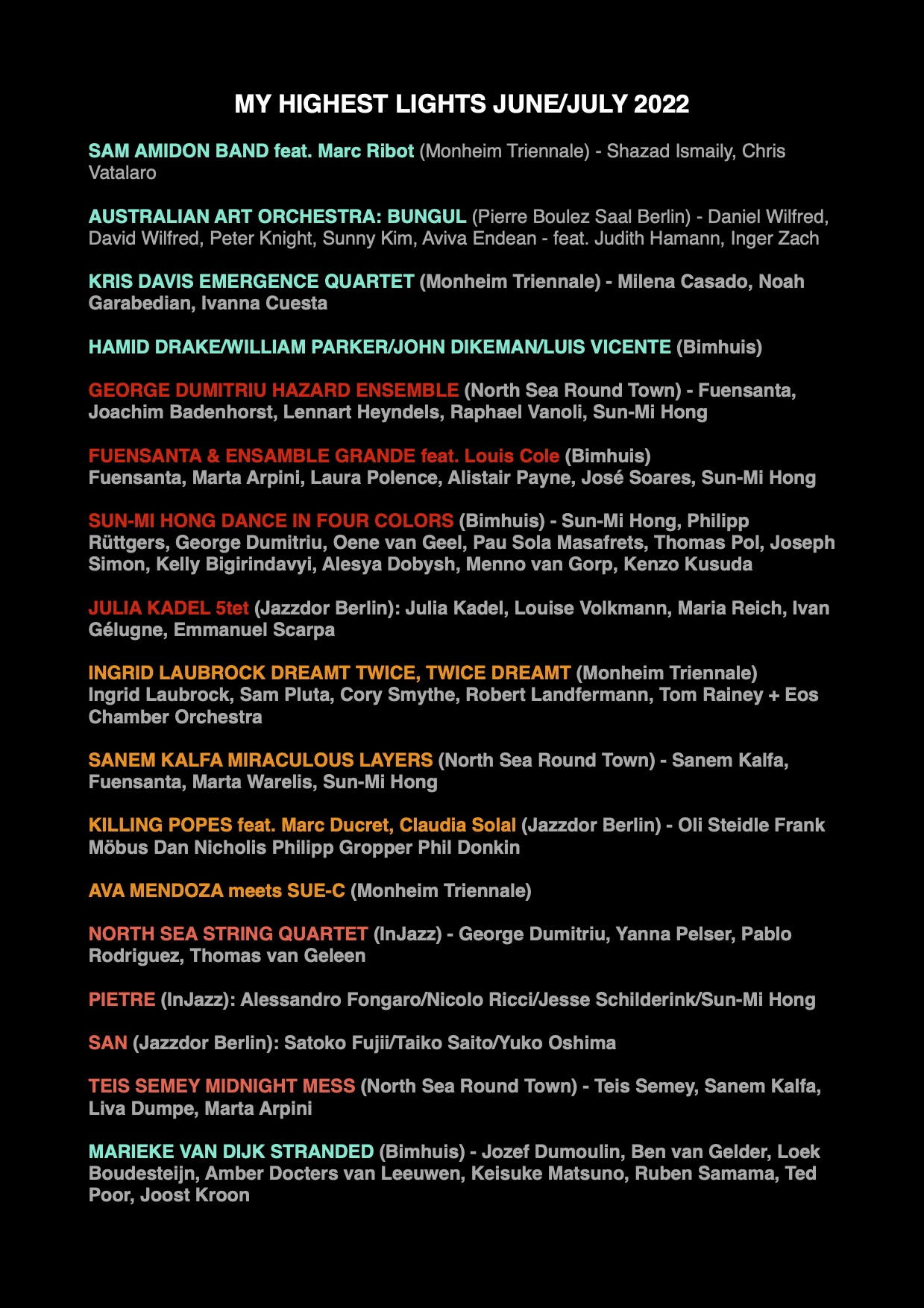
Listen und das Listen sind mnemotechnische Hilfen und mehr. Umberto Eco hat darüber selbst ein Buch veröffentlicht: „La Vertigine della Liste/The Vertigo of Lists“ (2009) – the title of the English publication is“The Infinity of Lists“. Given that I’m mostly immersed in live music, my lists are first of all about concert experiences. There will be more bimonthly lists. Maybe the list triggers something or questions rise about musicians/groups listed. Certain names occur more frequently and will occur in following lists too.
2022 8 Okt.
Henning Bolte | Filed under: Blog | RSS 2.0 | TB | Comments off
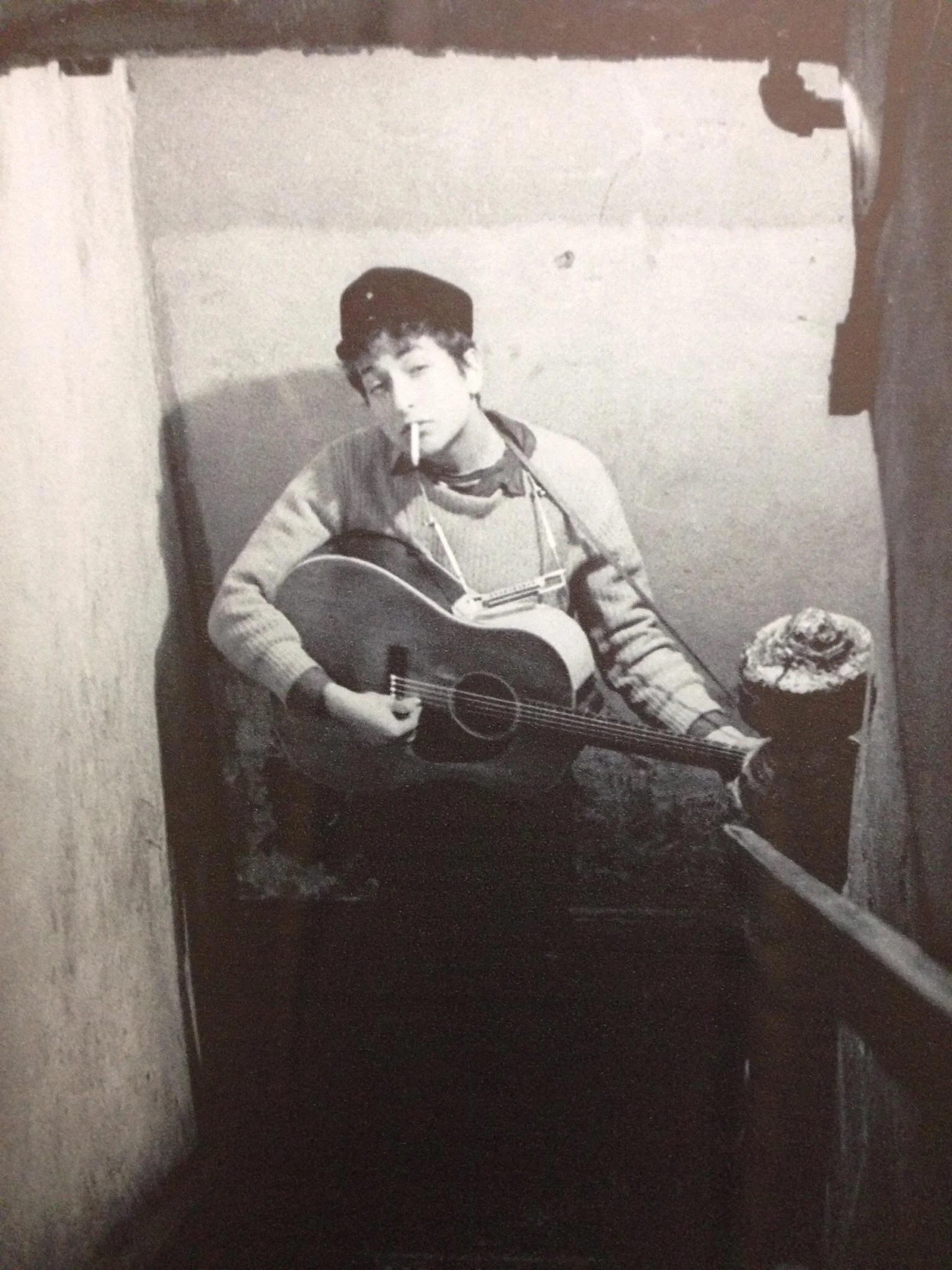
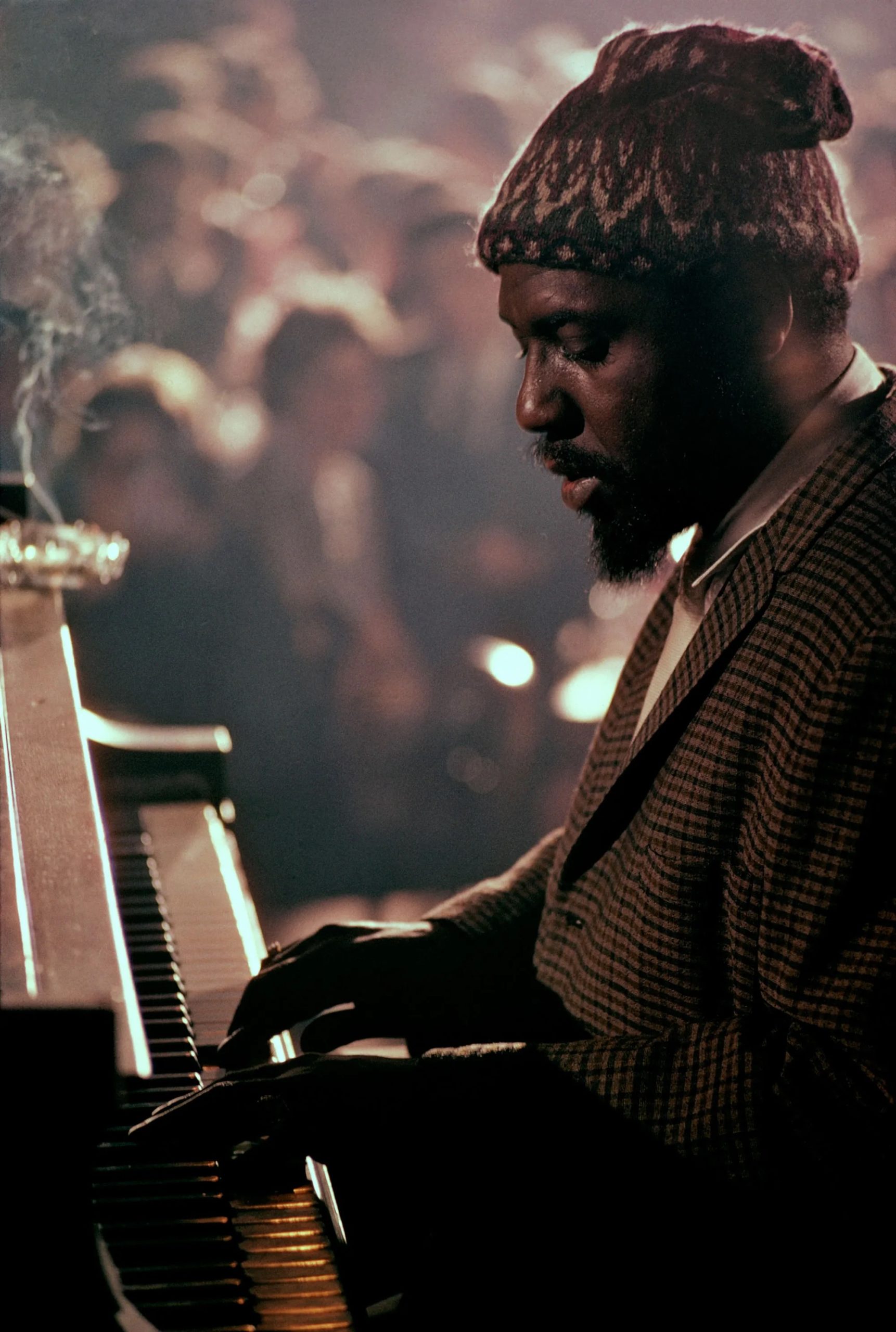
Das muss man sich ja nun mal bildlich vorstellen: der junge Spund Robert Zimmerman (geb. 1941) im Aufbruch zu neuen Ufern trifft im Manhattan der frühen 60er Jahre eines Nachmittags Thelonius Monk (geb.1917).
“I’d listen to a lot of jazz and bebop records, too … I tried to discern melodies and structures. There were a lot of similarities between some kinds of jazz and folk music … “Ruby My Dear” by Monk was another one. “Monk played at the Blue Note on 3rd Street with John Ore on bass and the drummer Frankie Dunlop. Sometimes he’d be in there in the afternoon sitting at the piano all alone playing stuff that sounded like Ivory Joe Hunter – a big half-eaten sandwich left on the top of his piano. I dropped in there once in the afternoon, just to listen-told him that I played folk music up the street. “We all play folk music,” he said. Monk was in his own dynamic universe even when he dawdled around. Even then, he summoned magic shadows into being.” (Bob Dylan, Chronicles, Vol. One, p. 94-95)
“Has any of it inspired me as a songwriter? Yeah, “Ruby, My Dear” by Monk. That song set me off in some direction to do something along those lines. I remember listening to that over and over.” (Bob Dylan in an interview with Irish Times, June 16, 2020)
Mehr zum fortwährenden Prozess der Wechselwirkungen zwischen Folk Musik und Jazz in meinem Essay für den Digital Guide von Jazzfest Berlin 2022.
A Dynamic Process of Continual Interactions
Here’s my essay for the Digital Guide of Jazzfest Berlin 2022 “On traces, techniques and tensions in the encounter of jazz and folk”
„The term ‚folk music‘ awakens numerous associations, images and emotions that are both appreciative and less appreciative in nature. In any event, folk traditions that have been formed in regional and local cultures over long periods are the origin and basis of all forms of music, ranging from sacred to classical (from Bach to Bartók and Berio) and from jazz to pop and rock – whether they have been used consciously or their effects have been absorbed subconsciously. They can be recognised more or less directly or made recognisable with the help of studio technology. Even what we call jazz, while evolving into an urban music practice, has deep inherent links with various folk traditions.
Folkloric influences in music are not to be underestimated and keep on resurfacing in contemporary music. The absorption and adaptation of folk traditions take place in a dynamic process of continual interactions, transformations, transmutations and impulses in which the effects of both internal music and external musical forces are manifest. They operate within a vital force field filled with thefts, distortions, trickster-like resistance, identificatory anchor points, escapism and reassuring references.“
Weiter HIER
Dazu Kurz-Interviews/Statements:
Deborah Walker/Silvia Tarozi, Olga Koziel/Sebastien Belieh, Mat Maneri, Lucian Ban, Levon Eskenian, Alexander Hawkins, Kateryna Ziabliuk
2022 6 Okt.
Henning Bolte | Filed under: Blog | RSS 2.0 | TB | Tags: Jazzfest Berlin 2022, KOMПOUSSULĂ | 2 Comments
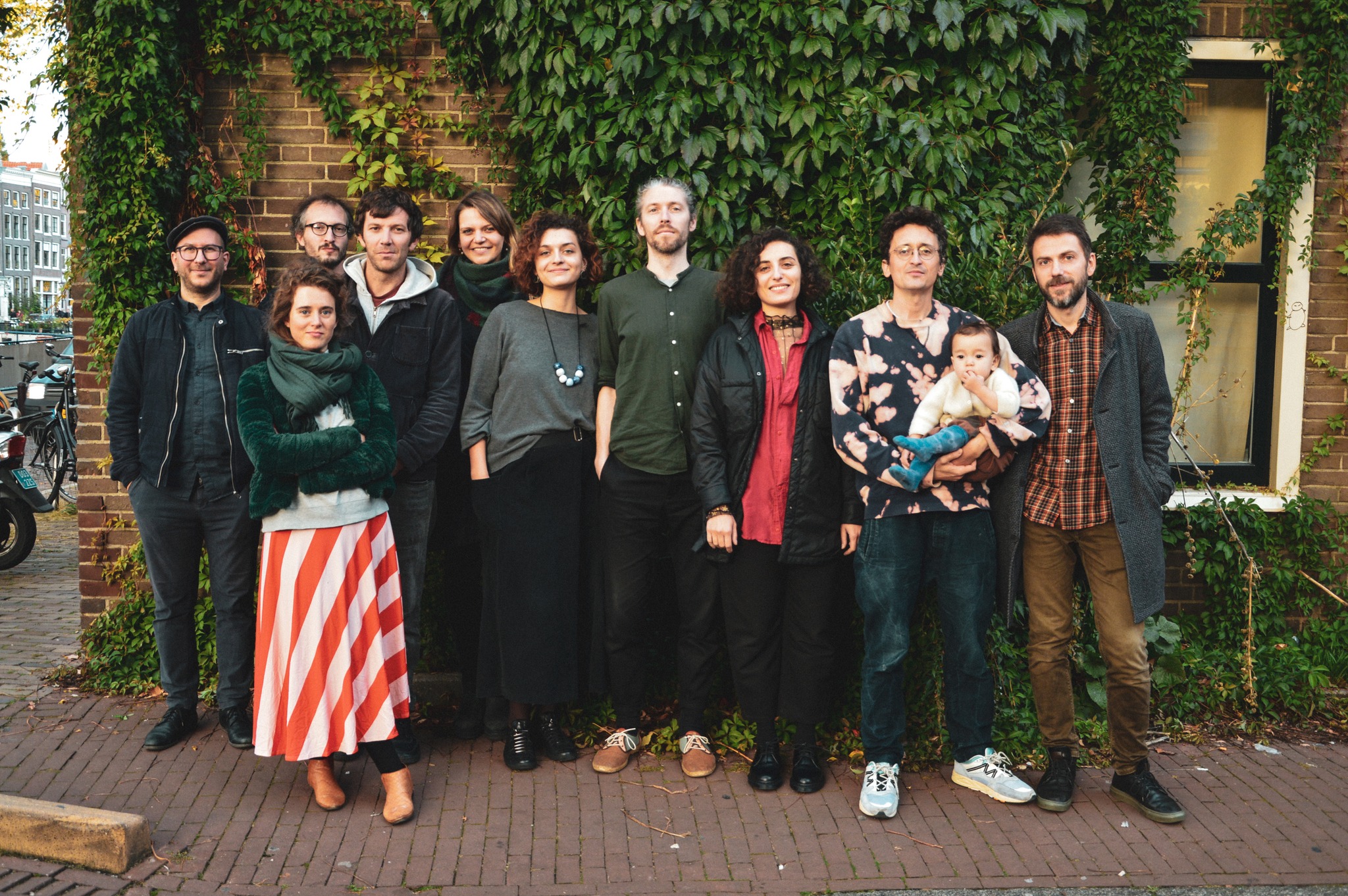
KOMПOUSSULĂ, a commission of Berlin Jazzfest 2022: preparatory meeting in Amsterdam (September 2022)
The title means compass or, in the languages of the members of the musician crew: Kompass, compas, pusula, kompas, busola, boussole …
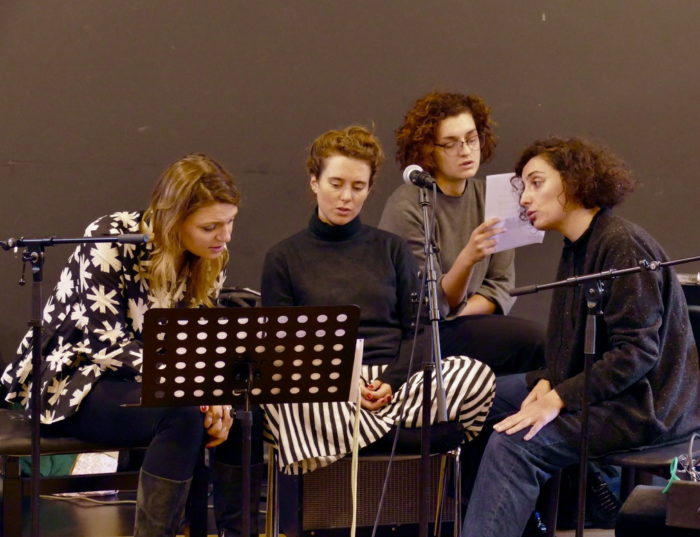
The line-up from left to right: Sebastien Beliah (b), Olga Koziel (voc/perc), Pierre Borel (sax), Louis Laurain (tr), Maryana Golovchenko (voc), Kateryna Ziabliuk (p, voc), Samuel Hall (dr), Sanem Kalfa (voc, electr, vcl), Joachim Badenhorst (sax/cl, voc, electr), George Dumitriu (viola, vln, g, electr)
The four female vocalists from left to right: Maryana Golovchenko, Olga Koziel, Kateryna Ziabliuk, Sanem Kalfa.
This unique crew contain or are connected to a couple of groups that all play the Jazzfest during the four days (November 3-6): Black Sea Songs, Lumpeks, Shadows of Forgotten Ancestor, Die Hochstapler and members of French Umlaut Big Band.
And a still wider spectrum is closely connected to these sound worlds and approaches in more concerts: there is the eminent trio of Lucian Ban, Mat Maneri and John Surman with its Bartók program Transylvanian Folk Songs, there is French drummer Camille Emaille with her Bulgarian-tinged group OTTO, the Italian duo Tarozzi/Walker will perform and the large Gurdjieff Folk Instruments Ensemble from Yerevan.
Jazzfest Berlin is on soon … ! Find the program HERE and background with short musician interviews and essay in the festival’s digital guide (English and German) HERE
“In its artistic treatment of Bartók’s Transylvanian field recordings, Ban and Maneri’s trio, completed by John Surman, is one example of how elements of Eastern European folk traditions continue to resonate within contemporary music and how these are registered, probed and reimagined against the background of personal and contemporary jazz influences. This is not about something sounding “folky”. It is about finding enrichment as the playing flows, whether it comes from a folk source or from the opposite direction, being incorporated within that folk source as a result of improvisation, where the dialectical process itself becomes audible. Variations of this can also be found in a younger and the very youngest generation, whose tracks in this year’s Jazzfest programme lead towards the lands around the Black Sea, to Ukraine and Poland. They are characterised by an intensifying playful approach, based on rawness, individuality, the marks of suffering and the hidden magic of the traditional – capturing and transforming the energies of their sound in a passionate, communal atmosphere of the now.”(from “A Dynamic Process of Continual Interactions: on traces, techniques and tensions in the encounter of jazz and folk”)
Wenn man DJ für die Leserschaft in dem Medium hier spielt, muss man gut überlegen oder spontan handeln. Hier, bei „Twist in My Sobriety“ und „Cathedral Song“ von Tanita Tikaram ist es spontan. „Twist in My Sobriety“ ist aus dem Jahre 1988. Tanita Tikaram war bei Veröffentlichung von „Twist …“ gerade mal 19. Ich kann beide wieder und wieder hören, ohne dass die Magie zerfällt. Ebenso wie die Faszination der Bilder, deren Bedeutungen man nur erahnen kann. Die Bilder von „Twist …“ erinnern mich an Sebastiāo Salgado, der in der Zeit zu fotografieren begann. Es sind der Erzählduktus, das besondere Timbre ihrer Stimme, der sitzende Groove und die mysteriösen Lyrics, die hier zusammenfinden.