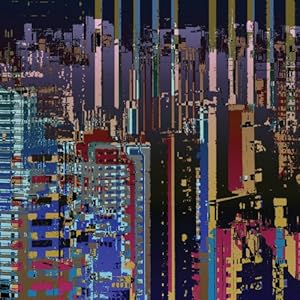
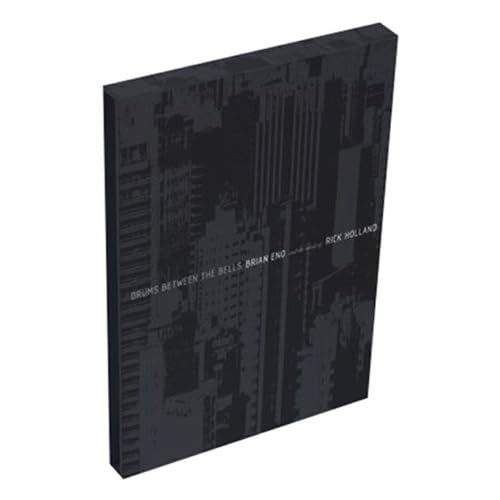
From early on, Brian Eno has been quite sceptical about words, their meanings, their ability to distract our attention from sound. So, although having written outstanding, witty, surreal lyrics for his brilliant four song albums in the seventies (“Here Come The Warm Jets”, “Taking Tiger Mountain (By Strategy)”, “Another Green World” (this perfect mélange of songs and purely atmospheric pieces) and “Before and After Science”), he had never added the lyrics.
Now I think, with the release of his collaboration with lyricist Rick Holland, every poem will be printed. An interesting problem for the master of Ambient Music: poems consist of a highly condensed language, everything within a poem requires careful attention, every syllable, every space between lines, every flow of pictures, every breath words take. Eno´s trick: everything becomes sound, the words, the silences; the listener decides for himself where to move, foreground, background, wordwise, soundwise. The music offers a broad spectrum: die-hard funk, trash jazz, exotica a la Eno, post-Kraut-electronics and drifting-sphere-music. Inspired stuff.
Poems and music – a special affair! “Drums Between The Bells” will speak, with an open heart, to the small, big Eno community, and to people who are curious about a still quite living thing called modern poetry. Remembering the Eno-Byrne masterpiece “My Life In The Bush Of Ghosts” (1980) with the cut-and sample approach to speaking and singing voices (mad priests, singers from the Lebanon etc), the new record leads from the “bush of ghosts” to a “theatre of voices”. Nine voices (most of them women) give life to words, sometimes these voices (including the ones of Brian and Rick) are pure realism, sometimes they are morphed and treated.
It´s never a gimmick, it always serves the words: in the brilliant slow motion piece, “the real”, a female voice speaks about our ability to see or see not “the real in things”, full of repetitions and small changes. A sophisticated way of mixing hypnotic induction with perception theory: solid earth suddenly feels like murky water. The last lines one can (depending on your state of mind) clearly indentify tell us: “while real runs out and seems to see the real as it runs” – then the voice turns from a soft speaker to a strange species. Seductive.
What do you think, Brian Eno loves about Rick Holland´s poems? I read his little book “Story the Flowers” and found an interesting mix of careful attention to everyday life, philosophy, humour and science. Small towns, big towns, coastal areas are portrayed in a deeply sensual way (I´m happy to leave out the word “spiritual” here). There is always an enigma that won´t be solved too soon. Something that hangs in the air. The music propels, waits, suggests, breathes, swirls, stops, penetrates. And it does a lot more.
Sometimes the words approach the singing area, but it takes a while till we discover an oldfashioned thing called song: near the end, Eno starts singing, and, you know, so many people – nevertheless how much they love his ambient works – have just waited too long for new songs of Mr. Eno (“Wrong Way Up”, 1990, “Just Another Day On Earth”, 2005). How many of us died on the way? Now one can take a deep breath, when listening to the brilliance of ”cloud 4” – but, what´s that: a song that could last forever stops after one minute and fourtythree seconds?! We call this English humour. And remember that old saying: brevity is the essence of wit.
And then? Then comes nothing (of course a very Cagean and uplifting nothing, by the way, 56 seconds long) – and then comes the last song, nearly as a shock: Eno delivers “Breath of Crows” with a deepness in his voice you have rarely ever heared. Robert Wyatt will send kisses! Eno sings with a vulnerability, a slowness, an intensity that is not so far away from the last Scott Walker albums. In “Story the Flowers” this piece is called “Seven Bungalow Neighborhood, Tree level, Mumbai”:
“My god is in the breath of crows,
It grows and shrinks with the elemental wish;
A fire with no link to the wish of man,
But it must be absolute, this god,
For when the mind is absolutely still,
It moves.
My god is in the breath of crows.
May I not delude a self image to think
He grows to grant my wish or wash my sin
But let me watch in wonder as he makes his work
Wonder in this.
The sounds of holy night abound
Kestrel calls and bells;
Drink the air, and the race for meaning quells.
Let it in. Let it in or the calls will sound like hollow tin
Or gramophone circling its background dust,
It must, replaced by must, by scent and sense;
A shell peeled pupil to reveal a deeper black,
Shelled like fresh new peas, each orb of wonder.
Wonder this.“
Don´t expect some final words about the album. Or do so. You will be surprised, I think, in more than one way! Simple as that.
P.S. I will be playing three tracks from Drums Between The Bells ( a title / sounds alien / dow) on the Klanghorizonte programm (live stream:wwwdradio.de). This will be broadcasted on Deutschlandfunk-Nachtradio in Germany, on 6th June, at 1.05 Uhr to 2.00 Uhr Germanically speaking. Which is very early in the morning. Indeed, some people might regard it as late on Sunday night, unless they are located in other parts of the world when it might count as early evening, or failing that, breakfast time